Key Facts
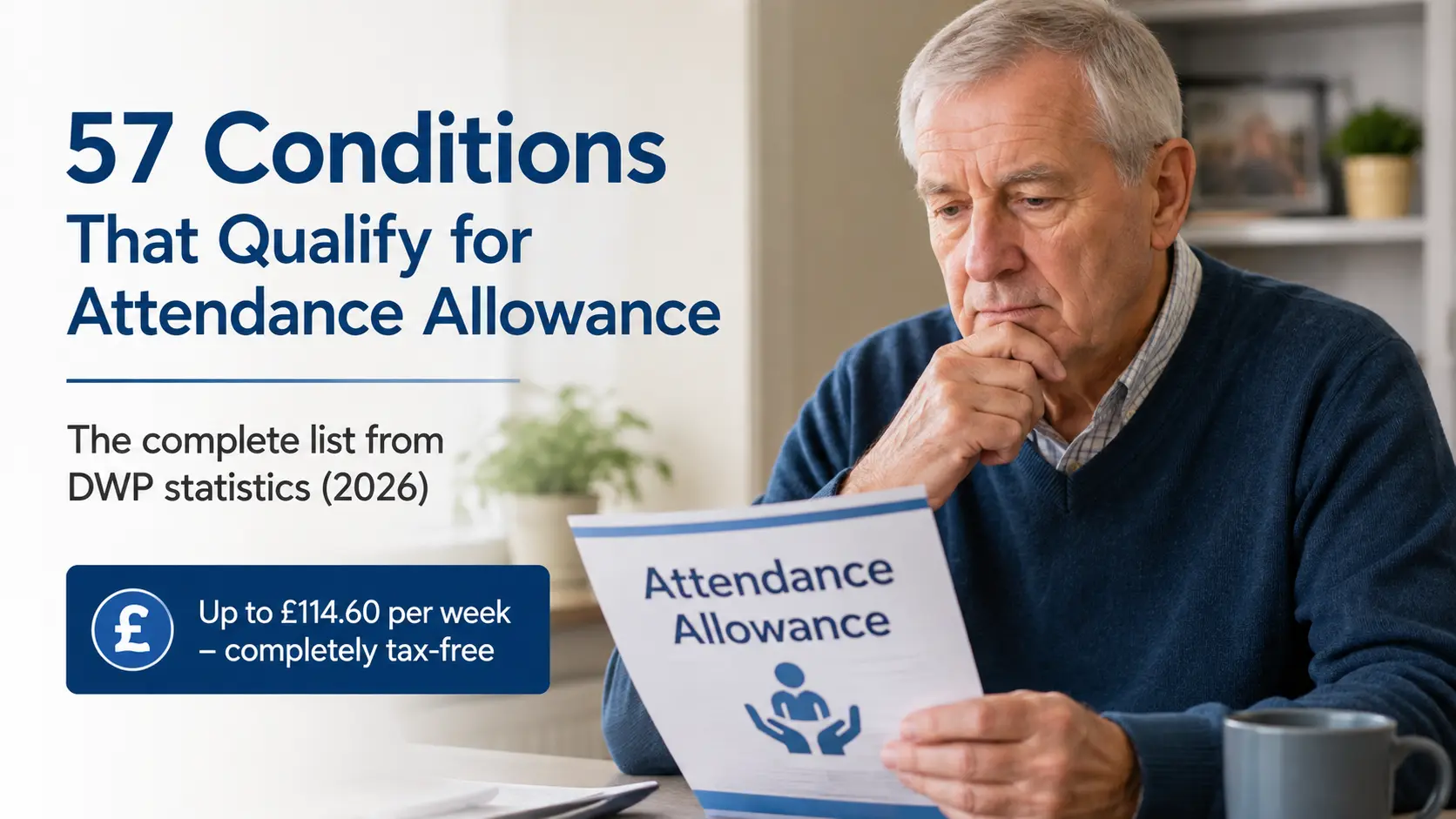
- 57 conditions are listed in DWP statistics as qualifying for Attendance Allowance
- 1.79 million people currently receive the benefit across Great Britain
- Worth up to £114.60 per week (£5,959/year) – completely tax-free
- Not means-tested – your savings and pension make no difference
- Important: Having a condition is not enough. You must need help with daily care or supervision
The 57 Conditions That Qualify for Attendance Allowance
The Department for Work and Pensions publishes data on the medical conditions of all 1.79 million Attendance Allowance claimants in Great Britain. These 57 conditions represent the “main disabling condition” recorded against each claim.
However, there is a critical point most people miss: having one of these conditions does not automatically qualify you. Attendance Allowance is awarded based on the care and supervision needs your condition creates – not the diagnosis itself. Two people with the same condition may get different outcomes depending on how well their needs are described.
Musculoskeletal Conditions
| Condition | Claimants |
|---|---|
| Arthritis | 522,638 |
| Disease of the muscles, bones or joints | 92,933 |
| Back pain (other / unspecified) | 81,002 |
| Trauma to limbs | 22,233 |
| Spondylosis | 21,649 |
| Chronic pain syndromes | 6,599 |
Neurological and Cognitive Conditions
| Condition | Claimants |
|---|---|
| Dementia | 204,946 |
| Cerebrovascular disease (stroke) | 76,851 |
| Parkinson’s disease | 48,073 |
| Neurological diseases (other) | 39,901 |
| Cognitive disorder (other / unspecified) | 24,219 |
| Epilepsy | 3,696 |
| Multiple sclerosis | 3,591 |
| Motor neurone disease | 780 |
Heart, Lung and Circulatory Conditions
| Condition | Claimants |
|---|---|
| Heart disease | 132,687 |
| Respiratory disorders and diseases (inc. COPD) | 110,267 |
| Peripheral vascular disease | 7,545 |
| Asthma | 7,230 |
Mental Health Conditions
| Condition | Claimants |
|---|---|
| Psychosis | 15,449 |
| Psychoneurosis (anxiety, depression, OCD) | 12,498 |
| Alcohol and drug abuse | 2,085 |
| Learning difficulties | 1,526 |
| Behavioural disorder | 887 |
| Personality disorder | 207 |
Cancer, Blood and Immune Conditions
| Condition | Claimants |
|---|---|
| Malignant disease (cancer) | 63,292 |
| Multi-system disorders | 8,927 |
| Blood disorders | 1,480 |
| Haemophilia | 115 |
See also: Attendance Allowance for Cancer
Sensory, Digestive and Other Conditions
| Condition | Claimants |
|---|---|
| Visual disorders and diseases | 51,899 |
| Renal disorders (kidney disease) | 23,157 |
| Diabetes mellitus | 21,380 |
| Hearing disorders | 9,953 |
| Bowel and stomach disease | 7,525 |
| Skin disease | 3,403 |
| Inflammatory bowel disease | 2,566 |
| Frailty | 2,265 |
| Metabolic disease | 2,185 |
| Major trauma | 2,237 |
See also: Attendance Allowance for Diabetes
Other/Specialist Categories
| Condition | Claimants |
|---|---|
| Terminally ill (special rules) | 46,422 |
| Infectious diseases (including COVID-19) | 1,056 |
| Cystic fibrosis | 108 |
| Traumatic paraplegia/tetraplegia | 558 |
| Haemodialysis | 320 |
| AIDS/HIV | 132 |
| Multiple allergy syndrome | 89 |
Source: DWP Attendance Allowance caseload statistics, November 2025 (most recent published data). Total claimants: 1,793,554.
Why Having a Condition Is Not Enough
This is the part that trips most people up. You can have arthritis, dementia, heart disease, or any other condition on this list – and still be rejected if your application does not clearly demonstrate your care needs.
The DWP does not ask: “Do you have one of these conditions?” They ask: “What help do you need because of your condition, how often do you need it, and what would happen without it?”
This is why approximately 60% of self-completed applications are rejected. Not because the person is not eligible, but because their form describes the diagnosis without properly articulating the daily impact.
Learn what stops people getting Attendance Allowance in the first placeWhat the DWP Actually Looks For
Regardless of your condition, the DWP assesses two things:
- Do you need help or have dificulty with personal care during the day? – Washing, dressing, eating, toileting, taking medication, or supervision to prevent harm (falls, wandering, leaving the cooker on)
- Do you need help or supervision at night? – Getting to the toilet, being repositioned in bed, someone monitoring you for breathlessness, confusion, or seizures
If you meet the day-time condition only, you will receive the lower rate (£76.70/week). If you meet both day and night conditions, you will receive the higher rate (£114.60/week). The difference is nearly £2,000 per year.
The Most Common Mistake: Describing Diagnosis, Not Impact
Consider two people with the same condition – arthritis:
| Person A (Rejected) | Person B (Awarded Higher Rate) |
|---|---|
| “I have osteoarthritis in my knees and hands. I take painkillers.” | “My arthritis means I cannot grip buttons or zips. My wife dresses me every morning – this takes 15 minutes. I cannot get in or out of the bath alone due to pain and stiffness in my knees. At night, I wake twice needing the toilet but cannot stand safely. My wife supports me each time.” |
Same condition. Completely different outcome. Person B described what help they need, how often, how long it takes, and what happens without help.
Do You Need to Be on the List to Claim?
No. The 57 conditions are simply how the DWP categorises existing claimants in their statistics. There is no official “approved list” that restricts who can apply.
You can claim Attendance Allowance with any physical or mental health condition – or combination of conditions – as long as it means you need help with personal care or supervision. You do not even need a formal diagnosis. What matters is the impact on your daily life. See our full guide to conditions that may qualify for Attendance Allowance for more detail on specific conditions.
Why Professional Assessment Changes Everything
The challenge with Attendance Allowance is not whether your condition qualifies – it almost certainly does if you are reading this page. The challenge is translating your daily struggles into the specific language the DWP requires.
At Attendance Allowance Services, our HCPC-registered Occupational Therapists:
- Conduct a thorough clinical assessment of your care needs – covering every activity of daily living
- Identify needs you may not think to mention (especially supervision and night-time needs)
- Describe your needs using the precise frequency, duration, and consequence language the DWP requires
- Ensure night-time needs are captured to maximise your chance of the higher rate
- Complete the entire 32-page form on your behalf
Our success rate is 99%. The average annual award for our clients exceeds £4,300. And there is no fee unless you are awarded the benefit.
See your condition on the list? Check if you qualify in 2 minutes
Free eligibility check. No obligation. Our OTs handle everything if you proceed. No fee unless you’re awarded.
Frequently Asked Questions
What are the 57 conditions that qualify for Attendance Allowance?
The DWP publishes statistics showing 57 categories of medical condition among current Attendance Allowance claimants. The most common are arthritis (522,638 claimants), dementia (204,946), heart disease (132,687), respiratory conditions including COPD (110,267), and cancer (63,292). However, any condition that causes you to need help with personal care or supervision can qualify – there is no restrictive list.
Do I need a diagnosis to claim Attendance Allowance?
No. You do not need a formal diagnosis. What matters is that you need help with personal care (washing, dressing, eating, toileting) or supervision to stay safe, and that you have needed this help for at least 6 months. You can apply even while still undergoing tests or waiting for a diagnosis.
Why do most Attendance Allowance applications get rejected?
Around 60% of self-completed applications are rejected – not because people are not eligible, but because the form does not clearly describe their care needs. The most common mistakes are being too vague, describing the diagnosis rather than the daily impact, forgetting night-time needs, and understating difficulties. Professional support from an Occupational Therapist dramatically improves success rates.
Can I claim Attendance Allowance for more than one condition?
Yes. The DWP assesses your total care needs across all conditions. If you have arthritis and depression, for example, both conditions contribute to your overall need for help. You should describe how all your conditions affect you – not just one.