The Short Answer
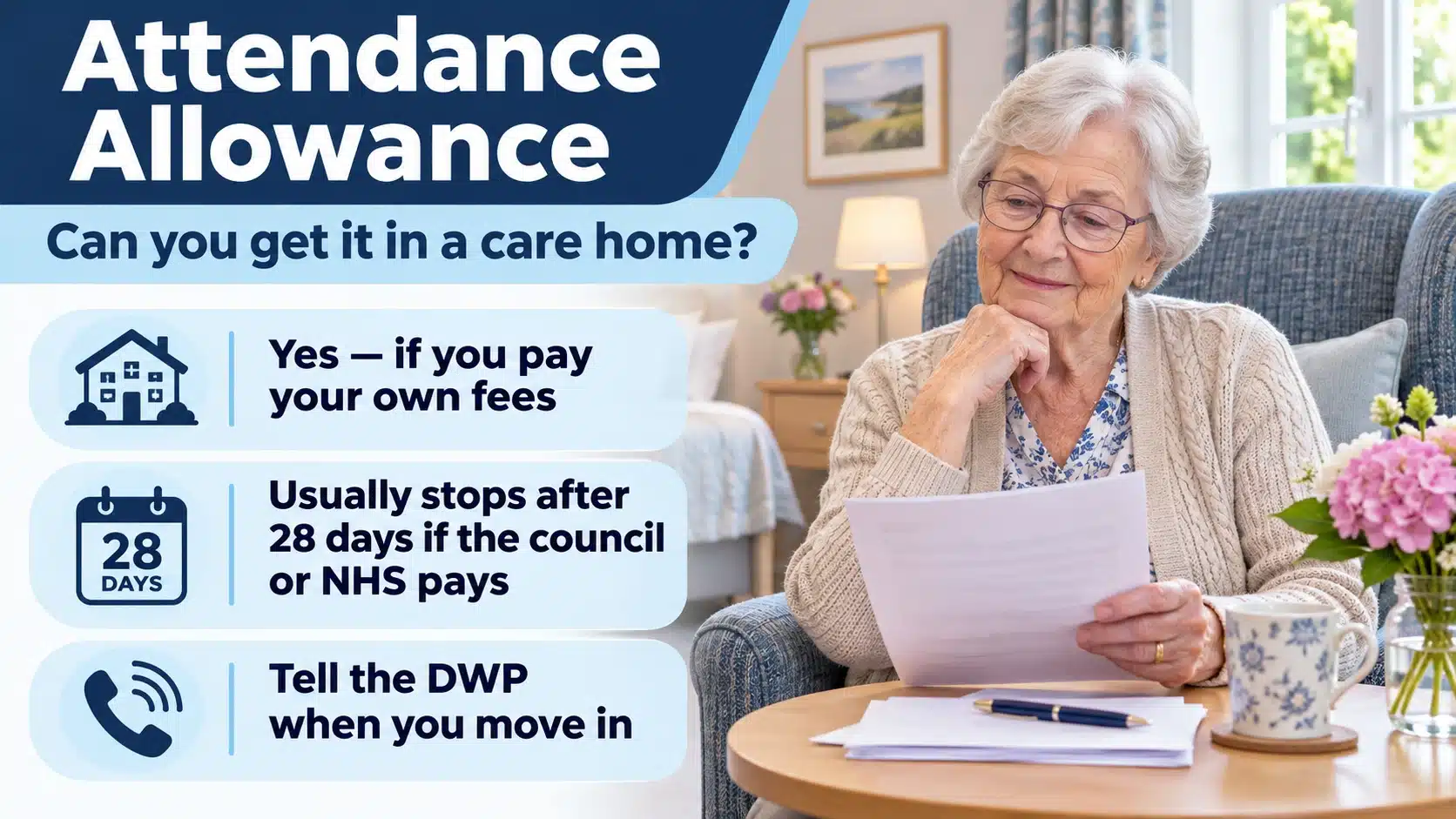
Yes, you can get Attendance Allowance in a care home if you pay all of your care home costs yourself. GOV.UK says you can still claim in that case, and Age UK says you can keep receiving it or make a new claim after you move in.
If your local council, or the NHS through NHS Continuing Healthcare, pays towards your accommodation, board or personal care, it usually stops 28 days after you go in (four weeks in Northern Ireland). You keep an underlying right to it, so it can be paid again if you leave. Whatever the funding, you must tell the DWP as soon as you move in.
Checked in November 2026 against GOV.UK: Attendance Allowance eligibility and GOV.UK: Report a care home stay, Age UK’s factsheets on Attendance Allowance and paying for permanent residential care, and nidirect. The Attendance Allowance rules are the same in England and Wales. Northern Ireland differs slightly and has its own section below.
When You Keep Attendance Allowance and When It Stops
The test is who pays for your care home place. GOV.UK says you cannot usually get Attendance Allowance if you live in a care home and your local authority pays for your care, and that you can still claim if you pay for all your care home costs yourself. Age UK gives the detail that matters in practice: what counts is whether any of the costs of accommodation, board or personal care are paid from public funds.
| Your situation | What happens to Attendance Allowance |
|---|---|
| You pay all your fees yourself (self-funding) | Paid as normal. You can keep it, or make a new claim after you move in |
| You pay the fees yourself, and the NHS pays a nursing care contribution | Age UK says it continues if none of the accommodation, board or personal care costs are paid from public funds. See the note on nursing care below |
| The council pays part or all of the accommodation, board or personal care | Stops 28 days after admission (or after the council’s support begins), sooner if linked to a recent hospital stay. You keep an underlying entitlement |
| NHS Continuing Healthcare pays | Stops after 28 days, or sooner if linked to a recent stay in hospital |
| The council helps for now and you will repay it (a deferred payment agreement) | Treated as self-funding, so it continues during the period of temporary funding |
| A respite or short stay paid for by the council or NHS | Paid until 28 days, with periods of less than 28 days linked and added together |
| You live at home, even with paid carers visiting | Not affected by the care home rules. Age UK says the council can take it into account when working out what you pay for council-arranged home care |
If You Pay Your Own Fees
If you pay the full cost of your place yourself, Age UK says you can carry on being paid, with or without help from benefits such as Pension Credit, and you can also make a new claim after you move in. The official notes to the claim form say Attendance Allowance is not usually affected by your income or savings, so owning a home or having savings does not stop you claiming. See is Attendance Allowance means-tested for more.
- Pension Credit. GOV.UK says that if you pay for the care home yourself you may be able to keep an extra amount for severe disability paid with Pension Credit. Age UK says this applies as long as nobody is paid Carer’s Allowance for looking after you. Our guide to Attendance Allowance and Pension Credit explains who qualifies
- Deferred payment agreements. Age UK says you are also treated as a self-funder if the council helps through a deferred payment agreement, where you repay the council later. Your Attendance Allowance is paid during the period of temporary funding
- How you spend it. The money is yours, or your appointee’s to use in your interest. See what Attendance Allowance is used for. Age UK says you can spend it on whatever you want, although the council can take it into account in its social care means test
If the Council or the NHS Pays: The 28-Day Rule
Age UK says that if any of the costs of accommodation, board or personal care are paid from public funds, for example by a local authority or the NHS, Attendance Allowance stops 28 days after admission, or sooner if you were previously in hospital. Its factsheet on paying for residential care puts the start of the 28 days at the point the council’s financial support begins, or sooner if the stay is linked to a recent stay in hospital or another state-funded care home.
- You keep an underlying entitlement. Age UK says that if you move out of the home, your Attendance Allowance can be paid again
- Days at home are paid. Age UK says that if you spend days at home away from the care home, you can be paid the daily rate for those days
- The 12-week property disregard. If you lose payment while the council is helping during its 12-week property disregard, Age UK says it can be reinstated at the end of the 12 weeks, when you become a self-funder
- The council counts it as income. Age UK says Attendance Allowance is taken into account as income in the council’s financial assessment, although it is disregarded when working out Pension Credit, Housing Benefit and Council Tax Reduction
- If you claim while already in a funded place. The official claim form notes say that if you are awarded Attendance Allowance while in a care home and the council or NHS pays anything towards the cost, the DWP cannot pay you until you come out. If you are paying for your stay without help from public funds, they can pay you
Nursing Homes and NHS Funding
- NHS Continuing Healthcare. Age UK says Attendance Allowance stops after 28 days (sooner if linked to a recent hospital stay) if the NHS pays for your care under Continuing Healthcare. In a nursing home, the DWP can treat you as being in a “similar institution” to a hospital, which has the same 28-day effect
- NHS-funded nursing care. This is a flat-rate payment the NHS makes towards the nursing costs in a nursing home. Age UK says you can keep Attendance Allowance if you are otherwise self-funding, as long as none of the accommodation, board or personal care costs are paid from public funds
One point where the sources read differently. GOV.UK’s care home page lists “NHS funding for nursing care” alongside NHS Continuing Healthcare and the council as funding that can stop benefits within 28 days. Age UK’s factsheet says a nursing care payment on its own does not end Attendance Allowance for a self-funder. If this applies to you, give the DWP the full funding details when you report the move, and ask them to confirm in writing what happens to your award.
Respite and Short Stays
If you pay for a short stay yourself, nothing changes. If the council or the NHS pays all or part of it, Age UK says Attendance Allowance stops being paid after 28 days, and periods of less than 28 days are linked and added together to reach the 28-day limit. Age UK also says that if you need regular respite stays it may be possible to plan them so your payments are not affected, and advises you to seek advice if this applies to you. Our guide to Attendance Allowance when in hospital explains how linked stays work for hospital admissions.
What You Must Tell the DWP, and When
GOV.UK says you must tell the organisation that pays your benefit as soon as possible if you go into a care home for one night or longer. For Attendance Allowance that means the Attendance Allowance helpline. Someone else can do this for you if they give their name and contact details, so a relative or an appointee can make the call.
GOV.UK says to have these ready:
- Your full name, date of birth and National Insurance number
- The name and address of the care home, and the date you were admitted
- The address you lived at before you were admitted
- How the stay is being paid for, and the name of your local council
- Details of a power of attorney or appointee, if there is one
- Details of any hospital stays in the 28 days before you were admitted
GOV.UK warns that you could be taken to court or have to pay a penalty if you give wrong information or do not report a change in your circumstances. The official claim form notes add that the DWP has the right to take back any money it pays that you should not have got.
You may need to tell other organisations separately. GOV.UK lists the Pension Service for State Pension and Pension Credit, your council for Housing Benefit, and the Carer’s Allowance Unit if someone claims Carer’s Allowance for looking after you. Age UK adds that if your Attendance Allowance stops you should tell the offices that pay your other benefits, so that you are not overpaid.
Claiming Attendance Allowance for Someone Already in a Care Home
Many families assume that once a parent is in a care home there is no point claiming. If they pay their own fees, that is not the case. The test is the same as for anyone else: whether a health condition or disability means they need help with personal care or supervision, by day, at night, or both. Age UK says entitlement is based on the help you could reasonably do with, not the help you actually receive, which matters because care home staff are already providing support.
The claim form asks whether you are in, or have recently left, a hospital or care home and whether the council or the NHS pays towards the stay (questions 47 and 48), and our guide to filling in the Attendance Allowance form shows how to answer them. You can also apply online.
Attendance Allowance Services is independent and is not part of the DWP:
- The eligibility check is free. You, or a relative on your behalf, speak to a registered Occupational Therapist, with no obligation
- We complete the application for you. Your Occupational Therapist completes and endorses it, and we post it by 1st Class Royal Mail within 4 days for your approval, signature and submission to the DWP
- No fee unless it is successful. Any fee is collected after you receive the backdated payment
- Family members and carers are welcome. We are happy to talk to anyone supporting an applicant
Is a parent or relative in a care home paying their own fees?
Free eligibility check, no obligation, and no fee unless the application is successful.
Or call us on 0208 081 4500 (Monday to Friday, 9am to 5pm)
If You Live in Northern Ireland
In Northern Ireland, Attendance Allowance is run by the Department for Communities through its Disability and Carers Service, not by the DWP. The care home rules work in a similar way, but the timings are expressed differently. nidirect says:
- If your local Health and Social Care Trust is helping with your care home fees, Attendance Allowance is paid for the first four weeks, if you were already entitled to it before you moved in
- If you are self-funding, it will usually continue
- If you are in the first 12 weeks of a permanent stay, your property is not being counted as capital and the Trust is helping with your fees, it is paid for the first four weeks and restarts from the 13th week or when you start self-funding
- You must contact the Disability and Carers Service straight away if you go into a residential or care home
Age NI says the Trust will assume you are receiving the benefits you are entitled to when it assesses your income, so it is worth making sure you have claimed everything that applies.
What About the National Care Service?
On 29 September 2026 the Government announced plans for a National Care Service in England, to be established in the next Parliament, providing free personal care for older people based on need. The announcement says it will not cover bed and board, for which existing means-tested council contributions will remain, and that Baroness Casey’s independent commission is due to report in summer 2027. This does not change the rules in this guide today. We will update the page if it does.
Frequently Asked Questions
Can you get Attendance Allowance if you live in a care home?
Yes, if you pay all of your care home costs yourself. GOV.UK says you can still claim in that case, and Age UK says you can continue to receive it or make a new claim. If your local authority pays for your care, you usually cannot get it.
Does Attendance Allowance stop when you go into a care home?
Not always. It continues if you pay the full fees yourself. If any of the costs of accommodation, board or personal care are paid from public funds, such as by your council or through NHS Continuing Healthcare, Age UK says it stops 28 days after admission, or sooner if you were previously in hospital. In Northern Ireland the period is four weeks.
Can you get Attendance Allowance in a nursing home?
The same funding test applies. If you pay the whole nursing home bill yourself, Age UK says you can carry on being paid. If you get NHS Continuing Healthcare or the council pays, it stops after 28 days. Tell the DWP exactly how your place is funded when you report the move.
Does NHS-funded nursing care affect Attendance Allowance?
Age UK says you can keep Attendance Allowance if you are otherwise self-funding and receive NHS-funded nursing care payments, as long as none of the costs of accommodation, board or personal care are paid from public funds. GOV.UK’s care home page lists NHS funding for nursing care among funding that can stop benefits, so ask the DWP to confirm in writing how your award is affected.
What happens to Attendance Allowance if the council pays for my care home?
Age UK says it stops 28 days after the council’s financial support begins, or sooner if the stay is linked to a recent stay in hospital or another state-funded care home. You keep an underlying entitlement, so it can be paid again if you leave, and you can be paid for days spent at home.
What if my savings run out and the council starts paying?
Tell the DWP when the council’s funding starts, because that is when the 28-day rule begins. If the council gives temporary help that you will repay, such as under a deferred payment agreement, Age UK says you are treated as a self-funder. If you lose payment during the council’s 12-week property disregard, it can be reinstated at the end of that period when you become a self-funder.
Is Attendance Allowance paid for respite care or a short stay in a care home?
If you pay for the stay yourself, there is no change. If the council or the NHS pays all or part, Age UK says it stops after 28 days, and periods of less than 28 days are linked and added together to reach the limit. Age UK says regular respite stays may be possible to plan so that payments are not affected, and advises seeking advice.
Do I have to tell the DWP if I go into a care home?
Yes. GOV.UK says you must tell the organisation that pays your benefit as soon as possible if you go into a care home for one night or longer, and that someone else can do this for you. It warns that you could be taken to court or have to pay a penalty if you give wrong information or do not report a change.
Can I keep the Pension Credit severe disability addition in a care home?
GOV.UK says that if you pay for the care home yourself you may be able to continue getting an extra amount for severe disability paid with Pension Credit. Age UK says this applies as long as no one is paid Carer’s Allowance for looking after you.
Does the council count my Attendance Allowance as income?
Age UK says Attendance Allowance is taken into account as income in the council’s financial assessment for care home fees, and that a council can also take it into account when working out what you pay for home care services. It is not counted when working out Pension Credit, Housing Benefit or Council Tax Reduction.
What are the rules in Northern Ireland?
nidirect says that if your local Health and Social Care Trust helps with your care home fees, Attendance Allowance is paid for the first four weeks if you were already entitled before moving in. If you are self-funding it will usually continue. You must contact the Disability and Carers Service straight away when you go into a care home.