Can You Get Attendance Allowance If You Have COPD?
Yes. Chronic Obstructive Pulmonary Disease (COPD) is one of the most common qualifying conditions for Attendance Allowance. But here is what most people get wrong: having COPD is not enough. The DWP does not award Attendance Allowance based on your diagnosis – they award it based on the ‘Difficulties caused’ care and supervision needs your condition creates.
This is where many people with COPD lose out. They describe their breathlessness but forget to explain how it affects every aspect of their daily routine – washing, dressing, eating, moving around the house, and especially what happens at night.
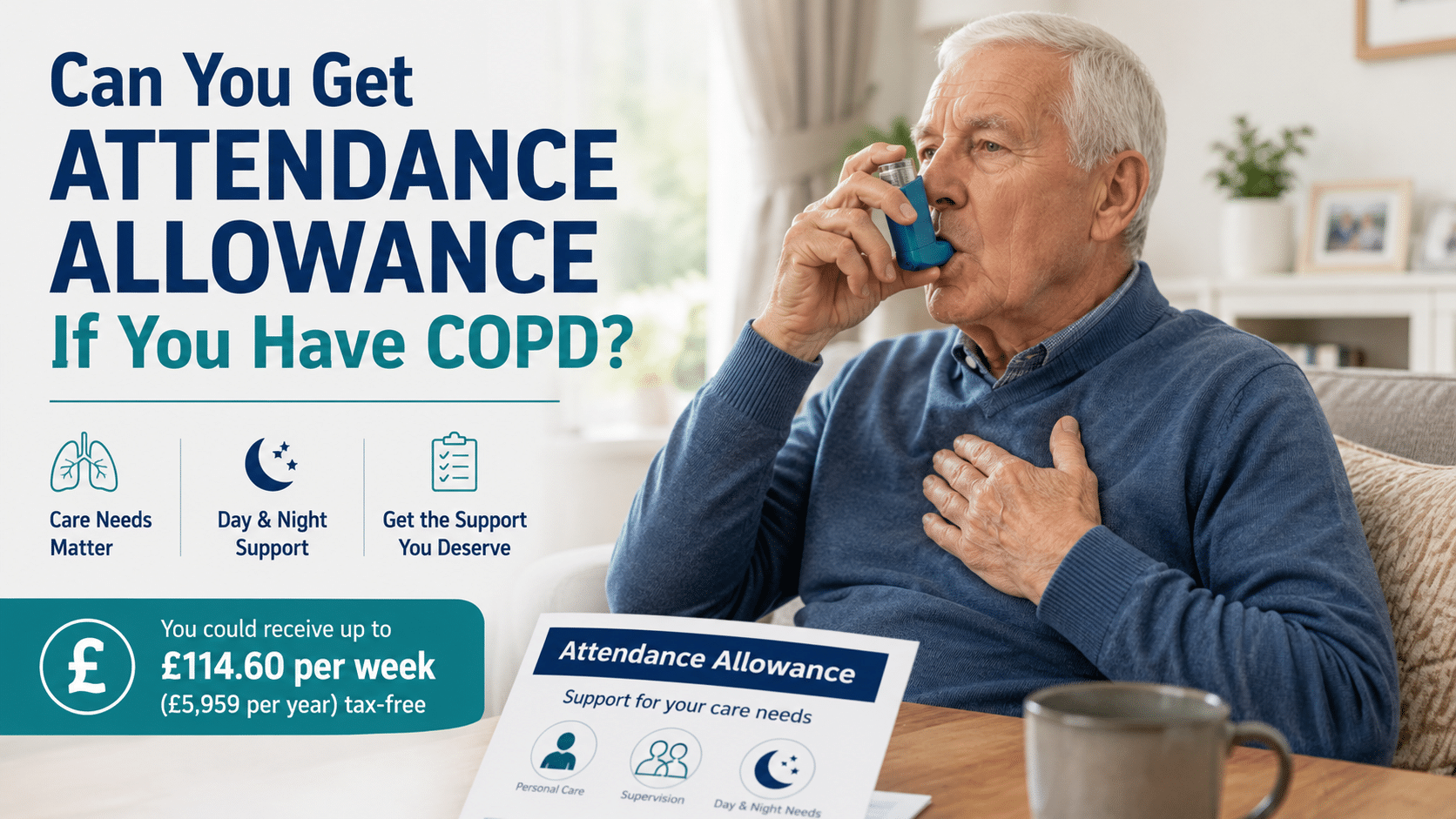
If you have COPD and need help with daily tasks or supervision to stay safe, you could receive up to £114.60 per week (£5,959 per year), completely tax-free.
How COPD Affects Daily Living – What the DWP Needs to Know
People with moderate to severe COPD often experience care needs that qualify for Attendance Allowance, including:
- Washing and bathing – breathlessness when bending, lifting arms, or standing in steam. Many people need to rest multiple times during a shower or cannot bath safely without supervision
- Dressing – becoming breathless when pulling clothing over the head or bending to put on shoes and socks
- Mobility within the home – needing to rest on stairs, risk of falling due to dizziness or sudden breathlessness
- Meal preparation – too breathless to stand at a cooker, unable to carry plates or pans safely
- Medication management – complex inhaler regimes, nebuliser use, needing prompting or physical help with inhalers during an exacerbation
- Night-time needs – breathlessness episodes waking you, needing to sit up or be repositioned, someone monitoring your breathing
- Supervision for safety – risk of sudden breathlessness causing falls, panic attacks, or collapse
Why COPD Claims Are Often Undervalued
COPD is a fluctuating condition. Some days are manageable; others are not. The DWP assesses based on the majority of days and your worst days – but most people instinctively describe their best days on the form.
Common reasons COPD claims are rejected or awarded at the lower rate when the higher rate should apply:
- “I manage most days” – This tells the DWP you do not need help. Even if you only need help 4 days out of 7, that needs to be clearly stated
- Forgetting night-time breathlessness – If COPD wakes you at night, if someone monitors your breathing, or if you need to use an inhaler/nebuliser during the night, this is a night-time care need that qualifies for the higher rate
- Not mentioning the impact of exacerbations – Flare-ups that happen regularly (even if not every day) must be described in detail
- Underestimating supervision needs – If you cannot be left alone because of the risk of sudden breathlessness, collapse, or panic, that is a supervision need
Lower Rate vs Higher Rate – What Determines Which You Get?
| Rate | Per Week | Criteria |
|---|---|---|
| Lower rate | £76.70 | Care or supervision needed during the day or night |
| Higher rate | £114.60 | Care or supervision needed during the day and night |
For COPD, night-time needs are more common than most people realise. If breathlessness wakes you, if you need to sleep with a window open, even in the winter months, if you need someone to help you sit up, if you sleep with extra pillows that need repositioning , if you use a nebuliser at night, or if someone checks on you because of the risk of respiratory distress – these are all night-time care needs that should push your claim to the higher rate.
The difference between the two rates is £1,971 per year. That is money lost simply because night-time needs were not properly described.
Why Professional Support Changes the Outcome
COPD claims are among the most commonly undervalued because the condition fluctuates. On a form, it is difficult to capture the full picture of a condition that varies day to day and gets significantly worse during exacerbations.
An HCPC-registered Occupational Therapist understands how to:
- Describe fluctuating conditions in the way DWP decision-makers require
- Identify care and supervision needs that people with COPD often overlook
- Present night-time respiratory needs clearly enough to secure the higher rate
- Quantify the frequency, duration, and risk of each care need
At Attendance Allowance Services, our clinical team specialises in respiratory conditions. We conduct a thorough assessment covering every aspect of daily living and complete the entire application. There is no fee unless you are awarded the benefit.
Living with COPD? You could be entitled to £5,959 per year
Our OTs handle the entire claim. No fee unless you’re awarded. 99% success rate.
Frequently Asked Questions
Can you get Attendance Allowance for COPD?
Yes. COPD is one of the most common qualifying conditions. However, the benefit is not awarded for having COPD – it is awarded for the care and supervision needs your COPD creates. You must demonstrate that you have difficulty or need help with personal care or supervision to stay safe, and that you have experienced this difficulty or needed for at least 6 months.
Do I need to be on oxygen to qualify for Attendance Allowance with COPD?
No. You do not need to be on oxygen therapy to qualify. What matters is how your breathing difficulties affect daily tasks like washing, dressing, eating, and moving around – and whether you need someone to help you or watch over you for safety. Many people with moderate COPD qualify without being on oxygen.
Can I get the higher rate of Attendance Allowance for COPD?
Yes, if your COPD affects you both during the day and at night. Night-time issues such as breathlessness waking you, unable to remain lying in your bed all night, difficulty or needing help to sit up or use an inhaler, or someone monitoring your breathing all count as night-time care needs. The higher rate is £114.60 per week compared to £76.70 for the lower rate – a difference of nearly £2,000 per year. Our OTs handle the entire claim. No fee unless you’re awarded. 99% success rate.