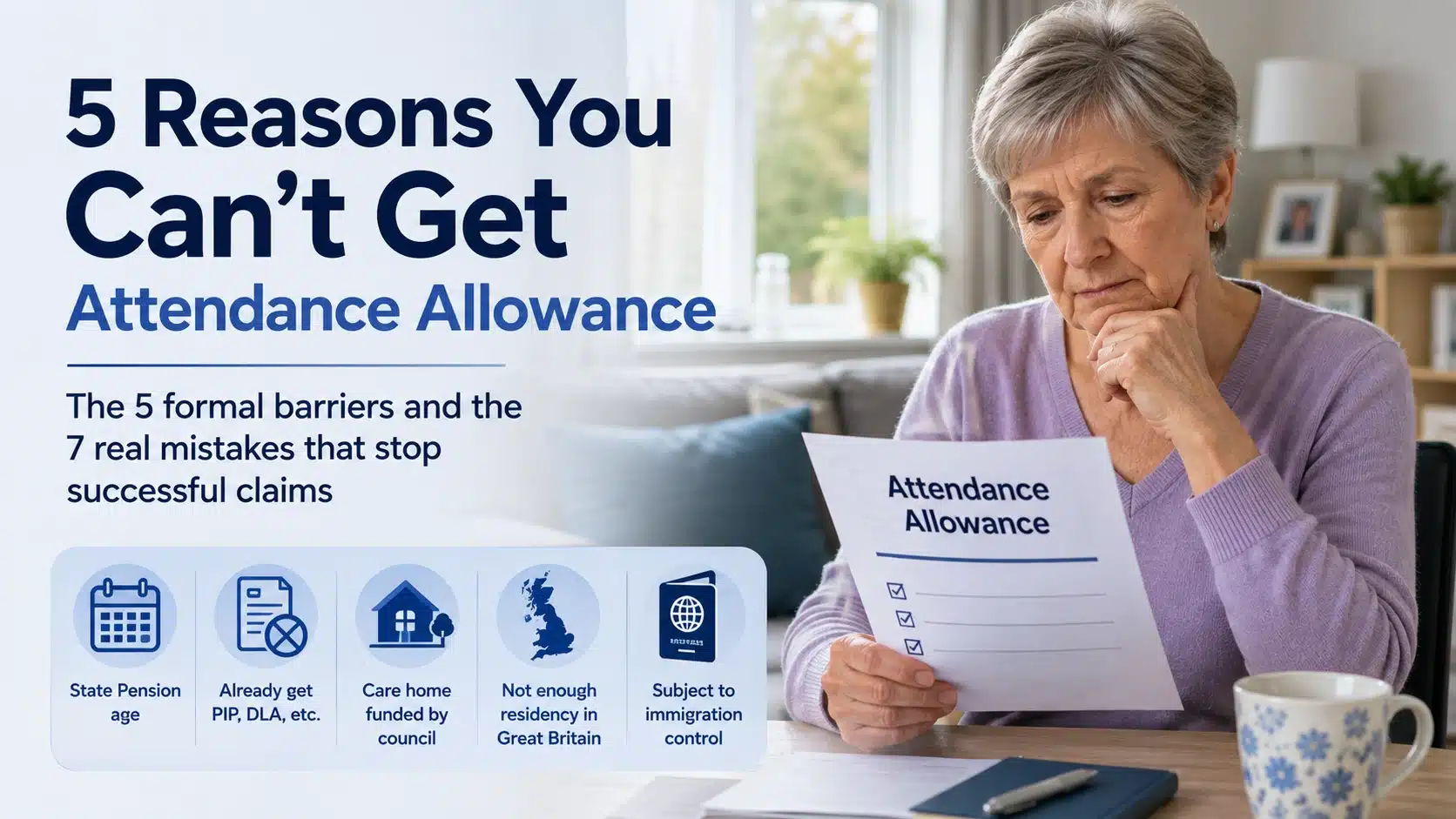
The Short Answer
There are only 5 formal eligibility barriers that genuinely prevent you from claiming Attendance Allowance. If you are over State Pension age, live in Great Britain, and have a health condition affecting daily life – you almost certainly qualify. The #1 reason people don’t get Attendance Allowance is not eligibility. It is how the application form is completed. Around 60% of self-completed claims are rejected due to insufficient detail.
Also see: What is Attendance Allowance Used For?
The 5 Formal Barriers (Things That Genuinely Disqualify You)
These are the only situations where you cannot claim Attendance Allowance, regardless of how the form is completed:
1. You Have Not Reached State Pension Age
Attendance Allowance is exclusively for people who have reached State Pension age (currently 66). If you are under 66, you cannot claim AA – but you may be able to claim Personal Independence Payment (PIP) instead, which serves a similar purpose for working-age adults.
2. You Already Receive DLA, PIP, or ADP
You cannot receive Attendance Allowance alongside:
- Disability Living Allowance (DLA)
- Personal Independence Payment (PIP)
- Pension Age Disability Payment (PADP)
- Scottish Adult Disability Living Allowance (SADLA)
- Armed Forces Independence Payment (AFIP)
If you already receive one of these, you are already getting the equivalent disability benefit.
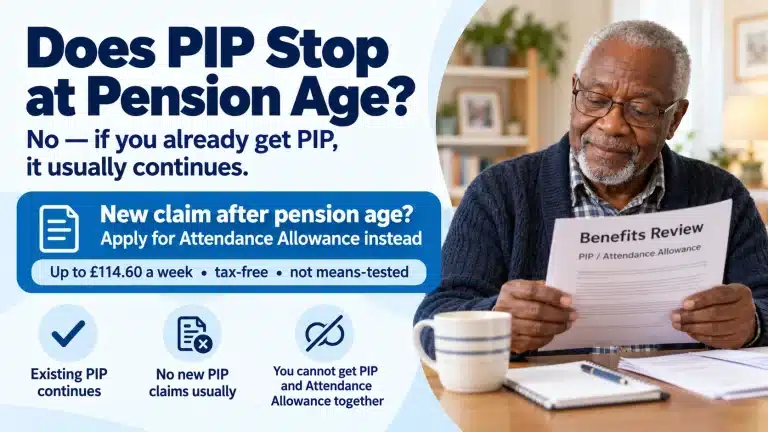
If your PIP has recently stopped, see does PIP stop at pension age to find out whether you can reclaim it or should apply for Attendance Allowance instead.3. You Live in a Care Home Funded by Your Local Authority
If your care home fees are paid by your local authority (council), Attendance Allowance payments will stop after 28 days of local authority funding. However, if you pay for your own care home fees (self-funded), you can still receive Attendance Allowance in full.
Important: If you live at home, receive home care, or live with family – this rule does not affect you. It only applies to residential care homes funded by the council.
4. You Have Not Lived in Great Britain for 2 of the Last 3 Years
You must have been present in England, Wales, or Scotland for at least 2 of the last 3 years (the “past presence test”) and be “habitually resident” in the UK, Ireland, Isle of Man, or Channel Islands. Exceptions apply for refugees, those with humanitarian protection, and some EU citizens with settled status.
5. You Are Subject to Immigration Control
If your immigration status does not permit you to access public funds, you cannot claim Attendance Allowance. This does not apply to British citizens, those with settled status, or those with indefinite leave to remain.
If none of the above apply to you – and for most UK-born pensioners over 66, none of them will – then nothing formally stops you from claiming. The question becomes: will your application succeed?
The Real Reason Most People Don’t Get Attendance Allowance
Here is the truth that most people find surprising: around 60% of Attendance Allowance applications are initially rejected. Not because the applicants are not eligible. Not because their conditions are not severe enough. But because their forms do not describe their care needs in the way the DWP requires.
The rejection rate is not an eligibility problem. It is a communication problem. And it is backed up by one telling statistic: approximately 70% of Attendance Allowance appeals succeed at tribunal. This means the DWP itself overturns or loses the majority of challenged decisions when the evidence is presented properly.
The 7 Mistakes That Actually Stop People Getting Attendance Allowance
Attendance Allowance Pitfalls – 9 Mistakes That Get Claims RejectedBased on thousands of claims handled by our clinical team, these are the real reasons applications fail:
Mistake 1: Describing Your Good Days Instead of Bad Days
The DWP needs to understand what life is like when things are difficult. Many people instinctively describe their best days – “I can usually manage” or “I do alright most of the time.” This gives the decision-maker the impression you do not need help.
What stops your claim: Answering as if every day is a good day, when in reality you struggle on most days.
See also: Attendance Allowance for Cancer
Mistake 2: Understating Your Needs Out of Pride
Older adults – particularly those from a generation that values independence – often minimise their difficulties. Saying “I manage” when the reality is “I manage, but it takes me 45 minutes to get dressed, I’ve fallen twice this month, and I can’t reach my feet” are completely different things in the eyes of the DWP.
What stops your claim: Understating difficulties because admitting them feels uncomfortable.
Mistake 3: Forgetting Night-Time Needs
The difference between the lower rate (£76.70/week) and the higher rate (£114.60/week) is almost entirely about whether you need help at night. Many people forget to mention:
- Waking to use the toilet and needing help getting there safely
- Being repositioned in bed due to pain
- Needing someone to check on you because of confusion or wandering
- Breathlessness that requires someone nearby
- Medication needed during the night
What stops your claim: Missing the night-time section costs you nearly £2,000 per year in lost benefit.
Mistake 4: Describing Your Diagnosis, Not Your Needs
Writing “I have COPD” tells the DWP nothing about what help you need. Writing “My COPD means I become breathless after walking 10 metres. I cannot shower safely without someone present because I become dizzy. I sleep propped up on pillows and my wife checks on me twice each night” tells them everything.
What stops your claim: The form asks about care needs, not medical conditions. A diagnosis alone scores zero points.
Mistake 5: Not Explaining What Would Happen Without Help
The DWP wants to know the consequences of not having help. If you say “my wife helps me get dressed” that’s good. But adding further functional difficulties related to dressing provides the DWP with the information they need.
What stops your claim: Not explaining the risk or consequence of being without support.
Mistake 6: Leaving Sections Blank or Writing “N/A”
Every blank section is a missed opportunity. The DWP cannot assume anything in your favour – if you leave a section empty, they must assume you do not have that need. Even if a question seems irrelevant, there may be a way your condition affects that area that you haven’t considered.
What stops your claim: Blank answers are treated as “no help needed” – even if you simply didn’t know what to write.
Mistake 7: Applying Without Waiting 6 Months
You must have needed help with personal care or supervision for at least 6 months before you can receive Attendance Allowance. You can submit your application before 6 months have passed (and it is often wise to do so, as processing takes weeks), but payment cannot begin until the 6-month qualifying period is complete.
The only exception is if you are terminally ill (not expected to live more than 12 months), in which case the 6-month rule is waived and you automatically qualify for the higher rate under “special rules.(SR1)”
What stops your claim: Applying too early means a delayed decision, not a rejection – but many people misunderstand this and give up.
What Does NOT Stop You Getting Attendance Allowance
Many people wrongly believe these things will disqualify them. They will not:
| Myth | Reality |
|---|---|
| “I have savings” | AA is not means-tested – . Savings make no difference. see our guide |
| “I own my home” | Property ownership does not affect eligibility. |
| “I don’t have a carer” | You do not need to have a carer. AA is based on what help you need, not what you receive. |
| “I live alone” | Living alone does not prevent a claim – in fact, it may strengthen it (you may need more help). |
| “I don’t have a diagnosis” | You do not need a formal diagnosis. The DWP assesses care needs, not diagnoses. |
| “I already get State Pension” | AA is paid on top of your State Pension. They are separate benefits. |
| “I already get Pension Credit” | You can get both. Getting AA may also increase your Pension Credit by triggering the Severe Disability Premium. See our guide: Attendance Allowance and Pension Credit. |
| “My condition isn’t on the list” | There is no restrictive list. Any condition that creates care needs qualifies. See the full DWP list of 57 qualifying conditions. |
| “I was rejected before” | A previous rejection does not prevent you from reapplying. If your needs have changed, or if the original form lacked detail, you can try again. See: What to do if rejected. |
How to Make Sure Nothing Stops Your Claim
If you meet the basic eligibility criteria (over 66, living in the UK, health condition affecting daily life for 6+ months), the only thing standing between you and up to £5,959 per year is how your needs are described on the form.
At Attendance Allowance Services, our HCPC-registered Occupational Therapists:
- Conduct a full clinical assessment to identify every care need – including those you may not think to mention
- Describe needs using the precise frequency, duration, and consequence language the DWP requires
- Ensure night-time needs are fully captured to maximise your chance of the higher rate
- Complete the entire 32-page form on your behalf
- Achieve a 99% success rate – compared to approximately 60% for DIY applications
There is no fee unless you are awarded the benefit.
Don’t let poor form completion stop you getting what you’re entitled to
Free eligibility check. No obligation. Our OTs handle the entire process. No fee unless you’re awarded.
Frequently Asked Questions
What stops you from getting Attendance Allowance?
The only formal barriers are: being under State Pension age (66), already receiving DLA or PIP, living in a council-funded care home, not having lived in Great Britain for 2 of the last 3 years, or being subject to immigration control. However, the most common reason people don’t get Attendance Allowance is that their application form does not describe their care needs clearly enough. Around 60% of self-completed applications are rejected for this reason.
Attendance Allowance When in Hospital – What Happens to Your Payments?Does having savings stop you getting Attendance Allowance?
No. Attendance Allowance is not means-tested. Your savings, income, pension, property, and other assets have absolutely no effect on your eligibility. Whether you have £100 or £100,000 in savings, you can still claim Attendance Allowance if you meet the care needs criteria.
Can you be refused Attendance Allowance even if you have a serious health condition?
Yes. Having a serious condition does not guarantee an award. Attendance Allowance is not based on diagnosis – it is based on the care and supervision needs your condition creates. If your form does not clearly describe what help you need, how often, and what would happen without it, you can be refused even with a serious illness.
Can I reapply for Attendance Allowance after being rejected?
Yes. You can reapply at any time if your needs have changed or worsened. You can also challenge the original decision through mandatory reconsideration (within 1 month) or a tribunal appeal. Approximately 70% of appeals succeed at tribunal, which shows that many initial rejections are due to form completion issues rather than genuine ineligibility.