Key Facts
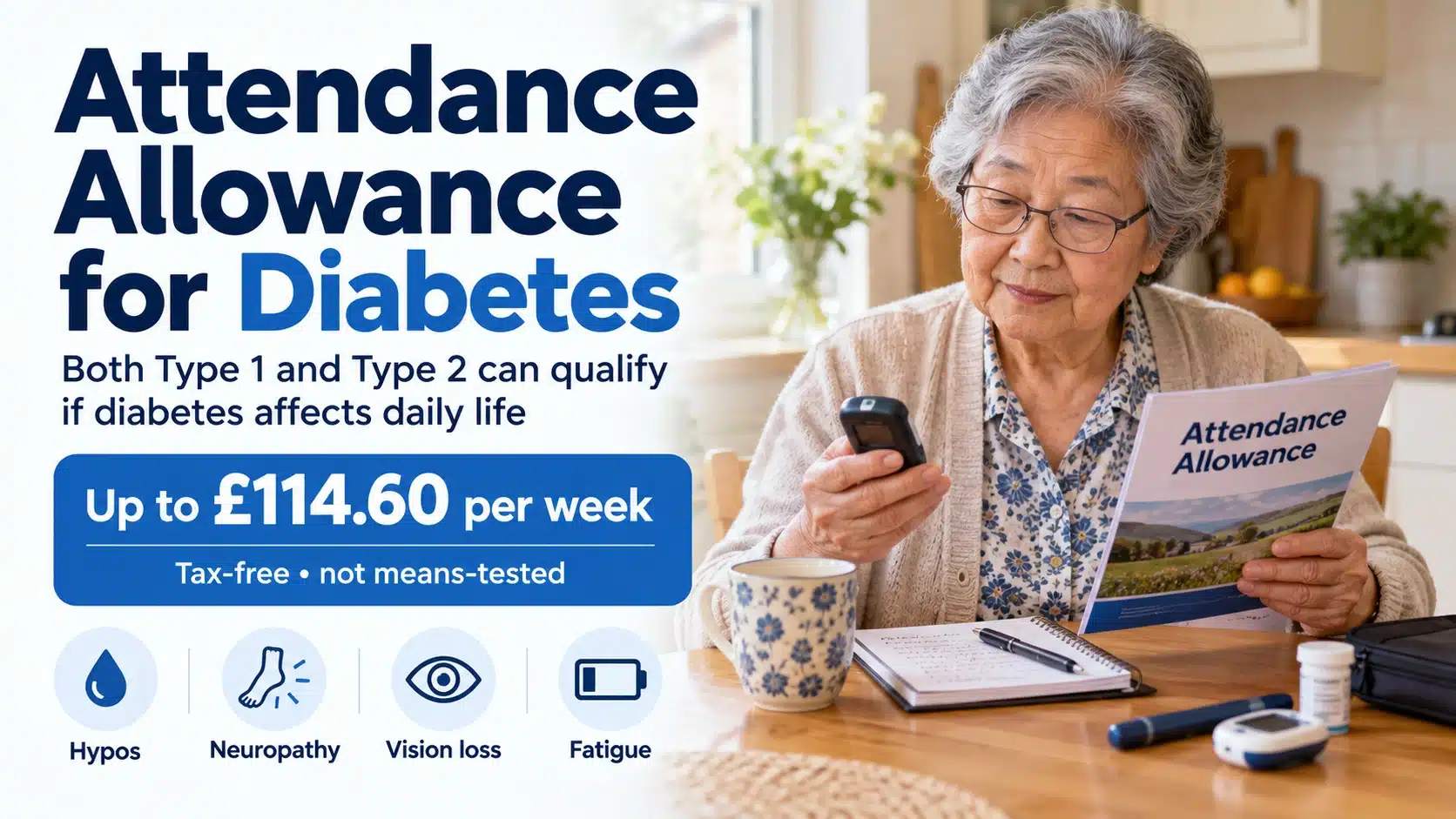
- Both Type 1 and Type 2 diabetes can qualify for Attendance Allowance
- Worth up to £114.60 per week (£5,959.20 per year) — tax-free, not means-tested
- It is NOT about the diagnosis — it is about how diabetes affects your daily life
- Complications are key: neuropathy, hypos, vision loss, and fatigue all count
Can You Get Attendance Allowance for Diabetes?
Yes — if diabetes affects your ability to manage daily tasks safely and independently. This is one of the most under-claimed conditions for Attendance Allowance, because many people assume that a “managed” condition does not qualify.
The reality is different. Diabetes — especially when combined with the complications that develop over years — creates real care needs that the DWP recognises. What matters is not your HbA1c level or which medications you take. What matters is:
- Do you need help managing your blood sugar (injections, monitoring, recognising hypos)?
- Do you struggle with daily activities because of diabetic complications?
- Do you need someone to watch over you in case of a hypoglycaemic episode?
- Do you need help at night because of pain, toilet visits, or blood sugar checks?
If you answered yes to any of these, you may be entitled to apply.
Type 1 vs Type 2 — Both Can Qualify
There is a common misconception that only Type 1 diabetes qualifies because it requires insulin injections. This is not true. The DWP does not distinguish between Type 1 and Type 2 — they assess functional impact, not the type of diabetes.
| Diabetes Type | Common Care Needs That Qualify |
|---|---|
| Type 1 | Insulin management, hypo risk (needing supervision), blood glucose monitoring help, pump management, night-time hypos requiring someone to check on you |
| Type 2 | Medication management, fatigue affecting daily tasks, neuropathy pain, mobility issues, vision problems, kidney-related fatigue, wound care |
| Type 2 (insulin-dependent) | All of the above, plus injection management, hypo risk, and blood sugar monitoring — same as Type 1 |
Diabetic Complications That Strengthen Your Claim
Diabetes rarely exists in isolation. Over the years, it causes or worsens other conditions that significantly affect daily living. These complications are often what makes an Attendance Allowance claim successful:
Diabetic neuropathy (nerve damage)
- Numbness, tingling, or burning pain in feet and hands
- Difficulty walking, balance problems, increased fall risk
- Inability to feel injuries — risk of burns, cuts, pressure sores
- Need for someone to check feet daily and manage wound care
Diabetic retinopathy and vision loss
- Difficulty reading medication labels, blood sugar monitors
- Needing help preparing meals safely (cutting, using the cooker)
- Unable to manage finances, correspondence, or appointments independently
- Increased supervision needs when out of the home
Kidney disease (diabetic nephropathy)
- Severe fatigue — too tired to cook, clean, or wash independently
- Dialysis-related care needs if kidney failure develops
- Fluid and diet restrictions needing someone else to prepare meals
Cardiovascular complications
- Breathlessness limiting mobility and self-care
- Heart failure causing extreme fatigue
- Stroke effects — speech, movement, cognitive changes
Hypoglycaemia (hypos)
- Risk of sudden confusion, collapse, or unconsciousness
- Needing someone present or on-call, especially at night
- Night-time hypos requiring someone to check blood sugar levels
- This is a strong basis for night-time supervision needs
How to Describe Diabetes on the Attendance Allowance Form
The most common reason diabetic claims fail is that applicants write about their medical management rather than their daily struggles. The DWP does not care about your medication regimen — they care about what you cannot do safely on your own.
| Wrong Approach ❌ | Right Approach ✅ |
|---|---|
| “I have Type 2 diabetes controlled with metformin” | “I cannot feel my feet due to diabetic neuropathy. I have fallen three times in the past month. My daughter checks on me every morning to make sure I haven’t fallen overnight.” |
| “I take insulin injections twice daily” | “My hands shake due to neuropathy and I struggle to draw insulin into the syringe accurately. My wife has to prepare my injections. I had two severe hypos last month where I became confused and couldn’t help myself.” |
| “I have diabetic retinopathy” | “My vision has deteriorated to the point where I cannot read my blood glucose monitor, medication labels, or correspondence. I need someone to manage my medication schedule and read my post.” |
Describing diabetes in this way requires clinical expertise. Our HCPC-registered Occupational Therapists conduct a thorough assessment and write the application using the exact functional language the DWP needs to see. We cover every area — day and night, good days and bad, risks and dangers.
How Much Is Attendance Allowance for Diabetes?
| Rate | Weekly | Annual | Who Gets This |
|---|---|---|---|
| Higher rate | £114.60 | £5,959.20 | Day AND night care needs (e.g. daytime help + night-time hypo supervision) |
| Lower rate | £76.70 | £3,988.40 | Day OR night care needs only |
Patients with diabetes and diabetes complications often qualify for the higher rate because neuropathy, hypo risk, and pain create care needs around the clock. Night-time is particularly relevant — checking blood sugar, managing pain, and the risk of hypoglycaemic episodes all count.
Attendance Allowance is tax-free and not means-tested. It does not affect your State Pension, savings, or other income.
Diabetes and Other Benefits
Claiming Attendance Allowance for diabetes can unlock additional support:
- Pension Credit top-up: The Severe Disability Premium can add up to £81.50/week extra if you live alone and receive AA
- Council Tax reduction: AA can qualify you for a council tax discount or exemption
- Carer’s Allowance: If someone provides 35+ hours/week of care, they may claim Carer’s Allowance based on your AA award
- Blue Badge: AA at higher rate can support a Blue Badge application
For more on how to use your award, see our guide on what Attendance Allowance is used for.
Living with diabetes should not mean living without support
Our HCPC-registered Occupational Therapists understand exactly how diabetes affects daily life — the complications, the risks, and the daily struggles that qualify for Attendance Allowance. No fee unless awarded. Free eligibility check takes 2 minutes.
Frequently Asked Questions
Can you get Attendance Allowance for Type 2 diabetes?
Yes. The DWP does not distinguish between Type 1 and Type 2. What matters is how diabetes affects your daily life. Type 2 diabetes with complications such as neuropathy, vision loss, kidney disease, or cardiovascular problems often creates care needs that qualify for Attendance Allowance at either the lower or higher rate.
Do I need to be on insulin to qualify?
No. Insulin dependence is not a requirement. Many people with tablet-controlled Type 2 diabetes qualify because of complications like neuropathy, fatigue, vision problems, or fall risk. The assessment is based on what help you need, not which medication you take.
What if my diabetes is “well managed”?
A well-managed condition can still create daily care needs. Managing diabetes well may itself require significant effort and help — blood sugar monitoring, dietary management, foot care, medication administration, and the ongoing risk of hypos. If you need help with any of these, you may qualify.
Can I claim if I have diabetes alongside other conditions?
Absolutely — and you should mention every condition, not just diabetes. Many people over State Pension age have diabetes alongside arthritis, heart disease, COPD, or dementia. The DWP assesses your total care needs from all conditions combined. Multiple conditions strengthen your claim.
How do I describe night-time needs related to diabetes?
Night-time needs are crucial for qualifying for the higher rate. For diabetes, this can include: needing someone to check blood sugar during the night, waking due to neuropathic pain, needing help getting to the toilet (neuropathy causes unsteadiness), risk of night-time hypos requiring supervision, and disturbed sleep from pain or medication side effects.
Does Attendance Allowance for diabetes affect my other benefits?
No. Attendance Allowance does not reduce your State Pension, Pension Credit, Housing Benefit, or any other income. It can actually increase your Pension Credit through the Severe Disability Premium. It is completely tax-free and not means-tested.