Key Facts
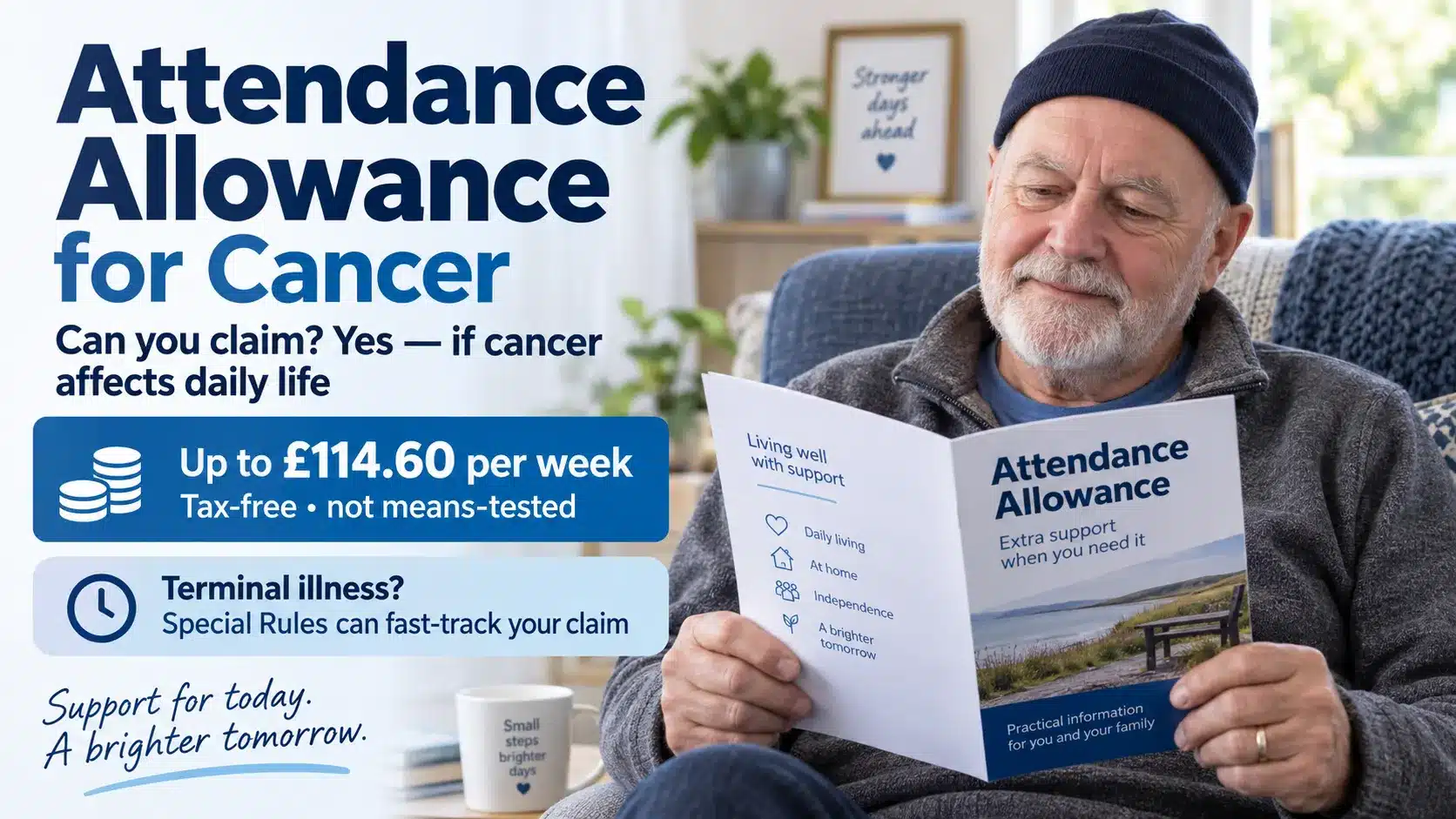
- People with cancer who are over State Pension age can claim Attendance Allowance — at any stage of treatment
- Worth up to £114.60 per week (£5,959.20 per year) — tax-free, not means-tested
- Terminal illness? Special Rules fast-track your claim — often approved within days
- You do not need to be receiving care — only that you need help or supervision
Can You Claim Attendance Allowance If You Have Cancer?
Yes. Cancer is one of the most common qualifying conditions for Attendance Allowance. Whether you have been recently diagnosed, are going through treatment, are in remission, or have a terminal prognosis, you may be entitled to claim.
What matters is not the cancer itself, but how it affects your daily life. The DWP assesses whether you need:
- Help with personal care (washing, dressing, eating, using the toilet)
- Supervision or someone to watch over you (because of falls, confusion, or fatigue)
- Help during the night (pain management, toilet visits, medication)
Many patients with cancer meet these criteria during treatment, even if they would not have met them before diagnosis. Chemotherapy fatigue, surgery recovery, medication side effects, and pain all count.
Which Types of Cancer Qualify?
There is no restricted list. Any type of cancer can qualify for Attendance Allowance, provided it affects your daily life. Common examples include:
| Cancer Type | Common Daily Living Impact |
|---|---|
| Lung cancer | Breathlessness, fatigue, difficulty walking, oxygen dependency |
| Bowel / colorectal cancer | Stoma care, continence issues, urgency, fatigue after surgery |
| Prostate cancer | Incontinence, fatigue from hormone therapy, pain, mobility issues |
| Breast cancer | Post-surgery limitations, lymphoedema, chemotherapy fatigue, depression |
| Brain tumour | Cognitive changes, seizure risk, supervision needs, mobility loss |
| Pancreatic cancer | Severe pain, weight loss, digestive problems, rapid decline |
| Blood cancers (leukaemia, lymphoma, myeloma) | Extreme fatigue, infection risk, bruising, chemotherapy side effects |
This is not an exhaustive list. If your cancer — or its treatment — makes daily tasks difficult, painful, or unsafe, you may qualify regardless of the type.
The Special Rules for Terminal Illness
If your cancer is terminal, there is a fast-track process that speeds up your claim significantly:
Special Rules — What Changes
- Automatic higher rate: £114.60/week — no assessment of daily living needed
- Fast-track processing: Claims are typically decided within days, not weeks
- Clinician-initiated: Your GP, consultant, or clinical nurse specialist completes an SR1 form
- No 6-month qualifying period: You can claim immediately
- Definition: Terminal illness means a progressive disease where death can reasonably be expected within 12 months
The SR1 form (formerly DS1500) is completed by your medical team, not by you. Many families do not realise this route exists. If your loved one has a terminal diagnosis, this should be explored immediately — there is no need to complete the full AA1 claim form.
How Cancer Affects Attendance Allowance Eligibility
The biggest mistake patients with cancer make on their application is describing the cancer rather than its impact on daily life. The DWP decision-maker does not assess your medical records — they assess what you wrote on the form about how you manage day to day.
What the DWP actually wants to know:
| Wrong Approach ❌ | Right Approach ✅ |
|---|---|
| “I have stage 3 bowel cancer” | “I need help getting to the toilet urgently 6–8 times daily due to bowel cancer. I have had accidents and cannot always reach the bathroom in time.” |
| “I am on chemotherapy” | “Chemotherapy leaves me so fatigued that for 4–5 days after each session I cannot get out of bed without help. I need someone to bring me meals, help me wash, and check on me during the night because of nausea.” |
| “I had my prostate removed” | “Since my prostatectomy I am incontinent. I need to change pads several times daily and nightly. I cannot always manage the process alone and sometimes need my wife’s help.” |
This is where professional support makes a real difference. Our HCPC-registered Occupational Therapists understand exactly how to translate medical treatment into the functional language the DWP needs to see. We describe your worst days, not your best ones — and we cover every area the form asks about.
How Much Is Attendance Allowance for Patients with cancer?
| Rate | Weekly | Annual | Who Gets This |
|---|---|---|---|
| Higher rate | £114.60 | £5,959.20 | Day AND night care needs, OR terminal illness |
| Lower rate | £76.70 | £3,988.40 | Day OR night care needs |
Many patients with cancer qualify for the higher rate because treatment side effects create both daytime and night-time care needs. Chemotherapy nausea, pain medication, insomnia, and bathroom urgency all count towards night-time needs.
Attendance Allowance is tax-free, does not affect your State Pension, and is not means-tested — your savings and income are irrelevant.
Cancer Treatment and Daily Living — What Counts
Even if you were independent before your diagnosis, cancer treatment can create significant care needs that qualify for Attendance Allowance:
During chemotherapy:
- Extreme fatigue for days after each cycle — unable to cook, clean, or wash independently
- Nausea and vomiting — needing someone nearby to assist
- Weakened immune system — needing someone to handle shopping, cooking safely
- Night-time sickness — needing help or supervision overnight
During radiotherapy:
- Skin soreness and sensitivity — difficulty dressing or bathing
- Fatigue that builds over the treatment course
- Transport needs — unable to drive to daily appointments
After surgery:
- Wound care and dressing changes
- Restricted movement — unable to reach, bend, or lift
- Stoma management (bowel cancer, bladder cancer)
- Lymphoedema management (breast cancer, gynaecological cancers)
Ongoing:
- Chronic pain requiring medication management
- Cognitive changes (“chemo brain”) — needing reminders, supervision
- Depression and anxiety — difficulty motivating to self-care
- Weight loss and weakness — needing help with meals and mobility
Can You Claim If You Are in Remission?
Yes. Being in remission does not automatically disqualify you. If ongoing side effects from treatment, surgery consequences, or residual symptoms still affect your daily life, you can claim. Many people in remission still experience:
- Chronic fatigue that limits what they can do
- Lymphoedema requiring daily management
- Stoma care that they need help with
- Neuropathy (nerve damage) from chemotherapy affecting hands and feet
- Psychological impact requiring supervision or prompting
The key is describing how your daily life is affected now, regardless of your current cancer status.
Attendance Allowance and Other Cancer Benefits
Attendance Allowance does not replace other support — it works alongside it:
- Pension Credit: Claiming AA can increase your Pension Credit through the Severe Disability Premium — worth up to an extra £81.50/week
- Council Tax: AA can unlock council tax reductions or exemptions
- State Pension: AA does not affect your State Pension in any way
- Macmillan grants: Separate one-off grants from Macmillan Cancer Support
- NHS travel costs: Help with travel to hospital appointments
For a full breakdown of how benefits interact, see our guide to what Attendance Allowance is used for.
Dealing with cancer is hard enough. Let us handle the paperwork.
Our HCPC-registered Occupational Therapists complete the entire application for cancer patients. We describe exactly how your treatment affects daily life — in the language the DWP needs to see. No fee unless you are awarded.
Why Professional Help Matters for Cancer Claims
Patients with cancer face a unique challenge with Attendance Allowance: they are often too focused on treatment to properly describe their daily struggles. Many people minimise their difficulties because they are comparing themselves to “how they used to be” rather than describing what they actually need help with now.
Our Occupational Therapists conduct a detailed assessment that captures:
- How treatment affects you on your worst days, not just average days
- Night-time needs that you may not think to mention (pain, toilet visits, anxiety)
- Risks and dangers (falls, burns from cooking, confusion from medication)
- What help you need even if no one is currently providing it
- How your needs fluctuate across treatment cycles
This professional clinical assessment is what separates successful applications from rejected ones. With a 99%+ success rate, our team knows exactly what the DWP is looking for.
Call 0208 081 4500 or check your eligibility online — it takes 2 minutes and costs nothing.
Frequently Asked Questions
Can you get Attendance Allowance for cancer?
Yes. Any type of cancer can qualify for Attendance Allowance if it affects your ability to manage daily tasks like washing, dressing, cooking, or getting around safely. Both early-stage and advanced cancer patients can claim. The award is based on your care needs, not the stage of your cancer.
How much is Attendance Allowance for cancer patients?
The same rates apply as for any other condition: £114.60 per week (higher rate) if you need help day and night, or £76.70 per week (lower rate) if you need help during the day or night only. Terminal illness claims automatically receive the higher rate.
Is there a fast-track for terminal cancer?
Yes. Under the Special Rules for Terminal Illness, if your clinician believes you may have 12 months or less to live, your claim is fast-tracked. You automatically receive the higher rate (£114.60/week) and the decision is typically made within days. Your medical team completes an SR1 form.
Can I claim during chemotherapy?
Absolutely. Chemotherapy often creates significant care needs — fatigue, nausea, immune suppression, and difficulty with daily tasks. Many patients qualify for the higher rate during treatment because they need help both day and night. You can apply at any point during your treatment.
Does Attendance Allowance affect my other cancer benefits?
No — Attendance Allowance is paid on top of your State Pension and does not reduce any other benefits. In fact, it can unlock additional support like the Severe Disability Premium in Pension Credit, worth up to £81.50 extra per week. It is tax-free and not means-tested.
Can I claim if my cancer is in remission?
Yes, if you still have ongoing care needs from treatment side effects, surgery consequences, or residual symptoms. Chronic fatigue, lymphoedema, stoma care, neuropathy, and psychological impact all count. Remission does not automatically end your eligibility.