
Key Facts
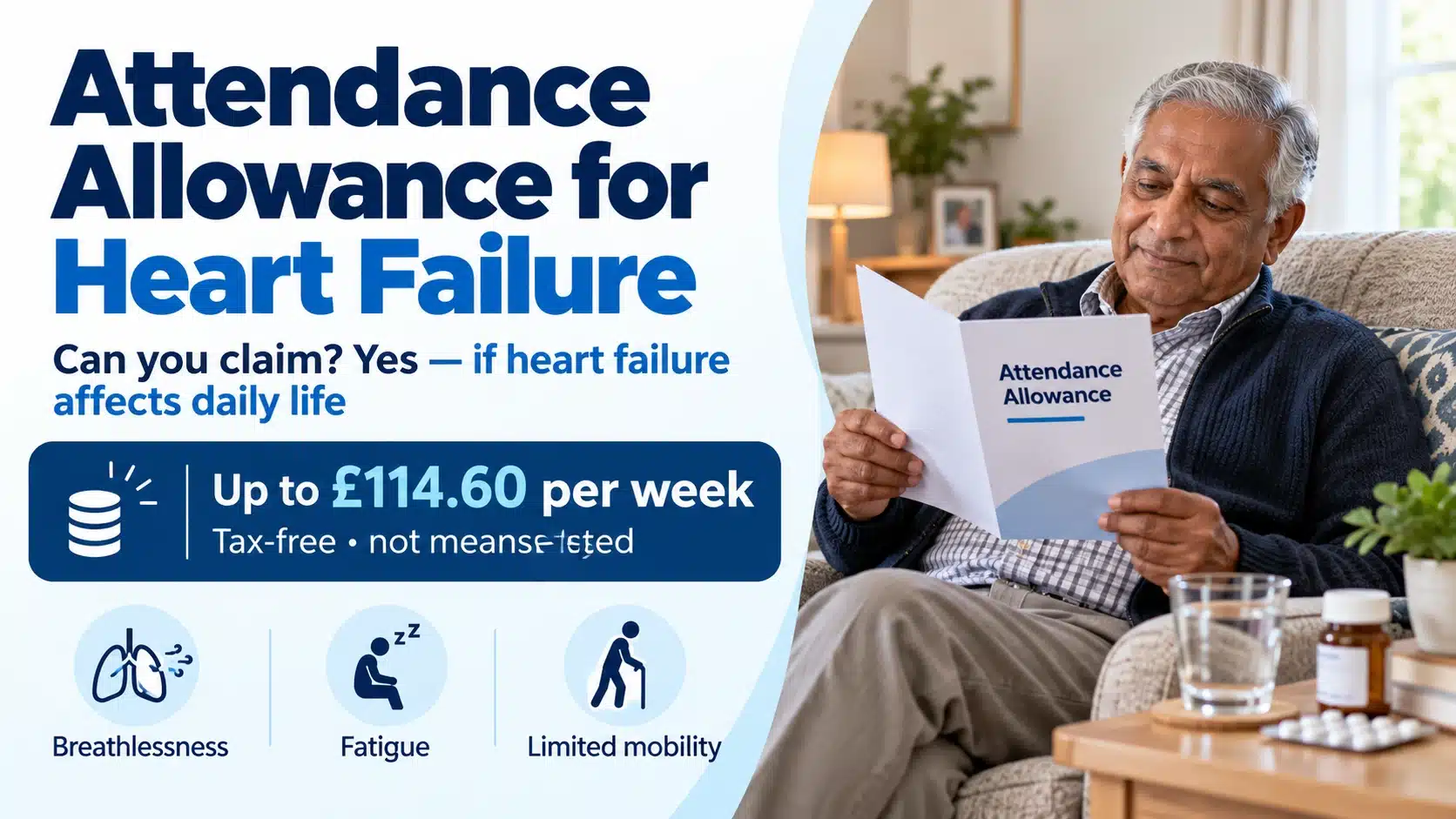
- Heart failure and heart disease can qualify for Attendance Allowance
- Worth up to £114.60 per week (£5,959.20 per year) — tax-free, not means-tested
- Breathlessness, fatigue, and limited mobility are the key daily impacts the DWP assesses
- You do not need to be housebound — even mild-to-moderate limitations count
Can You Claim Attendance Allowance for Heart Failure?
Yes. Heart failure is one of the conditions that commonly qualifies for Attendance Allowance, because it directly affects how much you can do in daily life. The progressive breathlessness, extreme fatigue, and activity limitation it causes create exactly the kind of care needs the DWP recognises.
What matters is not your ejection fraction or your NYHA class — it is how heart failure affects your ability to:
- Wash, dress, and manage personal care independently
- Prepare meals and eat safely
- Move around your home without becoming breathless or exhausted
- Manage at night (fluid retention, breathlessness when lying flat, toilet visits)
- Go out safely without someone accompanying you
Which Heart Conditions Qualify?
There is no restricted list. Any heart condition can qualify if it affects your daily life. Common examples include:
| Heart Condition | Common Daily Living Impact |
|---|---|
| Heart failure (HFrEF / HFpEF) | Breathlessness on minimal exertion, extreme fatigue, ankle swelling, needing to sleep propped up, fluid restriction management |
| Coronary artery disease / angina | Chest pain limiting activity, fear of exertion, needing to rest frequently, carrying GTN spray at all times |
| Post heart attack / bypass surgery | Reduced stamina, wound care, restricted lifting and bending, cardiac rehabilitation fatigue |
| Atrial fibrillation / arrhythmia | Unpredictable palpitations, dizziness, fall risk, fatigue, medication management (warfarin/anticoagulants) |
| Heart valve disease | Breathlessness, fatigue, dizziness, swollen ankles, restricted activity |
| Cardiomyopathy | Progressive weakness, breathlessness, arrhythmia risk, reduced exercise tolerance |
How Heart Failure Affects Daily Living
Heart failure creates care needs that many patients do not even recognise as qualifying for Attendance Allowance. Over time, you adapt and accept limitations that would have seemed unthinkable before your diagnosis. But the DWP assesses what you struggle with now — not what you have learned to accept.
Daytime care needs:
- Breathlessness on exertion: Cannot walk upstairs without stopping, cannot carry shopping, needs to rest after minimal activity
- Fatigue: Too exhausted to cook a full meal, needs to sit down while washing, cannot manage housework
- Personal care: Difficulty getting in/out of the bath, cannot bend to put on shoes or socks, needs help dressing
- Meal preparation: Too fatigued to stand and cook, cannot carry pans safely, risk of burns or falls in the kitchen
- Medication management: Multiple daily medications, warfarin/anticoagulant monitoring, diuretic management
- Swollen legs and feet: Difficulty putting on compression stockings, needing help with leg elevation
Night-time care needs:
- Orthopnoea: Needing to sleep propped up on multiple pillows because you cannot breathe lying flat
- Paroxysmal nocturnal dyspnoea: Waking suddenly at night gasping for breath — needing someone present
- Frequent toilet visits: Diuretic medication causes multiple night-time trips to the bathroom
- Anxiety about cardiac events: Fear of having a heart attack or episode alone at night
- Fluid monitoring: Needing to weigh yourself daily and monitor fluid intake
How to Describe Heart Failure on the Form
The biggest mistake is writing about your diagnosis instead of your daily struggles:
| Wrong Approach ❌ | Right Approach ✅ |
|---|---|
| “I have heart failure with reduced ejection fraction” | Describe in detail how your heart failure affects your ability to manage at home. |
| “I take furosemide and bisoprolol daily” | Explain the effects the diffirent heart medications have on your daily life. |
| “I had a heart attack in 2024” | Explain the impact that your hert attack has on your daily life. |
Our HCPC-registered Occupational Therapists understand exactly how to translate cardiac symptoms into the functional language the DWP needs. We describe your worst days, cover every area of daily life, and highlight the risks that come with heart failure — falls, breathlessness episodes, and the need for supervision.
How Much Is Attendance Allowance for Heart Conditions?
| Rate | Weekly | Annual | Who Gets This |
|---|---|---|---|
| Higher rate | £114.60 | £5,959.20 | Day AND night care needs |
| Lower rate | £76.70 | £3,988.40 | Day OR night care needs |
Many heart failure patients qualify for the higher rate because the condition creates both daytime limitations (breathlessness, fatigue) and night-time needs (orthopnoea, toilet visits from diuretics, anxiety about cardiac events).
Attendance Allowance is tax-free, not means-tested, and does not affect your State Pension.
Heart Failure and Other Benefits
- Pension Credit: Claiming AA can unlock the Severe Disability Premium — up to £81.50/week extra
- Council Tax: AA can qualify you for council tax reductions
- Carer’s Allowance: If someone cares for you 35+ hours/week, they may claim Carer’s Allowance
- Blue Badge: Higher rate AA supports Blue Badge applications for parking closer to destinations
- NHS exemptions: Heart conditions may qualify you for free prescriptions
Heart failure limits what you can do. It should not limit what you receive.
Our HCPC-registered Occupational Therapists understand cardiac conditions and know exactly how to present your daily limitations to the DWP. No fee unless awarded. Free eligibility check takes 2 minutes.
Frequently Asked Questions
Can you get Attendance Allowance for heart failure?
Yes. Heart failure commonly qualifies for Attendance Allowance because it causes breathlessness, fatigue, and activity limitation that directly affect daily living. The assessment is based on what you struggle to do, not on your diagnosis or medical test results.
Does heart failure qualify for the higher rate?
Often yes. Heart failure typically creates both daytime care needs (breathlessness, fatigue limiting personal care and meal preparation) and night-time needs (sleeping propped up, frequent toilet visits from diuretics, anxiety about cardiac events). If you need help day and night, you qualify for the higher rate of £114.60/week.
Can I claim after a heart attack?
Yes, provided you have needed help with daily activities for at least 6 months (or expect to need help for at least 6 months). Many post-heart attack patients have ongoing limitations — reduced stamina, restricted lifting, anxiety about exertion, and medication management needs.
Do I need to be severely ill to qualify?
No. You do not need to be housebound or bedridden. Even moderate heart failure that causes you to need help with cooking, shopping, bathing, or getting dressed can qualify. The key is whether you have difficutly, need help or supervision — not how severe your condition appears on paper.
Can I claim if I have heart failure alongside other conditions?
Absolutely — and you should mention every condition. Many heart failure patients also have diabetes, COPD, arthritis, or kidney disease. The DWP assesses your total care needs from all conditions combined, so multiple conditions strengthen your claim.
Is Attendance Allowance for heart failure means-tested?
No. Attendance Allowance is not means-tested. Your savings, income, property, and pension are completely irrelevant. Whether you have £500 or £500,000 in the bank, you can claim the same amount.