The Short Answer
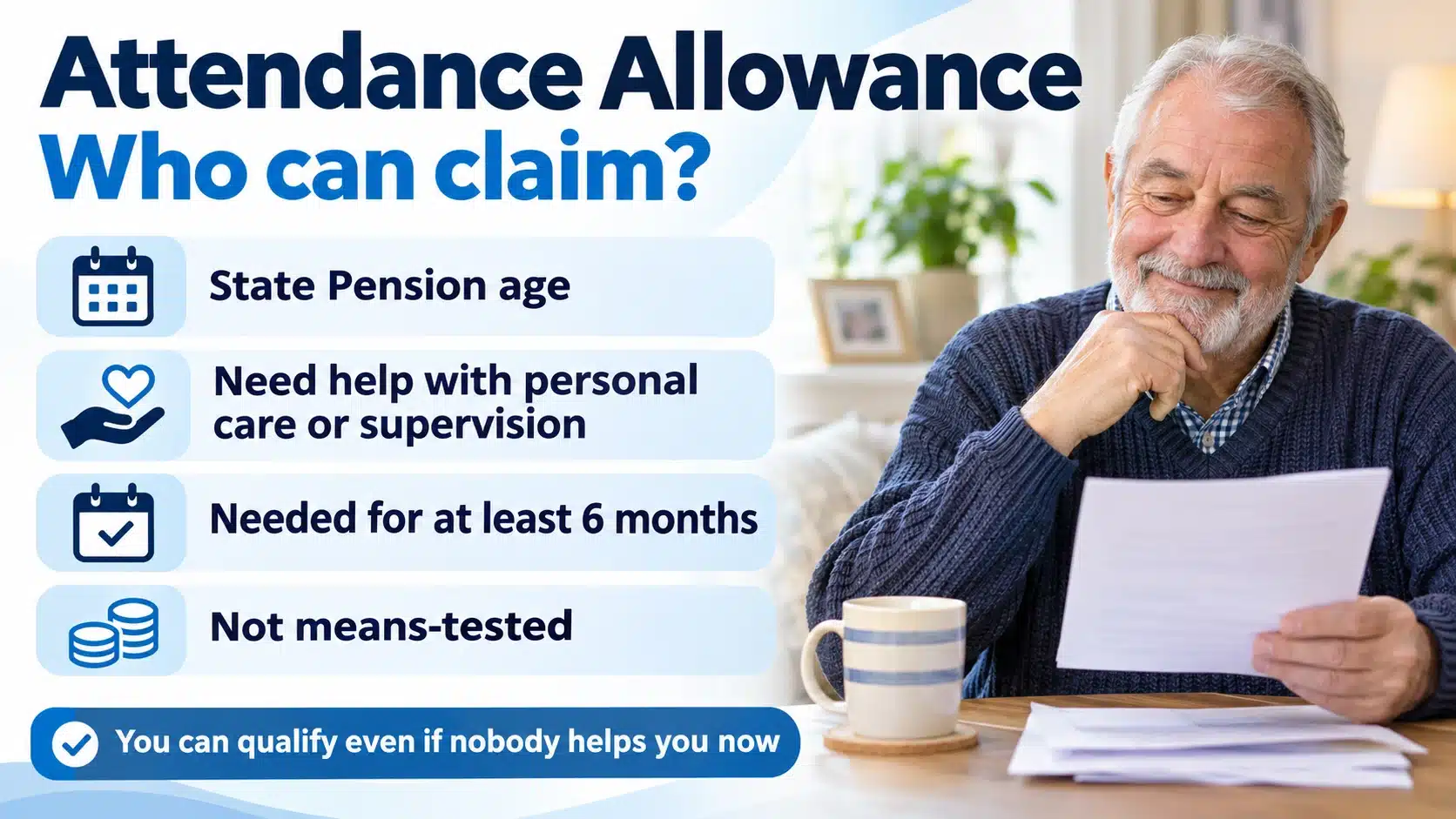
You can get Attendance Allowance if you have reached State Pension age, have a physical or mental disability or a health condition, and need help with personal care or supervision that you have needed for at least 6 months. You must also meet the residence rules and not be getting Disability Living Allowance or Personal Independence Payment.
It is not means-tested, so your income and savings do not count. You can qualify if you live alone, and even if nobody is helping you at the moment.
Checked in November 2026 against GOV.UK: Attendance Allowance eligibility, the State Pension age timetable, the official AA1 claim form notes (November 2025 edition) and Age UK Factsheet 34 (May 2026). This guide covers England and Wales. If you live in Northern Ireland, see the section “Where You Live Can Change the Rules” below. Scotland has its own benefit, Pension Age Disability Payment.
The Attendance Allowance Eligibility Criteria at a Glance
| Test | The rule (GOV.UK) | In plain English |
|---|---|---|
| 1. Age | You have reached State Pension age | There is no set age. It depends on your date of birth (table below) |
| 2. Health | A physical disability (including sensory), a mental disability (including learning difficulties) or a health condition | There is no list of named conditions. What matters is how it affects you |
| 3. Care needs | Severe enough that you need help caring for yourself, or someone to supervise you for your own or someone else’s safety | Help with personal care, or someone watching over you, by day, by night or both |
| 4. Time | You have needed that help for at least 6 months | Different, quicker rules apply if you are nearing the end of life |
| 5. Residence | In Great Britain when you claim, and there for at least 2 of the last 3 years; habitually resident in the UK, Ireland, Isle of Man or Channel Islands; not subject to immigration control | There are exceptions, for example for refugees and for armed forces families |
| 6. Other benefits | You do not get Disability Living Allowance, Personal Independence Payment, Adult Disability Payment, Scottish Adult Disability Living Allowance or Armed Forces Independence Payment | If you already get one of these, you cannot also get Attendance Allowance |
Age: What Is the Age Limit for Attendance Allowance?
The minimum is State Pension age. GOV.UK’s eligibility rules do not set an upper age limit. State Pension age is rising from 66 to 67 between 2026 and 2028, so the answer depends on when you were born. GOV.UK’s State Pension age timetable gives:
| Date of birth | State Pension age | Example |
|---|---|---|
| Before 6 April 1960 | Already reached | Anyone born before this date has passed State Pension age |
| 6 April 1960 to 5 March 1961 | 66 years and 1 month, rising one month for each month of birth, up to 66 years and 11 months | Born 6 October 1960: 66 years and 7 months, which is 6 May 2027 |
| 6 March 1961 to 5 April 1977 | 67 | Born 6 March 1961: 67 on 6 March 2028 |
The examples are our arithmetic from GOV.UK’s table. To find your own date, use the GOV.UK State Pension age checker.
If you are under State Pension age you cannot claim Attendance Allowance, but Age UK says you can claim Personal Independence Payment instead, and that if you already get Personal Independence Payment or Disability Living Allowance when you reach State Pension age, it can carry on being paid. See Attendance Allowance vs PIP and does PIP stop at pension age.
The Health Test: Do You Need a Particular Condition?
No. GOV.UK refers to a physical disability (including a sensory disability, for example blindness), a mental disability (including learning difficulties) or a health condition. The official claim form notes add that your disability may be physical, or you may have mental-health problems, learning difficulties, or sight, hearing or speech difficulties, and that you may not think of yourself as disabled but may still be able to get Attendance Allowance.
There is no list of named conditions you must have. The GOV.UK test is whether your disability or health condition is severe enough for you to need help caring for yourself, or someone to supervise you, so what counts is the effect on you, not the name of the condition. Our guide to the conditions people claim for shows where claims commonly come from.
The Care Test: Help With Personal Care or Supervision
The official claim form notes explain the two kinds of need:
- Help with personal care means day-to-day help with things like washing (or getting into or out of a bath or shower), dressing, eating, going to or using the toilet, or telling people what you need or making yourself understood
- Supervision means needing someone to watch over you to help you avoid substantial danger to yourself or other people. The notes give examples such as when you take medicines or have treatment, keeping you away from danger you may not know is there, and stopping you hurting yourself or others
The notes add that you may need this help because you find it hard to move your arms or legs or have no control over them, get breathless easily or are in pain, or have behaviour difficulties, mental-health problems or get confused.
The day test and the night test
Age UK sets out the tests in more detail:
- Daytime. You must reasonably require either frequent attention throughout the day in connection with your bodily functions, or continual supervision to avoid substantial danger to yourself or others
- Night-time. You must reasonably require either prolonged or repeated attention, or another person to be awake for a prolonged period or at frequent intervals to watch over you to avoid danger
- Which rate. You receive the lower rate if you meet either the day or the night conditions, and the higher rate if you meet both. The official notes also say someone with you while you are on dialysis can qualify for the lower rate. See our guide to the higher rate of Attendance Allowance for how the two rates are decided, and Attendance Allowance rates for 2026/27 for the amounts
Age UK gives the detail that decides many claims:
- Bodily functions include breathing, eating, drinking, getting in or out of bed, going to the toilet, moving around your home, washing, dressing, sleeping, communicating, hobbies and pastimes, and taking medication. Seeing and hearing count, so needing someone to read your post to you or to help you communicate can count
- Walking counts in some settings. Age UK says needs arising from mobility problems count but only at home, when visiting others or when attending social activities, for example help getting in and out of a car or using a walking frame or wheelchair
- “Continual” does not mean non-stop. Age UK says breaks of an hour or so are fine. You may need supervision if you are at risk of falls, get confused, have fits or seizures, or your condition deteriorates or relapses without much warning
- “Prolonged” and “repeated” at night. Age UK says prolonged means one spell of at least 20 minutes, and repeatedly means two or more shorter spells. Watching over you counts if it is for 20 minutes or more, or at frequent intervals, usually at least three times a night
The official notes say they know disabilities can affect people more on one day than another, and ask you to say as much as you can about how yours varies, and the help needed during the day can be different from the help needed at night. You do not have to be getting the help: the notes say that even if you are not actually getting the help you need, you can still get Attendance Allowance, and Age UK says it does not matter if you live alone or with other people, or if you have a carer.
How Long You Must Have Needed Help
GOV.UK says you must have needed help for at least 6 months. Age UK adds three practical points:
- The exception. The six-month wait usually applies, but not if you received Attendance Allowance within the last two years
- If you have already needed help for six months or more, claim straight away and make it clear when your need for help started
- If you have only recently become disabled, you can still apply straight away, because it may take several weeks to deal with your claim, but any award can only go into payment after the six-month period. Age UK also says an award cannot be backdated to before you claim, so it is worth claiming as soon as you meet the conditions
There are different rules if you are nearing the end of life, for example because of a life-limiting illness. GOV.UK says you might be able to get Attendance Allowance more quickly and at a higher rate.
Residence and Immigration Rules
GOV.UK says you must be in Great Britain when you claim (there are exceptions, such as for members and family members of the armed forces), and must have been in Great Britain for at least 2 of the last 3 years (this does not apply if you are a refugee or have humanitarian protection status). Age UK puts this as at least 104 weeks out of the last 156. You must be habitually resident in the UK, Ireland, the Isle of Man or the Channel Islands, and not subject to immigration control, unless you are a sponsored immigrant. GOV.UK says UK nationals living in the EU, EEA or Switzerland might still be able to get Attendance Allowance.
What Does Not Affect Eligibility
- Your income and savings. The official notes say Attendance Allowance is not usually affected by your income or savings. See is Attendance Allowance means-tested
- Your other benefits. The notes say it is not taken off other benefits and tax credits you may get, and you may get extra money with other benefits
- National Insurance. The notes say you do not usually need to have paid any National Insurance contributions
- Tax. The notes say you do not have to pay tax on it
- Living alone, or having a carer. Age UK says neither matters
- Whether you are getting help now. What matters is the help you need, not the help you receive
Where You Live Can Change the Rules
- Care homes. GOV.UK says you cannot usually get Attendance Allowance if you live in a care home and your care is paid for by your local authority, but you can still claim if you pay for all your care home costs yourself. See Attendance Allowance in a care home
- Scotland. GOV.UK says to apply for Pension Age Disability Payment instead of Attendance Allowance. See the official mygov.scot page
- Northern Ireland. Attendance Allowance there is run by the Department for Communities, and nidirect says you must be habitually resident and in Northern Ireland
GOV.UK also says you will only need to attend an assessment if it is unclear how your disability or health condition affects you.
A Quick Self-Check
This is not a decision, only a way to see whether it is worth applying. If you can answer “yes” to the first five, and “no” to the sixth, you may qualify:
- Have you reached State Pension age?
- Do you have a physical or mental disability, or a health condition?
- Do you need help with personal care, or someone to supervise or watch over you, during the day, the night or both?
- Have you needed that help for at least 6 months (or have you been awarded Attendance Allowance within the last two years, or are you nearing the end of life)?
- Do you meet the residence rules, and, if you live in a care home, do you pay all the costs yourself?
- Do you currently get Disability Living Allowance, Personal Independence Payment or Adult Disability Payment?
If You Are Not Sure Whether You Qualify
Most of the tests are straightforward. The one that is hardest to judge is the care test, because, as the official notes say, you may not think of yourself as disabled even if you need the sort of help they describe. Attendance Allowance Services is independent and is not part of the DWP. More than 5,000 clients have used our service, and about 99% of the applications we prepare are approved.
- The eligibility check is free. You speak to a registered Occupational Therapist, with no obligation
- We complete the application for you. Your Occupational Therapist completes and endorses it, and we post it by 1st Class Royal Mail within 4 days for your approval, signature and submission to the DWP
- No fee unless it is successful. Any fee is collected after you receive the backdated payment
- Family members and carers are welcome. We are happy to talk to anyone supporting an applicant
Wondering whether you can claim?
Free eligibility check, no obligation, and no fee unless the application is successful.
Or call us on 0208 081 4500 (Monday to Friday, 9am to 5pm)
Frequently Asked Questions
What are the eligibility criteria for Attendance Allowance?
GOV.UK says you must have reached State Pension age and have a physical or mental disability or a health condition severe enough that you need help caring for yourself or someone to supervise you. You must have needed that help for at least 6 months, be in Great Britain and meet the residence rules, and not get Disability Living Allowance, Personal Independence Payment or similar benefits.
What age can you claim Attendance Allowance?
From State Pension age. That is 66 or already passed if you were born before 6 April 1960, between 66 years and 1 month and 66 years and 11 months if you were born from 6 April 1960 to 5 March 1961, and 67 if you were born from 6 March 1961 to 5 April 1977, according to GOV.UK’s State Pension age timetable.
Is there an upper age limit for Attendance Allowance?
GOV.UK’s eligibility rules give a minimum age, State Pension age, and do not set a maximum age. What matters after that is whether you need help with personal care or supervision, and the other tests.
Can I claim Attendance Allowance if I live alone or have no carer?
Yes. Age UK says it does not matter if you live alone or with other people, or if you have a carer. The official claim form notes say that even if you are not actually getting the help you need, you can still get Attendance Allowance.
Can I claim Attendance Allowance if I have savings or a pension?
Yes. The official claim form notes say Attendance Allowance is not usually affected by your income or savings. It is also not taken off other benefits and tax credits you may get.
Do I need a diagnosis to get Attendance Allowance?
You do not need a particular diagnosis. GOV.UK refers to a physical disability, a mental disability or a health condition, and what matters is how it affects your need for help with personal care or supervision.
How long do I need to have needed help before I can claim?
At least 6 months, according to GOV.UK. Age UK says you can apply straight away if you have recently become disabled, but an award can only be paid after the six-month period, and that the six-month wait does not apply if you received Attendance Allowance within the last two years. Different rules apply if you are nearing the end of life.
Can I claim Attendance Allowance and PIP at the same time?
No. GOV.UK says you cannot get Attendance Allowance if you get Disability Living Allowance, Personal Independence Payment, Adult Disability Payment, Scottish Adult Disability Living Allowance or Armed Forces Independence Payment. If you already get Personal Independence Payment when you reach State Pension age, Age UK says it can continue.
Can I claim Attendance Allowance if I live in a care home?
If you pay all your care home costs yourself, yes. GOV.UK says you cannot usually get it if you live in a care home and your local authority pays for your care.
Is it different if I am nearing the end of life?
Yes. GOV.UK says there are different eligibility rules if you are nearing the end of life, for example because of a life-limiting illness, and that you might be able to get Attendance Allowance more quickly and at a higher rate.