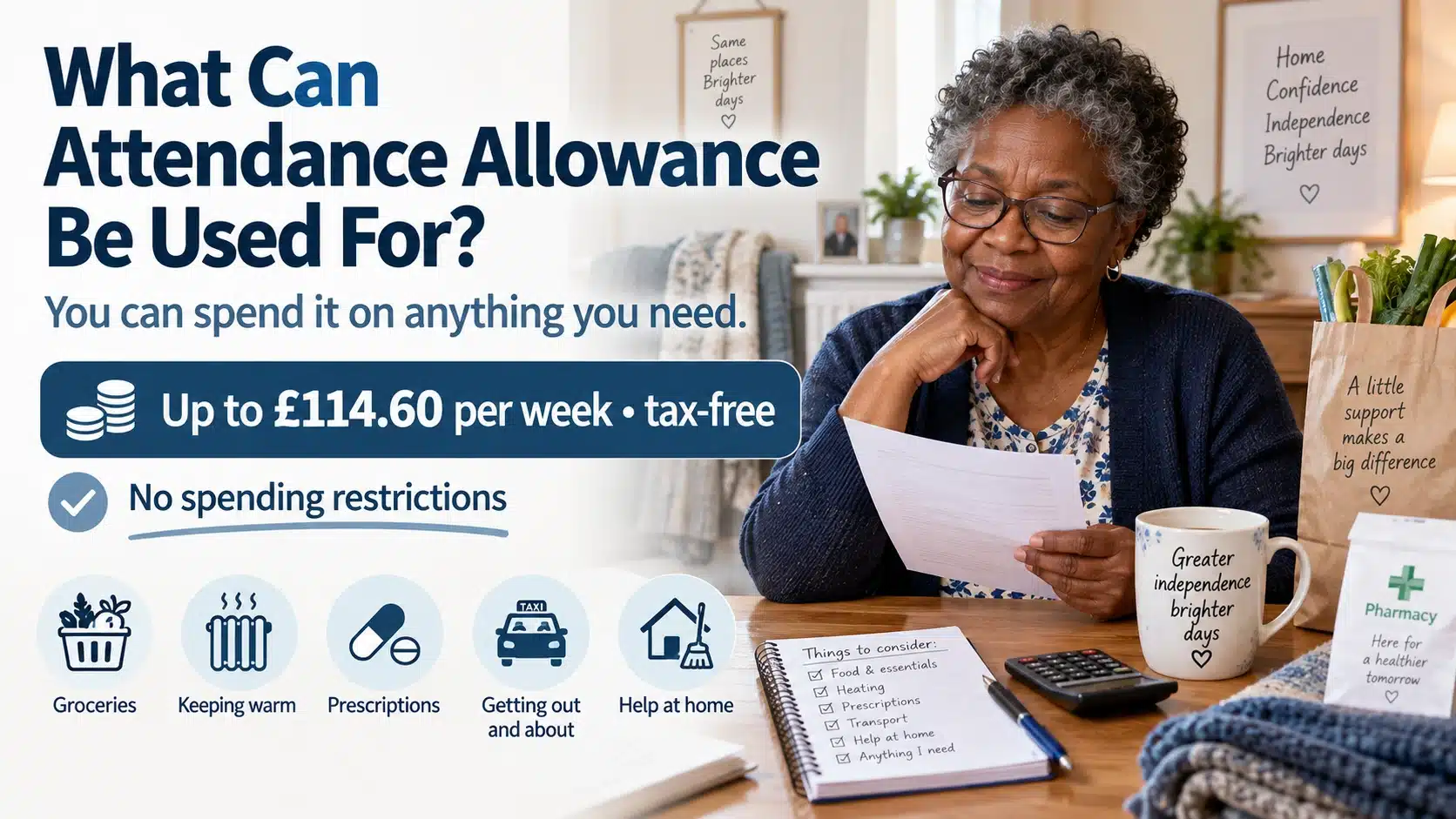
The Short Answer
Attendance Allowance can be used for anything you want. There are no restrictions, no receipts to keep, and no DWP monitoring of how you spend it. Most pensioners use it for care, household help, heating bills, taxis, or simply to make daily life more comfortable. The higher rate pays £114.60 per week (£497/month) and the lower rate £76.70 per week (£332/month), completely tax-free.
There Are No Rules on How You Spend It
Unlike some benefits that must be spent on specific things, Attendance Allowance comes with zero spending restrictions. The DWP does not:
- Ask what you spend it on
- Require receipts or proof of expenditure
- Monitor your bank account
- Require you to use it for care
- Reduce it if you save rather than spend it
Once the money is in your account, it is yours to use however you see fit. This is because Attendance Allowance is a contribution towards the extra costs that come with having a long-term health condition — and those costs look different for everyone.
This money is completely tax-free and yours to spend as you choose.How Most Pensioners Use Attendance Allowance
Although there are no rules, most people use their payments in practical ways that make daily life easier. Here are the most common uses:
1. Paying for Care and Household Help
The most common use. This includes:
- A home carer to help with washing, dressing, or meals
- A cleaner for housework you can no longer manage
- A gardener to maintain your outdoor space safely
- Someone to do your shopping or collect prescriptions
- Help with laundry, ironing, or cooking
At the higher rate (£114.60/week), you could afford around 4–5 hours of private home care per week, or a cleaner twice weekly plus a gardener fortnightly.
2. Transport and Getting Out
- Taxis to medical appointments, the supermarket, or social activities
- Dial-a-ride or community transport subscriptions
- Fuel costs if a family member drives you
- A mobility scooter or powered wheelchair (purchase or hire)
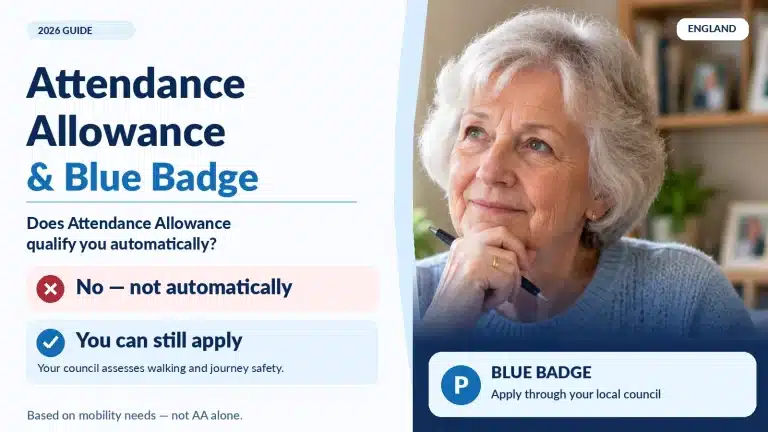
Attendance Allowance does not qualify you for a Blue Badge by itself, but you can still apply if you find walking very difficult, and your local council decides. See Attendance Allowance and Blue Badge.
3. Heating, Utilities, and Home Comfort
- Keeping the heating on for longer (essential with many conditions)
- Higher electricity bills from medical equipment
- Warm clothing, blankets, or electric heaters
- Adapted furniture — reclining chairs, adjustable beds
- Stairlifts, grab rails, or bathroom adaptations
4. Food and Nutrition
- Ready meals or meal delivery services if you cannot cook
- Special dietary food (diabetes, coeliac, etc.)
- Eating out or takeaways when cooking is impossible
- Nutritional supplements recommended by your doctor
5. Social Activities and Mental Wellbeing
- Day centre or lunch club fees
- Hobbies, classes, or group activities
- Internet and phone bills to stay connected
- Treats and outings that improve quality of life
Isolation is one of the biggest risks for older people with health conditions. Using Attendance Allowance to stay socially active is a perfectly valid and important use.
6. Saving It
You can save your Attendance Allowance if you want to. Some people build up savings for:
- A large one-off purchase (stairlift, mobility scooter)
- Future care costs
- Emergency expenses
- Funeral planning
Saving Attendance Allowance does not affect your entitlement. The DWP does not reduce or stop your payments based on how much you have saved. However, if you also claim means-tested benefits like Pension Credit, your total savings can affect those separately.
How Much Do You Actually Receive?
| Rate | Per Week | Per Month (approx.) | Per Year |
|---|---|---|---|
| Higher rate | £114.60 | £497 | £5,959.20 |
| Lower rate | £76.70 | £332 | £3,988.40 |
You receive the higher rate if you need help or supervision both during the day and at night. The lower rate is for people who need help either during the day or at night (but not both). For the full rate breakdown, see Attendance Allowance rates 2026/27.
It Also Unlocks Extra Benefits
Receiving Attendance Allowance is valuable on its own, but it also acts as a gateway to additional support:
| Benefit | What It Means |
|---|---|
| Pension Credit top-up | Severe Disability Addition of £82.90/week if you live alone and receive AA |
| Council Tax Reduction | Discount of up to 100% on your council tax bill |
| Carer’s Allowance | Your carer may get £81.90/week if they look after you 35+ hours |
| Disabled Persons Railcard | A third off rail fares for you and one adult companion |
| NHS exemptions | Free prescriptions, dental treatment, eye tests (via Pension Credit) |
Combined, a successful higher-rate claim can bring in over £10,000 per year in total household benefits. See our guide on Attendance Allowance and Pension Credit.
Common Misconceptions
“I thought you had to use it for care”
No. The name “Attendance Allowance” makes people think it must be spent on an attendant or carer. It doesn’t. It’s a payment towards extra costs caused by disability — whatever form those costs take.
“I’d feel guilty spending it on myself”
You shouldn’t. This is money you are legally entitled to because your health condition creates extra costs. A taxi to the shops, keeping the heating on, or a meal delivery service are all legitimate and important uses that maintain your independence.
“The DWP will check my bank statements”
They won’t. Attendance Allowance is not means-tested. The DWP does not look at your bank account, savings, income, or spending. Your financial circumstances are completely irrelevant to your entitlement.
Not Yet Claiming?
If you are over State Pension age (66) and have any health condition that affects daily life, you may be entitled to up to £5,959.20 per year — tax-free, with no spending restrictions.
Around 800,000 eligible pensioners do not claim. Many assume they “aren’t bad enough” or that their savings disqualify them. Neither is true.
At Attendance Allowance Services, our HCPC-registered Occupational Therapists assess your care needs and complete the form with the clinical detail the DWP requires. Our success rate is 99% across 5,000+ claims. There is no fee unless your claim succeeds.
Up to £114.60/week — yours to spend however you choose
Free eligibility check. Takes 2 minutes. No obligation.
Check Your Eligibility — Free →
Or call 0208 081 4500
Frequently Asked Questions
Can I spend Attendance Allowance on anything I want?
Yes. There are absolutely no restrictions. You can spend it on care, heating, transport, food, social activities, household help, or anything else. You can also save it. The DWP does not monitor how you spend it.
Does the DWP check how I spend Attendance Allowance?
No. Attendance Allowance is not means-tested. The DWP does not look at your bank account, spending, or savings. Once the money is paid to you, it is yours.
Can I use Attendance Allowance to pay a family member who cares for me?
Yes. Many people use their AA to contribute towards costs borne by family carers. Additionally, if a family member provides 35+ hours of care per week, they may be able to claim Carer’s Allowance (£81.90/week) on top of your AA.
Will saving my Attendance Allowance affect my other benefits?
Saving Attendance Allowance will not affect your AA entitlement — it cannot be stopped or reduced based on savings. However, if you also claim means-tested benefits like Pension Credit, your total savings (from all sources) can affect those. The threshold is typically £10,000.
Can Attendance Allowance be used to pay for a care home?
Yes, if you are self-funding your care home place, AA continues to be paid and you can use it towards care home fees. If the local authority funds your place, AA stops after 28 days.
Is Attendance Allowance the same as PIP?
No. Attendance Allowance is for people over State Pension age (66+). PIP is for people aged 16 to State Pension age. You cannot claim both. For more, see Attendance Allowance vs PIP.