
Quick Answer
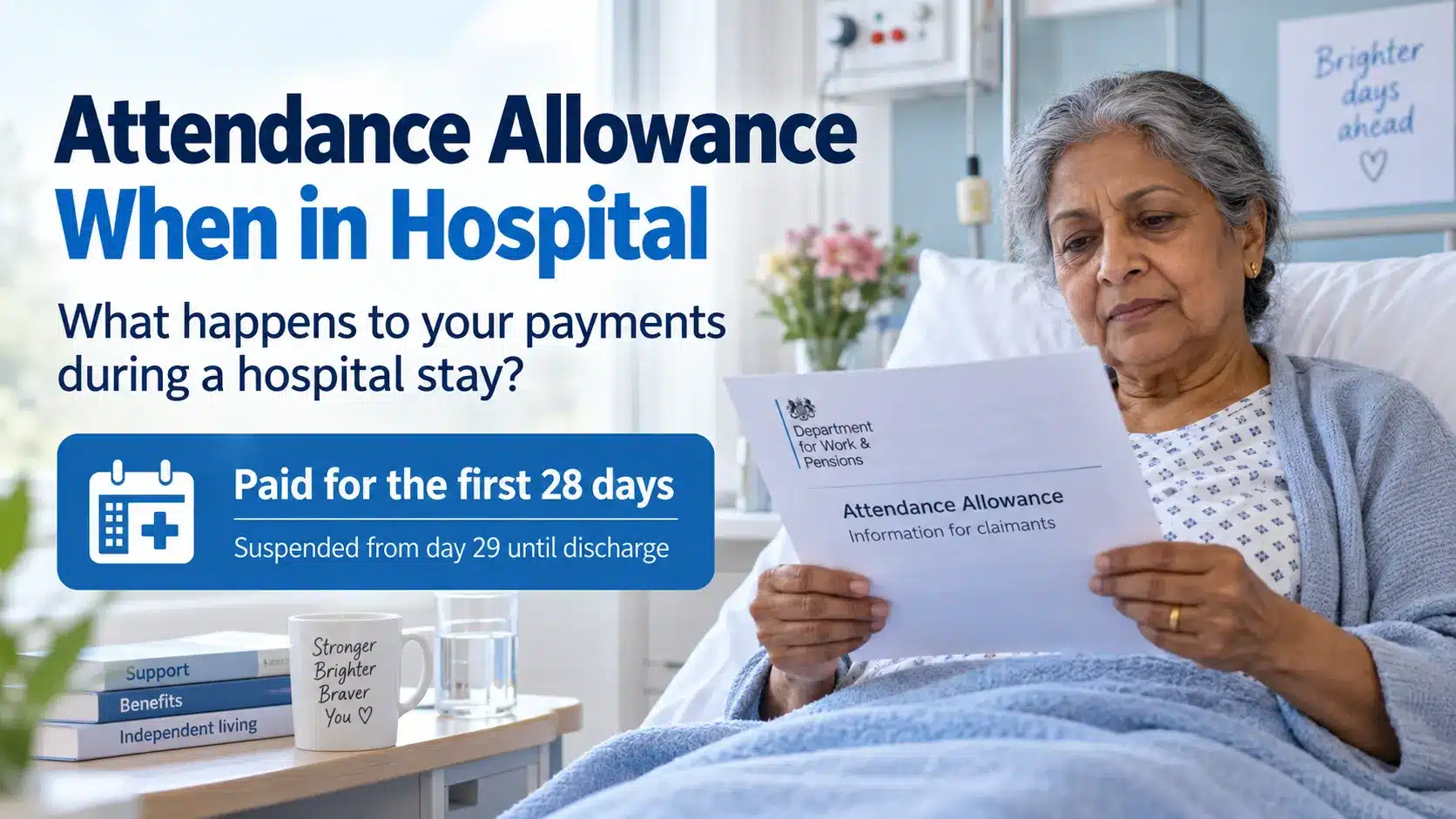
If you go into hospital, your Attendance Allowance continues to be paid for the first 28 days. After 28 days as an inpatient, payments are suspended (not cancelled). They restart automatically when you are discharged. You must tell the Attendance Allowance helpline within the first week: 0800 731 0122. Day patients and outpatient visits have no effect on your payments.
The 28-Day Rule Explained
The DWP operates a simple rule for Attendance Allowance and hospital stays:
| Situation | What Happens to AA |
|---|---|
| Hospital stay of 28 days or fewer | Paid in full — no change |
| Hospital stay of more than 28 days | Suspended from day 29 (restarts on discharge) |
| Day patient or outpatient appointment | No effect — payments continue normally |
| Respite care (local authority funded) | Suspended after 28 days (same rule as hospital) |
| Private care home (self-funded) | Paid in full — no time limit |
The 28 days are counted from the day after admission. The day you are admitted and the day you are discharged do not count.
How the 28 Days Are Counted
The counting rules can work in your favour or against you depending on the pattern of admissions:
Linking rule: Two stays less than 28 days apart
If you leave hospital and are readmitted within 28 days, the DWP links the two stays together. This means the days from both admissions are added up towards the 28-day limit.
Example: You are in hospital for 10 days, discharged, then readmitted 2 weeks later for 20 days. The DWP counts this as 30 days total (10 + 20), so your AA would be suspended from what would have been day 29.
Fresh start: Two stays more than 28 days apart
If there is a gap of 29 days or more between hospital stays, the count resets. Each admission gets its own fresh 28-day period.
Example: You are in hospital for 14 days, discharged, then readmitted 6 weeks later for 14 days. Each stay is counted separately — your AA continues throughout both.
What You Must Do: Tell the DWP
You are legally required to report a hospital stay to the DWP. This applies whether you think you will be in for 2 days or 2 months.
How to report:
- Phone: Attendance Allowance helpline — 0800 731 0122
- When: As soon as possible, ideally within the first week
- What they need: Your National Insurance number, the hospital name, and your admission date
Important: If you do not report your hospital stay and the DWP later discovers it, they may ask you to repay any overpayment. It is always better to report immediately — even if you expect to be discharged within 28 days.
What Happens When You Leave Hospital?
If your AA was suspended because you exceeded 28 days:
- Call the helpline (0800 731 0122) on the day you are discharged
- Payments restart from the day after discharge
- There is no need to make a new claim or submit a new form
- The rate stays the same (higher or lower) as before admission
If your condition has worsened during the hospital stay — for example, you were on the lower rate but now need care day and night — you can request a supersession to move to the higher rate (£114.60/week instead of £76.70/week). This is worth an extra £1,970.80 per year.
Care Homes vs Hospitals: Different Rules
The hospital rules are often confused with care home rules. Here is the key distinction:
| Living Situation | Attendance Allowance |
|---|---|
| Living at home | Paid — no restrictions |
| Care home — self-funded | Paid — no restrictions |
| Care home — local authority funded | Stopped after 28 days |
| NHS hospital inpatient | Suspended after 28 days (restarts on discharge) |
The key difference: if you pay for your own care home place, AA continues indefinitely. If the local authority pays, the 28-day rule applies just like a hospital stay.
If you move into a care home permanently, the rules differ depending on whether you fund the place yourself or the local authority pays – see the section above for details.
Does a Hospital Stay Affect Your Carer’s Benefits?
If someone receives Carer’s Allowance because they look after you, their payments are also affected:
- Carer’s Allowance continues for the same 28-day period as your AA
- If your AA is suspended after 28 days, their Carer’s Allowance stops too
- Both restart when you are discharged
Your carer should also report your hospital stay to the Carer’s Allowance Unit.
Planning Ahead: Don’t Let a Hospital Stay Catch You Off Guard
If you are not yet claiming Attendance Allowance, a hospital stay is actually one of the most common triggers that prompts people to apply. Many people first think about their care needs when recovering from an operation, a fall, or an illness that required hospitalisation.
If your hospital stay has highlighted that you now need regular help with daily tasks — washing, dressing, preparing meals, taking medication, or staying safe — you likely qualify for Attendance Allowance.
Apply before your next admission
If you qualify, having AA in place means you’re protected and receiving payments from day one of any future hospital stay. Don’t wait until it’s too late.
Check Your Eligibility — Free, 2 Minutes →
Or call 0208 081 4500 to speak to our team
Frequently Asked Questions
Do I still get Attendance Allowance if I go into hospital?
Yes — for the first 28 days. After 28 consecutive days as an inpatient, payments are suspended until you are discharged. Day patient visits and outpatient appointments have no effect on your payments.
Do I need to tell the DWP if I go into hospital?
Yes. Call the Attendance Allowance helpline on 0800 731 0122 as soon as possible after admission. Give them your NI number, the hospital name, and your admission date.
What happens when I leave hospital?
Call the helpline on the day of discharge. If your AA was suspended, it restarts from the day after you leave. There is no need to reapply or fill in a new form.
Does the 28-day clock reset between hospital stays?
Only if there is a gap of 29+ days between stays. If you are readmitted within 28 days of a previous discharge, the DWP links the stays and counts them as one continuous period.
Can I still apply for Attendance Allowance while in hospital?
You can submit the form while in hospital, but the claim cannot be processed until you are discharged. It is better to apply once home. The exception is the terminal illness (special rules) route, which can be processed immediately.
What about hospice stays?
Hospice stays are treated the same as hospital stays — the 28-day rule applies. However, most hospice patients qualify under special rules for terminal illness, where AA is awarded at the higher rate without a waiting period.