The Hard Truth
Around 60% of self-completed Attendance Allowance claims are rejected — not because the applicant does not qualify, but because of avoidable mistakes in how the form is completed. The same pitfalls appear again and again. This guide shows you exactly what they are so you can avoid them — or, better still, let an HCPC-registered Occupational Therapist handle your application. Call 0208 081 4500 or check your eligibility free.
Patients with cancer face unique pitfalls – see our cancer guide
Pitfall #1: Describing Your Diagnosis Instead of Your Daily Life
This is the single most common reason claims fail. The DWP does not award Attendance Allowance based on what condition you have. They award it based on what you struggle to do.
What goes wrong: People write things like “I have arthritis in both knees” or “I was diagnosed with COPD in 2019.” These are medical facts, but they tell the DWP nothing about what help you need.
What the DWP needs: To explain your functional difficulties in as much detail as you can.
Every answer should describe what happens, how long it takes, what makes it worse, and the difficulties you experience with each task.
Pitfall #2: Only Mentioning Your Worst Days
The form asks about your typical needs — not just your worst days, but also not just your best days. Many people either:
- Minimise their difficulties (British stoicism — “I manage”)
- Only describe crisis days that happen infrequently
The correct approach: Describe what a typical bad day looks like (the kind that happens at least 2–3 times per week). If you need help with something most days, that counts — even if you occasionally manage alone.
Pitfall #3: Forgetting Night-Time Needs
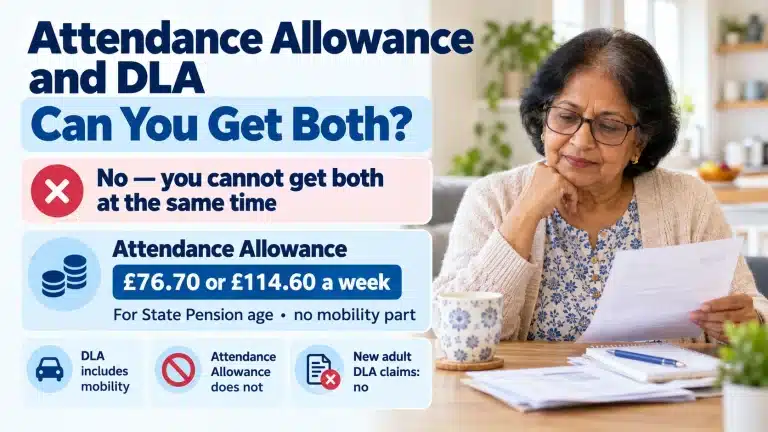
The difference between the lower rate (£76.70/week) and the higher rate (£114.60/week) often comes down to night-time care needs. Many people forget to mention:
- Getting up to use the toilet. The difficulties that arise or needing help/supervision
- Needing the bed position pillow adjusted
- Being at risk of falling if getting up in the dark
- Needing medication during the night
- Experiencing confusion, anxiety, or wandering at night (common with dementia)
- Needing someone to check on them
If you need any form of help or supervision during the night — even if it’s just someone being awake or nearby — mention it. This is worth an extra £1,970.80 per year.
Pitfall #4: Not Explaining What Could Happen Without Help
The DWP assesses what help you reasonably need, not just what you currently receive. If you live alone and have no carer, many people write “I do everything myself.” This reads as “I don’t need help.”
What you should say: Explain what would happen if you struggled with certain tasks. For example:
- “If I tried to carry a hot pan from the cooker, I would likely drop it because my grip fails without warning”
- “If nobody reminded me, I would miss my medication 3–4 times per week”
- “I have fallen twice in the last month getting out of the shower”
Risk and supervision needs count just as much as physical assistance.
Pitfall #5: Leaving Questions Blank or Writing “N/A”
Every blank answer is a missed opportunity to demonstrate your care needs. The DWP cannot infer anything from silence — they can only score what you explicitly state.
Common sections people skip:
- Communication difficulties (“I can still talk”) — but can you use a phone, remember conversations, follow complex information?
- Social and leisure (“I don’t go out much”) — but why don’t you go out? What stops you?
- Supervision needs (“I don’t have a carer”) — but do you need someone to keep you safe?
If a question does not apply, explain briefly why rather than just writing N/A. “I no longer cook because I burned myself twice and now my daughter prepares all my meals” is far more informative than leaving the cooking section blank.
Errors on the form are the biggest cause of delays. See our processing times guide for what to expect and how to avoid holdups.
Pitfall #6: Not Providing Supporting Evidence
The AA1 form does not technically require medical evidence, but claims without supporting documentation have significantly lower success rates. The DWP may contact your GP — but they only ask a standard set of questions that may not capture your daily needs.
Evidence that strengthens claims:
- Letter from your GP describing your functional limitations
- Occupational Therapist assessment report
- Hospital discharge summaries
- Community nurse or district nurse notes
- Consultant letters
- Care plan from social services
Our OTs provide a professional functional assessment that accompanies your form — this is one of the main reasons for our 99% success rate.
Pitfall #7: Applying Too Early (Before 6 Months)
To qualify for Attendance Allowance, you must have needed help for at least 6 months (unless terminally ill under special rules). Some people apply as soon as they are diagnosed and are automatically refused.
The exception: If you are not expected to live more than 12 months, the special rules route removes the 6-month waiting period entirely. Claims are fast-tracked and awarded at the higher rate automatically. Ask your GP or consultant about an SR1/DS1500 form.
Tip: The 6-month clock starts from when you first needed help, not when you were diagnosed. If you needed a walking stick for 2 years before your arthritis was formally diagnosed, the 6 months are already served.
If you have just stopped receiving PIP, you may already have met this period; see our guide on PIP and pension age for when to apply.Pitfall #8: Using Vague Language
The DWP decision makers process hundreds of forms. Vague language gets overlooked. Specific language gets awarded.
| Vague (likely refused) | Specific (likely awarded) |
|---|---|
| “I find it hard to walk” | “I can walk about 20 metres before needing to stop. I use a walking frame indoors and a wheelchair for anything over 50 metres” |
| “I need help with washing” | “I cannot get in or out of the bath. I use a shower stool and my husband washes my back and legs because I cannot reach below my knees” |
| “I forget things” | “I forgot to turn off the hob 3 times last month. My daughter now checks on me twice daily and has put a timer on the cooker” |
| “I have pain” | “The pain in my hips wakes me 2–3 times per night. I need to take codeine at 2am and it takes 40 minutes to settle enough to sleep” |
Pitfall #9: Not Claiming Because “Others Are Worse Off”
This is the most expensive pitfall of all — it costs you £5,959 per year in unclaimed benefit.
Attendance Allowance is not reserved for people in the most severe circumstances. It is designed for anyone over State Pension age who needs regular help with personal care or supervision due to a health condition. You do not need to be housebound, have a formal carer, or be in constant pain.
If you experience difficulty, need help with any of the following, you likely qualify:
- Getting washed or dressed
- Preparing meals safely
- Taking medication reliably
- Getting in/out of bed or chairs
- Using the toilet
- Avoiding falls or accidents
- Leaving the house safely
- if you have a managed condition like diabetes , the pitfall is understating its impact
Read more: What stops you from getting Attendance Allowance?
Avoid every pitfall. Get it right first time.
Our HCPC-registered Occupational Therapists complete your form with the clinical detail the DWP requires. 99% success rate across 5,000+ claims. No fee unless successful.
Check Your Eligibility — Free, 2 Minutes →
Or call 0208 081 4500
Frequently Asked Questions
What is the biggest reason Attendance Allowance claims are refused?
The most common reason is describing your medical condition instead of how it affects your daily life. The DWP awards based on care needs, not diagnosis. Around 60% of self-completed forms are rejected for this reason.
Can I reapply if my Attendance Allowance claim is rejected?
Yes. You can request a Mandatory Reconsideration within one month of the decision, or make a completely new claim at any time with additional evidence. Many people succeed on their second attempt with professional support. See what to do if your claim is rejected.
Should I get help filling in the form?
Given the 60% rejection rate for self-completed forms, professional support significantly improves your chances. An HCPC-registered Occupational Therapist understands exactly what the DWP looks for and can articulate your care needs in clinical language. Our success rate is 99%.
How many pages is the Attendance Allowance form?
The AA1 form is 32 pages in England and Wales (88 pages in Scotland for PADP). Not every section applies to everyone, but most questions require detailed, specific answers. See our full guide to the Attendance Allowance form (AA1).
What if my condition varies from day to day?
Describe your typical bad days — the kind that happen at least 2–3 times per week. Variable conditions (like arthritis, MS, COPD) are well recognised by the DWP.
Many people don’t apply because they wrongly believe AA is means-tested – see our guide