The Short Answer
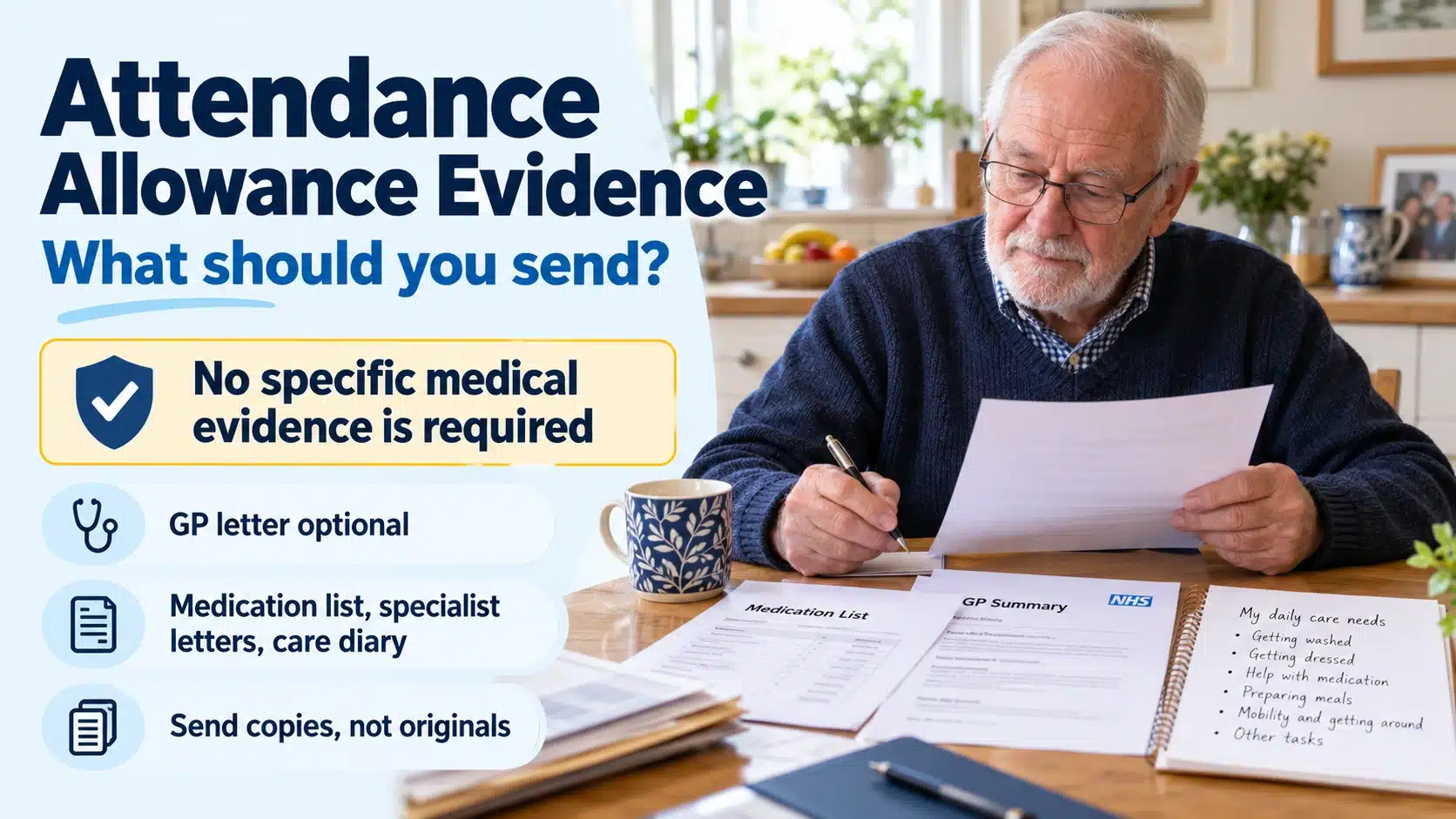
You do not have to send any specific medical evidence with an Attendance Allowance claim. Age UK’s factsheet says so directly, and adds that if you have a patient summary from your GP or letters from specialists, you can enclose them. What matters most is that the form explains, in your own words, what help you need, how often and why.
Useful extras are a printed medication list, hospital or specialist letters, a care plan if you have one, a short diary of your needs, and the optional statement from someone who knows you. Send copies, not originals. If you came here looking for proof that you already get Attendance Allowance, skip to the proof section.
Checked in October 2026 against GOV.UK, the official AA1 claim form and notes, Age UK Factsheet 34 and Citizens Advice. This guide covers England and Wales.
What Evidence Is Most Important?
The strongest applications show how a health condition affects daily life, not just what the diagnosis is. Citizens Advice says the DWP will be looking for three things: what difficulties you have or how much help you need, how often you have difficulties or need help, and what sort of help you need.
That means the evidence that counts most is about:
- Personal care needs, such as getting in and out of bed, washing, dressing, eating and using the toilet
- Supervision, where someone needs to be nearby to keep you safe
- Safety risks, such as falls, blackouts or leaving the cooker on
- How often you need help, by day and by night
Citizens Advice also makes two points that are easy to miss. The person making the decision is not a medical expert, so do not assume they will understand how your condition affects you. And you do not need a formal diagnosis: you can claim while tests are still going on, as long as you have needed help or supervision, or had difficulties, for 6 months because of your condition.
New to Attendance Allowance? Start with our beginner’s guide to what Attendance Allowance is and who can claim it.
Types of Helpful Evidence
None of these is compulsory. Use what you already have, and do not delay your claim to collect more.
| Evidence | What it shows | Where to get it and what to know |
|---|---|---|
| Printed medication list | Your conditions, treatments and doses | Ask your pharmacy or surgery. The form lets you attach a printed prescription list instead of writing out each medicine, but it still asks you to list each illness |
| GP patient summary | A record of your conditions, treatments and consultations | Ask your GP surgery. Age UK suggests enclosing one if you have it |
| Hospital or specialist letters | Diagnosis, treatment and what is expected to happen next | You may already have copies from appointments. Send copies, because the form says the DWP cannot return them |
| Care plan or assessment report | Help you already receive or have been assessed as needing | From your council, an Occupational Therapist or another professional. Question 21 of the form asks for copies |
| Care diary | How often you need help, how long it takes and what makes it hard, day and night | You write it. Citizens Advice suggests at least a week and says you can send it with a posted form |
| Statement from someone who knows you | How your condition affects you, from someone who sees it | Questions 55 to 62 of the form. Optional, but Citizens Advice says it is best to have it completed |
| Certificate of vision impairment | Sight loss, if it applies to you | The form lists it as an example of a document to send at question 65 |
On the statement from someone who knows you, Citizens Advice says a healthcare professional you have seen recently, such as a doctor, consultant or specialist nurse, is the best choice. If that is not possible, a friend, relative or carer can do it. Age UK adds that it helps if the person knows a little about the rules, so they can include the most relevant information. Our guide to how to fill in the Attendance Allowance form explains who is best placed to complete it.
Do I Need a Letter From My GP?
No. There is no specific medical evidence you have to send. Question 20 of the form lets the DWP contact your GP, or the other people you list, if it needs more information, and the form points out that your GP gives medical facts and does not decide whether you get Attendance Allowance.
If you would like a letter anyway, ask the surgery before you rely on it. The BMA says NHS GPs are not obliged to provide letters of support or reports for benefit claims, and not obliged to provide them free of charge. Some surgeries charge a fee and some decline. BMA guidance tells GPs to explain to patients that a refusal will not affect the outcome of the claim, so a “no” from your surgery is not a mark against you.
Copies of your own records are a different matter. Lancashire County Council’s welfare rights service says you can ask your GP practice for a copy of your medical record and medication list free of charge, and that a separate supporting letter may cost money. If a GP does write a letter, the same service says it should cover your medical conditions, the treatment or care you receive and, above all, how the conditions affect you day to day.
Keep a Care Diary
A diary costs nothing and records things a medical letter rarely does: how often you need help, how long it takes, and what is different at night. The DWP notes suggest writing down what you needed help with over one or two days. Citizens Advice suggests at least a week, has a free diary template, and says that if you apply by post you can send the diary with the form. Include good days and bad days, and how many of each you have in an average week.
Help with personal tasks does not mean housework or gardening. It means things like getting in or out of bed, washing, dressing, going to the toilet, eating, taking medication, or being reminded or encouraged to do these things. Here is a made-up example of the level of detail that helps. Write your own days, in your own words.
| Time | What I needed help with | How long | What made it hard |
|---|---|---|---|
| 2.45am | Getting up to use the toilet | 10 minutes | Unsteady in the dark. My husband helped me there and back |
| 7.30am | Washing and dressing | 40 minutes | Breathless, so I had to sit down halfway. My daughter helped with my back and legs |
| 1.00pm | Remembering my tablets | 5 minutes | I could not remember if I had taken them. My husband checked the box |
Do not forget the night. If you need help or watching over at night, those answers can matter more than anything else on the form. Our guide to Attendance Allowance and night-time care explains what the DWP is looking for.
Practical Examples: Describe the Effect, Not Just the Condition
These examples are made up to show the difference. They are not a template. Your answers need to describe your own situation.
Washing.
Weaker: “I have arthritis.”
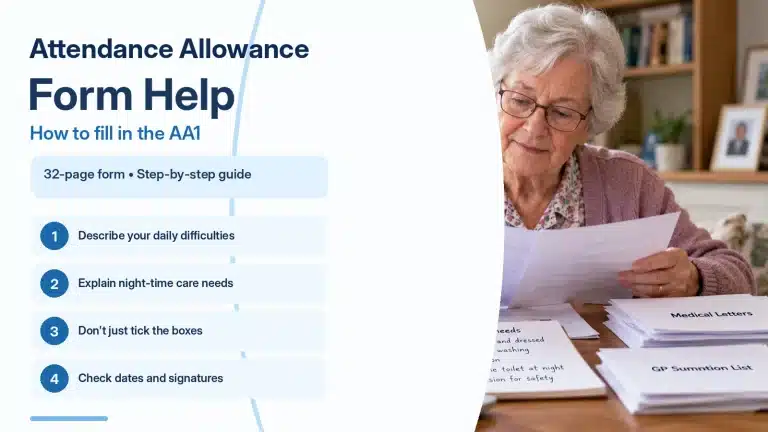
Stronger: Describe the exact difficulties you have, breaking down each component of the task, ensuring you inform the DWP of every element of difficulty you have performing this task and the help you need (if any)
Supervision.
Weaker: “My memory is not what it was.”
Stronger: “I forget whether I have taken my tablets, and twice this month I have left the cooker on. My husband reminds me to take them morning and evening and checks the cooker is off before we go to bed.”
Detail is critical, and it is fine to repeat yourself. If the same problem affects several tasks, write it in each answer. For examples written around particular conditions, see our guides to Attendance Allowance for arthritis, dementia and COPD.
What Happens to Your Evidence
- The DWP may contact your GP or the other people you named. That is what the consent at question 20 allows. The form says that if you do not agree, the DWP may be unable to check that you qualify
- You will only need an assessment if it is unclear how your condition affects you. GOV.UK says that if you do, you will get a letter saying why and where to go, and a medical professional will need to examine you. Age UK says a medical examination is not normally necessary
- Send copies, not originals. The form says to send copies because the DWP cannot return them
- Label every extra page. Age UK says to write your name and National Insurance number on each extra sheet and attach it securely to the rest of the claim
- Keep a copy of everything you send. Citizens Advice suggests this in case you need to refer to it later, and recommends taking a screenshot or photo of each page if you apply online
If You Are Still Waiting for a Letter
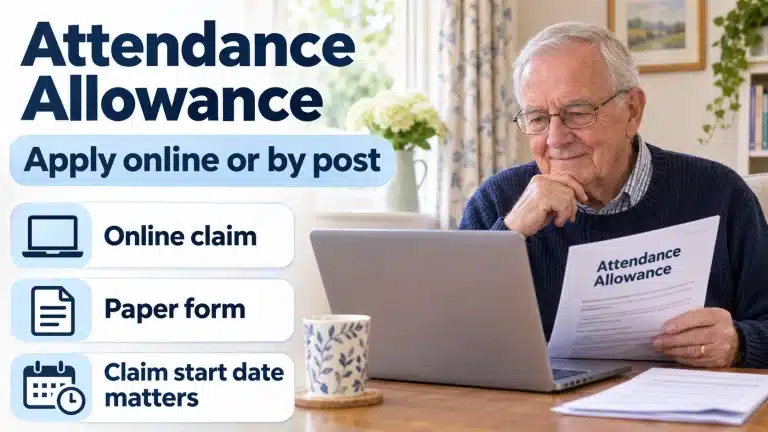
Do not hold your claim back while you wait. Your claim start date, and so your back pay, depends on when you apply. GOV.UK says that if you apply online, your claim starts on the date you make it. If you post a printed form, it starts on the date the DWP receives it. If you phone for a form, it starts on the date of your call, as long as you return the form within 6 weeks.
Citizens Advice says that if you are waiting for something like a letter from your doctor, you should still send the form on time, with a note saying you will send more evidence and roughly when. If you applied online, you can still post evidence afterwards. Our Attendance Allowance form guide has the posting details, and our guide to Attendance Allowance back pay explains how backdating works.
Looking for Proof That You Already Get Attendance Allowance?
If you came here for proof of an award rather than evidence for a claim, the route is different. GOV.UK has an online service, Get proof of your benefits and State Pension, that covers Attendance Allowance. You sign in with a GOV.UK One Login (you may be asked to prove your identity), then download a proof file or ask for it by post, which GOV.UK says can take up to a week to arrive.
GOV.UK says you cannot use the online service if you are an appointee or manage someone else’s benefits, or if you live outside the UK. In those cases, contact the Attendance Allowance helpline at the Disability Service Centre; the details are on GOV.UK.
Your decision letter also shows your rate and how long the award lasts, so keep it with your important papers. You may be asked for proof when you claim something that depends on getting Attendance Allowance. GOV.UK says you could get extra Pension Credit, Housing Benefit or Council Tax Reduction if you get it. Our guides explain how Attendance Allowance and Pension Credit work together and how it affects your Council Tax.
Common Mistakes With Evidence
Almost every item here comes from the form itself or from Citizens Advice and Age UK. To see how these mistakes play out when a claim is refused, read our guide to Attendance Allowance pitfalls and our clinical perspective on why applications are rejected.
- Relying on the diagnosis. “I have COPD” tells the decision maker very little about the help you need. Say what you cannot do safely and what happens without help
- Forgetting the night. Help or watching over at night is easy to leave out because it feels normal
- Not saying how often or how long. “I need help in the bathroom” says much less than “four times a day, about 10 minutes each time”
- Describing only a good day. The DWP notes say disabilities affect people more on some days than others, and ask how yours varies
- Sending originals. The DWP cannot return documents, so send copies
- Extra pages with no name or National Insurance number. Pages can become separated from the form
- Waiting for a letter before applying. You can lose weeks of back pay. Apply, and send the letter on when it arrives
- Assuming a GP letter is required, or that a GP saying no counts against you. Neither is true
How Attendance Allowance Services Can Help
Attendance Allowance Services is independent and is not part of the DWP. Our registered clinicians:
- Speak with you in a free eligibility call, with no obligation
- Identify the care and supervision needs that could qualify
- Describe how your condition limits your day-to-day life
- Complete a professionally endorsed application, which we post by 1st Class Royal Mail within 4 days for you to approve, sign and submit to the DWP
There is no fee unless the application is successful, and any fee is collected after you receive the backdated payment. Family members and carers are welcome to take part in the call.
Not sure what to include? Talk it through with an Occupational Therapist
Free eligibility check, no obligation, and no fee unless the application is successful.
Or call us on 0208 081 4500 (Monday to Friday, 9am to 5pm)
Ready to apply? Our step-by-step guide explains how to apply for Attendance Allowance.
Frequently Asked Questions
What evidence do I need for an Attendance Allowance application?
None is compulsory. Age UK says you do not have to send any specific medical evidence. The form asks about your conditions, your medication, the professionals you see and how your needs affect you by day and by night. You can add copies of a patient summary, specialist letters, a medication list, a care plan or a diary if you have them.
Do I need a GP letter for Attendance Allowance?
No. A GP letter is not required, and NHS GPs are not obliged to write letters of support for benefit claims or to do so free of charge, according to the BMA. If you give consent at question 20 of the form, the DWP can ask your GP for information itself.
Do I need a formal diagnosis to claim Attendance Allowance?
No. Citizens Advice says you can claim while tests and appointments are still going on, as long as you have needed help or supervision, or had difficulties, for 6 months because of your condition. The test is the help you need, not the name of the condition.
Will the DWP contact my GP?
It may. If you give consent at question 20, the DWP can contact your GP or the other people you named to ask for more information. Age UK says the DWP may also arrange for a healthcare professional to visit you. Neither happens on every claim.
Will I have to attend a medical assessment?
Not usually. GOV.UK says you will only need an assessment if it is unclear how your condition affects you. If you do, you will get a letter saying why and where to go, and a medical professional will need to examine you.
What if my condition varies from day to day?
Describe both good days and bad days, and roughly how many of each you have in an average week. The DWP notes say disabilities can affect people more on one day than another and ask you to explain how yours varies. A diary kept for a week or more makes this much easier to answer accurately.
Can I send evidence after I have applied?
Yes. Citizens Advice says that if you applied online you can still post evidence afterwards. If you are waiting for a letter and applying by post, send the form on time with a note saying more evidence is coming and roughly when. Sending it late can cost you back pay, because your claim start date depends on when you apply.
Do I have to send original documents?
No, and you should not. The form says to send copies because the DWP cannot return them, so keep a copy for yourself too. Write your name and National Insurance number on any extra page you add.
How do I get proof that I receive Attendance Allowance?
Use the GOV.UK service Get proof of your benefits and State Pension, which covers Attendance Allowance. You sign in with a GOV.UK One Login and can download a proof file or ask for it by post. If you are an appointee, or you cannot use the online service, contact the Attendance Allowance helpline at the Disability Service Centre; the details are on GOV.UK.
Can Attendance Allowance Services help with my application?
Yes. A registered Occupational Therapist talks through your day-to-day needs in a free eligibility call and completes the application, which we post by 1st Class Royal Mail within 4 days for you to approve, sign and submit. There is no fee unless it is successful. Tell the Occupational Therapist about any letters, medication lists or diary you already have.