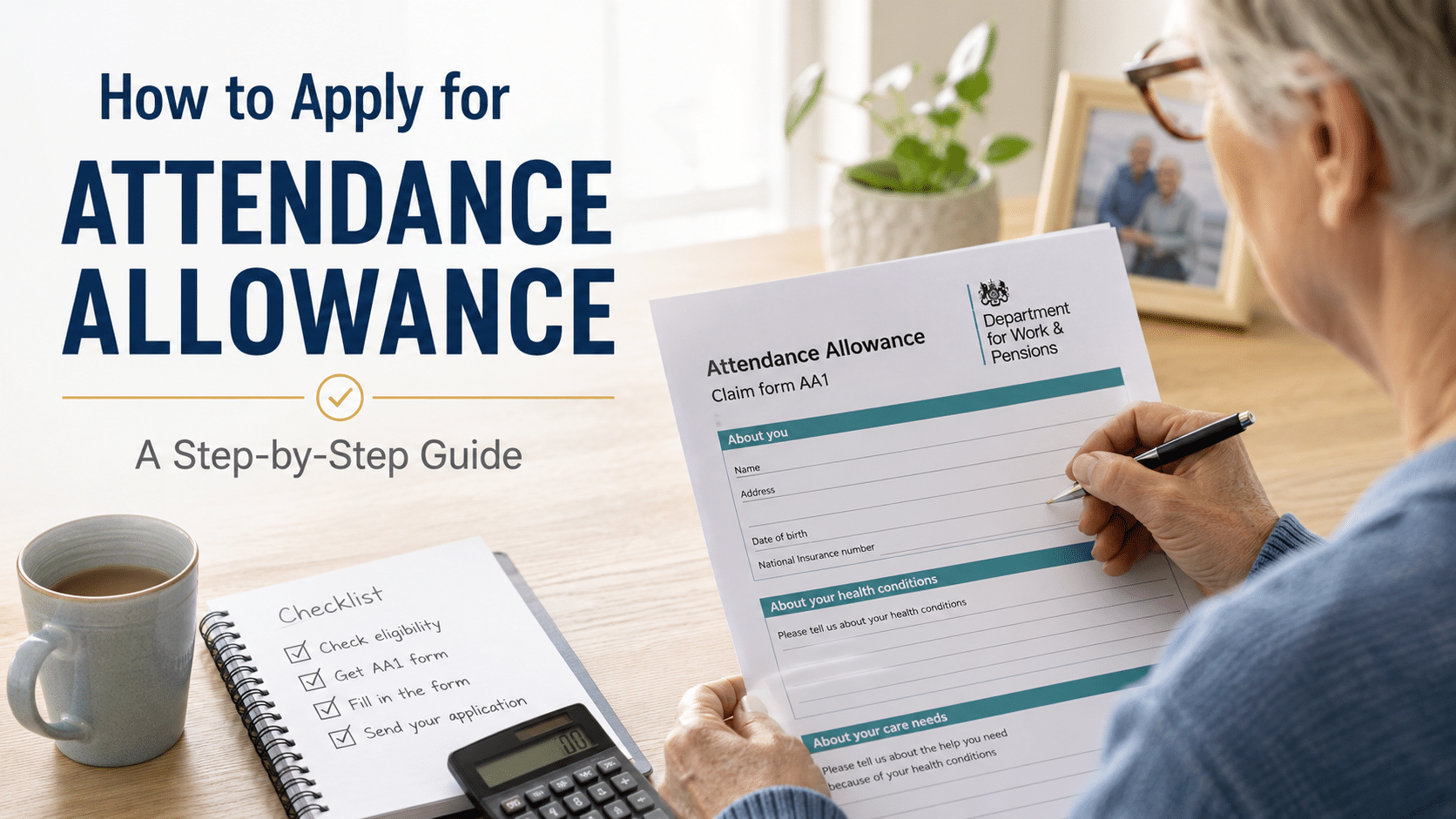
The Reality of DIY Applications
Approximately 64% of Attendance Allowance applications are rejected. Not because claimants are ineligible – but because the 32-page form is deceptively complex and most people do not describe their needs in the way the DWP requires. One wrong answer or missing detail can cost you up to £5,959 per year.
How the Attendance Allowance Application Works
Applying for Attendance Allowance involves completing a 32-page paper form called the AA1. It asks detailed questions about your health conditions and – critically – how those conditions affect your daily life. The DWP uses your answers to decide whether you qualify and at which rate.
Not sure you want to do this alone? Read how we can help you complete the application.On the surface, it sounds straightforward. In practice, it is one of the most commonly failed benefit applications in the UK. Here is why.
Why the Form Is Harder Than It Looks
The AA1 form does not ask “what is your diagnosis?” and award the benefit based on that. It asks you to describe your care needs in a very specific way that maps to their decision criteria. The problem is, those criteria are not obvious to most people.
The DWP is looking for very specific things:
- Frequency – How many times per day or night do you need help? Vague answers like “sometimes” or “when needed” are scored as zero
- Duration – How long does each episode of help take? The threshold for “prolonged” night-time attention is exactly 20 minutes – if you write “15 minutes” you may not meet the criteria
- Consequence – What would happen without help? Without this, the DWP cannot assess risk
- Worst days, not best – Most people instinctively describe their best days. The DWP assesses on your worst days or the majority of days
Most rejections happen not because someone is “not ill enough” but because their form does not present their needs in the language the DWP decision-makers use.
Common Mistakes That Lead to Rejection
After handling thousands of applications, our clinical team sees the same DIY mistakes repeatedly:
- “I need help getting dressed” – Too vague. The DWP needs to know why, how often, how long it takes, and what happens without help
- Focusing on diagnosis, not impact – Writing “I have arthritis” tells them nothing. The DWP wants to know you cannot grip buttons, cannot lift your arms, and cannot dress without 20 minutes of help every morning
- Forgetting night-time needs – This is the single biggest reason people receive the lower rate (£76.70/week) instead of the higher rate (£114.60/week). A difference of nearly £2,000 per year
- Understating for pride – Many elderly people minimise their difficulties. “I manage” or “I cope” on a form means “I don’t need help” to a decision-maker who has never met you
- Leaving sections blank – Blank sections are interpreted as “no problems in this area.” Even if a section feels less relevant, explaining why helps your case
The Difference Between Lower and Higher Rate
| Rate | Per Week | Per Year | Criteria |
|---|---|---|---|
| Lower rate | £76.70 | £3,988 | Care needs during the day or night |
| Higher rate | £114.60 | £5,959 | Care needs during the day and night |
Many people who genuinely need help both day and night receive only the lower rate because their form does not clearly articulate the night-time component. That is £1,971 per year lost because of how the form was filled in – not because of their actual needs.
Why an Occupational Therapist Makes the Difference
An HCPC-registered Occupational Therapist is clinically trained to assess functional limitations. They know exactly what language the DWP responds to, what thresholds matter, and how to present fluctuating conditions accurately.
At Attendance Allowance Services, our OTs:
- Conduct a thorough clinical assessment covering every aspect of daily living and night-time needs
- Identify care needs that families often overlook or minimise (especially supervision and safety risks)
- Complete the entire 32-page form using the precise terminology that maps to DWP decision criteria
- Ensure night-time needs are described to the standard required for the higher rate
- Endorse the application with their professional HCPC registration
The result: our success rate is 99%, compared to approximately 36% for DIY applications. And there is no fee unless you are awarded the benefit.
What If You Have Already Been Rejected?
If you have already applied on your own and been turned down, you are not alone – and it does not mean you are ineligible. It almost certainly means the form did not present your needs strongly enough.
You have the right to challenge the decision through a mandatory reconsideration (within 1 month) and then a tribunal appeal if needed. Our clinical team regularly helps clients who were rejected first time. Read more: Attendance Allowance rejected – what to do next.
Wondering what happens next? See our guide on Attendance Allowance processing times in 2026.
Don’t risk losing £5,959 per year to a form error
Our HCPC-registered Occupational Therapists handle the entire application. No fee unless you’re awarded. Free eligibility check takes 2 minutes.
Frequently Asked Questions
Can I apply for Attendance Allowance myself?
Yes, anyone can request the AA1 form and complete it themselves. However, around 60% of self-completed applications are rejected. The form requires very specific descriptions of care needs – frequency, duration, and consequences – that most people struggle to articulate without professional guidance.
Why do so many Attendance Allowance applications get rejected?
Rejections rarely happen because someone is not unwell enough. They happen because the form does not describe their needs in the way DWP decision-makers require. Common issues include being too vague, understating difficulties, forgetting to describe night-time needs, and not explaining what would happen without help.
How much does it cost to get professional help with my application?
At Attendance Allowance Services, there is no upfront fee. We work on a no-win, no-fee basis – you only pay if your application is successful. This means there is no financial risk to getting professional support.
What is the success rate with professional help vs applying alone?
DIY applications have a success rate of approximately 36%. Applications completed by our HCPC-registered Occupational Therapists have a 99% success rate. The difference comes from clinical expertise in describing care needs in the precise language the DWP requires.