The Short Answer
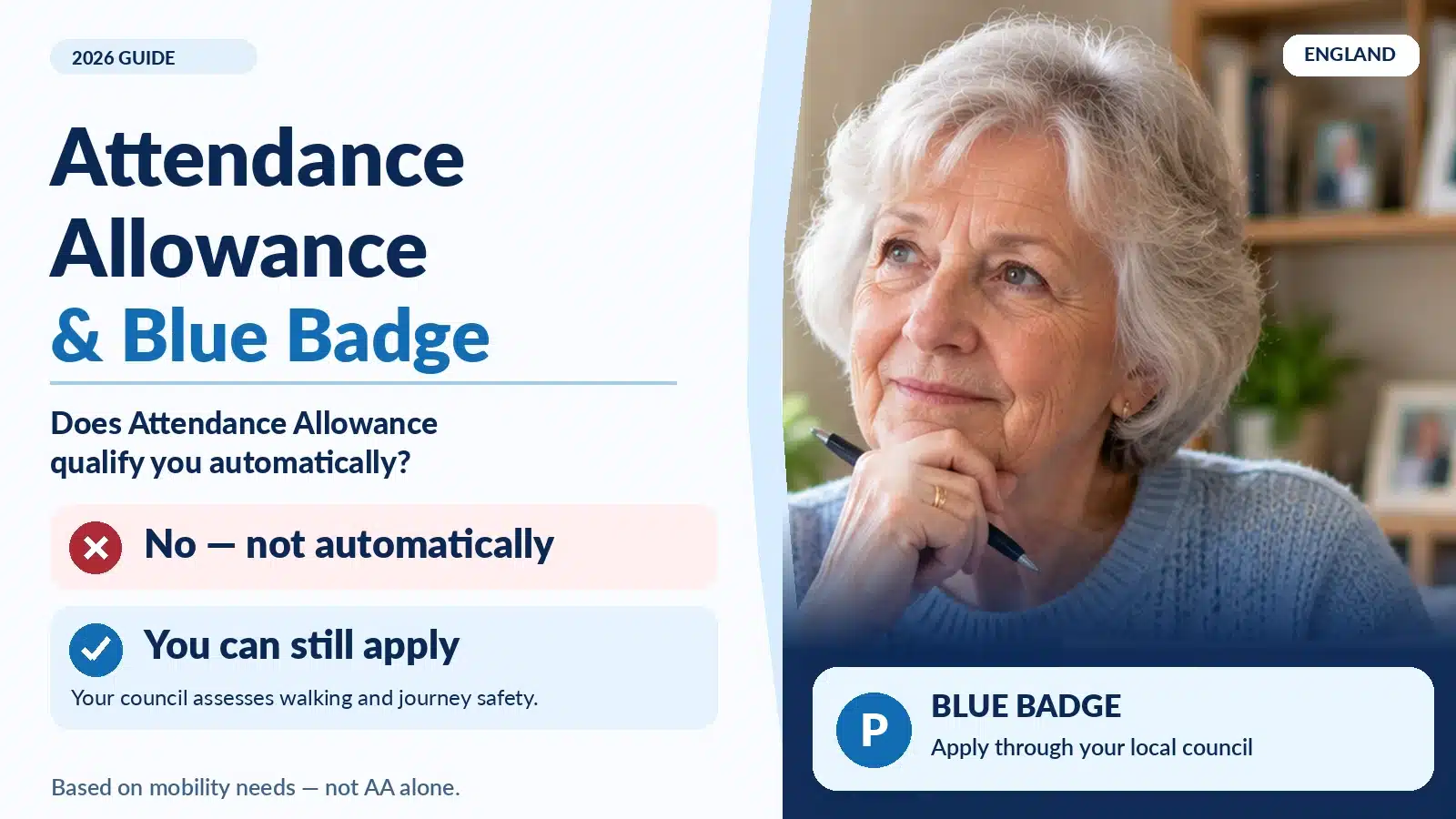
No. Attendance Allowance is not one of the benefits that qualifies you for a Blue Badge. GOV.UK also says plainly that Attendance Allowance “does not cover mobility needs”.
That does not mean you cannot get a badge. Anyone can apply, and your local council decides based on how your condition affects your walking or your ability to make journeys safely. Receiving Attendance Allowance is not one of the criteria the council uses.
Rules checked in October 2026 against GOV.UK, Who can get a Blue Badge?. This guide covers the scheme in England.
Does Attendance Allowance Qualify You for a Blue Badge?
No. GOV.UK lists the benefits that give an automatic right to a Blue Badge, and Attendance Allowance is not among them. Getting Attendance Allowance, at either rate, does not on its own entitle you to a badge, and it is not one of the benefits that gives an automatic right to one. Councils say the same: Salford City Council, for example, states that Attendance Allowance is not a qualifying benefit for a Blue Badge.
We say this clearly because some websites suggest that the higher rate of Attendance Allowance supports or qualifies you for a Blue Badge. The official rules do not say that, and we would rather you had the right information before you apply.
Who Gets a Blue Badge Automatically?
GOV.UK says you automatically qualify for a Blue Badge if you are aged 3 or over and at least one of the following applies:
| You receive or have | Automatic Blue Badge? |
|---|---|
| The higher rate of the mobility component of Disability Living Allowance (DLA) | Yes |
| Personal Independence Payment (PIP) with 8 points or more under the “moving around” activity (you cannot walk more than 50 metres) | Yes |
| PIP mobility with 10 points specifically for descriptor E under “planning and following journeys” (unable to undertake any journey because of overwhelming psychological distress) | Yes |
| Registered blind (severely sight impaired) | Yes |
| War Pensioners’ Mobility Supplement | Yes |
| An Armed Forces Compensation Scheme lump sum within tariff levels 1 to 8, with certification of a permanent and substantial disability that causes inability to walk or very considerable difficulty in walking | Yes |
| Attendance Allowance | No. Not on the list |
PIP carries on after State Pension age, and DLA can too, which is why it matters not to give up a mobility award by mistake. Our guide on whether PIP stops at pension age explains the rules, and Attendance Allowance and DLA covers the same for DLA.
What If You Do Not Get One of Those Benefits?
You can still apply. GOV.UK says you may be eligible for a badge if one or more of the following applies. These are the ones most relevant to people claiming Attendance Allowance:
- You cannot walk at all
- You cannot walk without help from someone else or using mobility aids
- You find walking very difficult due to pain, breathlessness or the time it takes
- Walking is dangerous to your health and safety
- You have a life-limiting illness that means you cannot walk or find walking very difficult, and you have an SR1 form
- You struggle severely to plan or follow a journey
- You are constantly a significant risk to yourself or others near vehicles, in traffic or car parks
- You frequently become extremely anxious or fearful of public or open spaces
The full list is on GOV.UK. Your local council decides whether you are eligible, and it cannot start assessing your application until it has all the evidence it needs.
These criteria are about how you move and travel, not about which benefit you receive. Conditions that commonly come up in Attendance Allowance claims, such as arthritis, COPD, heart failure and dementia, can affect walking and journeys in these ways. Having one of them does not guarantee a badge, and the council looks at each person individually.
Can your Attendance Allowance award help your application?
It can help as supporting evidence, but it does not decide the outcome. GOV.UK says to have proof of any benefits you get when you apply, and some councils name evidence of other benefits you receive among the documents they accept for an assessed application, for example Kirklees Council. An Attendance Allowance award letter shows that DWP has already accepted that your condition affects the help you need, which can sit alongside the medical evidence about your walking. Salford City Council says it assesses how your condition affects your ability to complete journeys safely, not just your benefit award. Check your own council’s Blue Badge page to see what it accepts.
What the Council Will Ask For
You apply on GOV.UK, for yourself, for someone else, or for an organisation. You will need:
- Proof of identity, such as a passport, driving licence or birth certificate
- Proof of address, such as a recent council tax bill or a letter from a government department
- A recent digital head and shoulders photo
- Your National Insurance number, if you have one
- Your contact details
If you are applying without one of the automatic benefits, the council assesses your application and GOV.UK says you will be asked for extra information about:
- Any relevant medication you take
- Any relevant treatments you receive or are due to receive
- The healthcare professionals involved in treating your condition
- How your condition affects your walking, or, for a hidden condition, how journeys between your vehicle and your destination are affected
You can upload supporting documents such as prescriptions, diagnosis letters, or letters between the professionals treating you. Because you will be asked how your condition affects your walking, it helps to think before you start about how far you can walk, how long it takes, and what happens when you try.
If the evidence is not enough for the council to decide, some councils arrange an independent mobility assessment, or pass the application to an expert assessor, at no cost to you. Kirklees Council says this on its Blue Badge page. It means that for an assessed application the decision can involve a separate assessment team, and it can take longer than an application made with one of the automatic benefits.
Cost, timescale and what happens if you are refused
- Cost: up to £10 in England
- How long a badge lasts: usually up to 3 years, and you must reapply before it expires
- How long it takes: councils usually decide within 12 weeks, and it can take longer if they need more evidence
- If you are refused: your council should tell you why. If you think it did not take account of all the important facts, you can ask it to reconsider, and you can reapply if your mobility problems become more serious
What a Blue Badge Lets You Do
The scheme is for disabled people with severe walking difficulties, whether they travel as drivers or as passengers. According to GOV.UK’s rights and responsibilities guidance for England:
- On-street disabled bays: you may park for free and, unless signs say otherwise, without a time limit
- Single or double yellow lines: you may park for up to 3 hours, but in general not where there are loading or unloading restrictions, shown by yellow kerb dashes or signs on plates
You must display the badge and, on yellow lines or in time-limited bays, the blue parking clock showing when you arrived. The rules differ in some places, such as parts of central London, so always check the signs. The badge does not give free parking everywhere.
Does Attendance Allowance Cover Mobility?
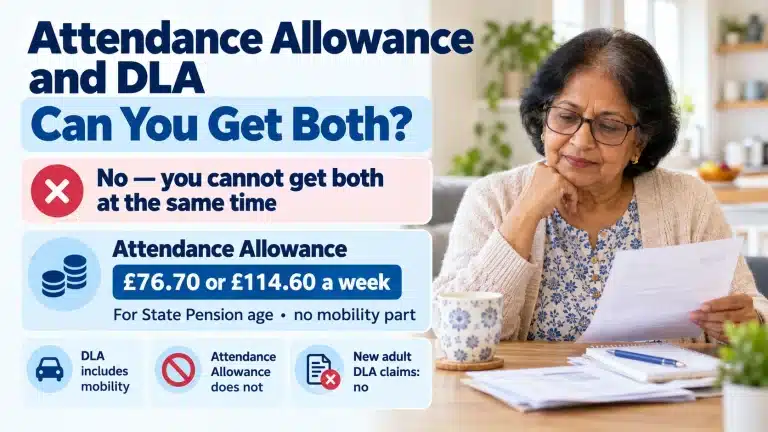
No. GOV.UK’s Attendance Allowance page states that it does not cover mobility needs. It is a benefit for help with personal care and supervision, paid at £76.70 or £114.60 a week in 2026/27, and it has no mobility part. That is the main difference from PIP and DLA, which both have a mobility component. Our Attendance Allowance vs PIP guide covers the gap.
Can You Get Motability With Attendance Allowance?
No. GOV.UK says that to join the Motability Scheme you need to be getting one of these:
- The higher rate of the mobility component of DLA
- The enhanced rate of the mobility component of PIP
- The War Pensioners’ Mobility Supplement
- The Armed Forces Independence Payment
Attendance Allowance is not on the list, and the same is true of the vehicle tax exemption, which uses a similar list of mobility benefits. If Attendance Allowance is your only disability benefit, you cannot join Motability through it.
What Attendance Allowance Does Help With When You Travel
- The Disabled Persons Railcard. The official railcard site lists Attendance Allowance as a qualifying benefit. You send a copy of your award letter. The card gives you and one adult companion a third off most rail fares, and costs £20 for one year or £54 for three years at the time of writing. Check railcard.co.uk for current prices
- Local council schemes. GOV.UK says your local council may run dial-a-ride or taxi schemes, for example using vouchers or tokens, and you may also be eligible for a bus pass. Ask your council what is available where you live
- Extra money for the costs of getting out. Our guide to what Attendance Allowance is used for lists the everyday costs families use it towards, including taxis and community transport
Not Claiming Attendance Allowance Yet?
If you have reached State Pension age and need help with personal care or supervision, Attendance Allowance is worth checking, whether or not you ever get a Blue Badge. At Attendance Allowance Services:
- The eligibility check is free. You speak to a registered Occupational Therapist, with no obligation
- We complete the application for you. Your Occupational Therapist completes and endorses it, and we post it by 1st Class Royal Mail within 4 days for your approval, signature and submission to the DWP
- No fee unless it is successful. Any fee is collected after you receive the backdated payment
- Family members and carers are welcome. We are happy to talk to anyone supporting an applicant
Check whether Attendance Allowance could apply
Free eligibility check, no obligation, and no fee unless the application is successful.
Or call us on 0208 081 4500 (Monday to Friday, 9am to 5pm)
Frequently Asked Questions
Can you get a Blue Badge if you get Attendance Allowance?
You can apply, but Attendance Allowance does not qualify you automatically. Your local council decides, based on how your condition affects your walking or your ability to make journeys safely. If your condition makes walking very difficult, you may qualify on those grounds.
Is Attendance Allowance a qualifying benefit for a Blue Badge?
No. GOV.UK lists the benefits that give an automatic Blue Badge, including the higher rate mobility component of DLA and PIP with 8 points or more for “moving around”. Attendance Allowance is not on that list.
Does having Attendance Allowance make a Blue Badge easier to get?
Not officially. Councils assess how your condition affects your walking or your ability to make journeys safely, and they say Attendance Allowance is not a qualifying benefit. Your award letter can still be useful supporting evidence where a council accepts evidence of other benefits, but it does not decide the outcome. Check your own council’s Blue Badge page.
Who automatically gets a Blue Badge?
GOV.UK says people aged 3 or over automatically qualify if they get the higher rate mobility component of DLA, PIP with 8 points or more under the “moving around” activity, PIP with 10 points for descriptor E under “planning and following journeys”, or War Pensioners’ Mobility Supplement, are registered blind, or meet the Armed Forces Compensation Scheme conditions.
Can you get a Blue Badge without PIP or DLA?
Yes. If you do not get one of the automatic benefits, you can still apply, and the council assesses whether you qualify. For example, you may be eligible if you find walking very difficult due to pain, breathlessness or the time it takes, or if walking is dangerous to your health and safety.
Can someone with dementia get a Blue Badge?
Possibly. GOV.UK says you may be eligible if you struggle severely to plan or follow a journey, or are constantly a significant risk to yourself or others near vehicles, in traffic or car parks. A dementia diagnosis does not decide it on its own, and the council assesses each application.
How much does a Blue Badge cost and how long does it last?
A Blue Badge costs up to £10 in England and usually lasts up to 3 years. You must reapply before it expires.
How long does a Blue Badge application take?
Councils usually decide within 12 weeks, and it can take longer if they need more evidence. If your application is refused and you think the council did not take account of all the important facts, you can ask it to reconsider.
Can someone else apply for a Blue Badge for me?
Yes. GOV.UK says you can apply for yourself, someone else or an organisation. The council will still ask for proof of the applicant’s identity, address and a recent photo.
Can you get Motability with Attendance Allowance?
No. The Motability Scheme needs a qualifying mobility benefit, such as the higher rate mobility component of DLA or the enhanced rate mobility component of PIP. Attendance Allowance has no mobility part and is not on the list.
Does Attendance Allowance help with getting around?
Indirectly. It does not cover mobility needs and does not qualify you for a Blue Badge or Motability, but it does qualify you for a Disabled Persons Railcard, and it is extra money you can put towards the costs of getting out.