
The Short Answer
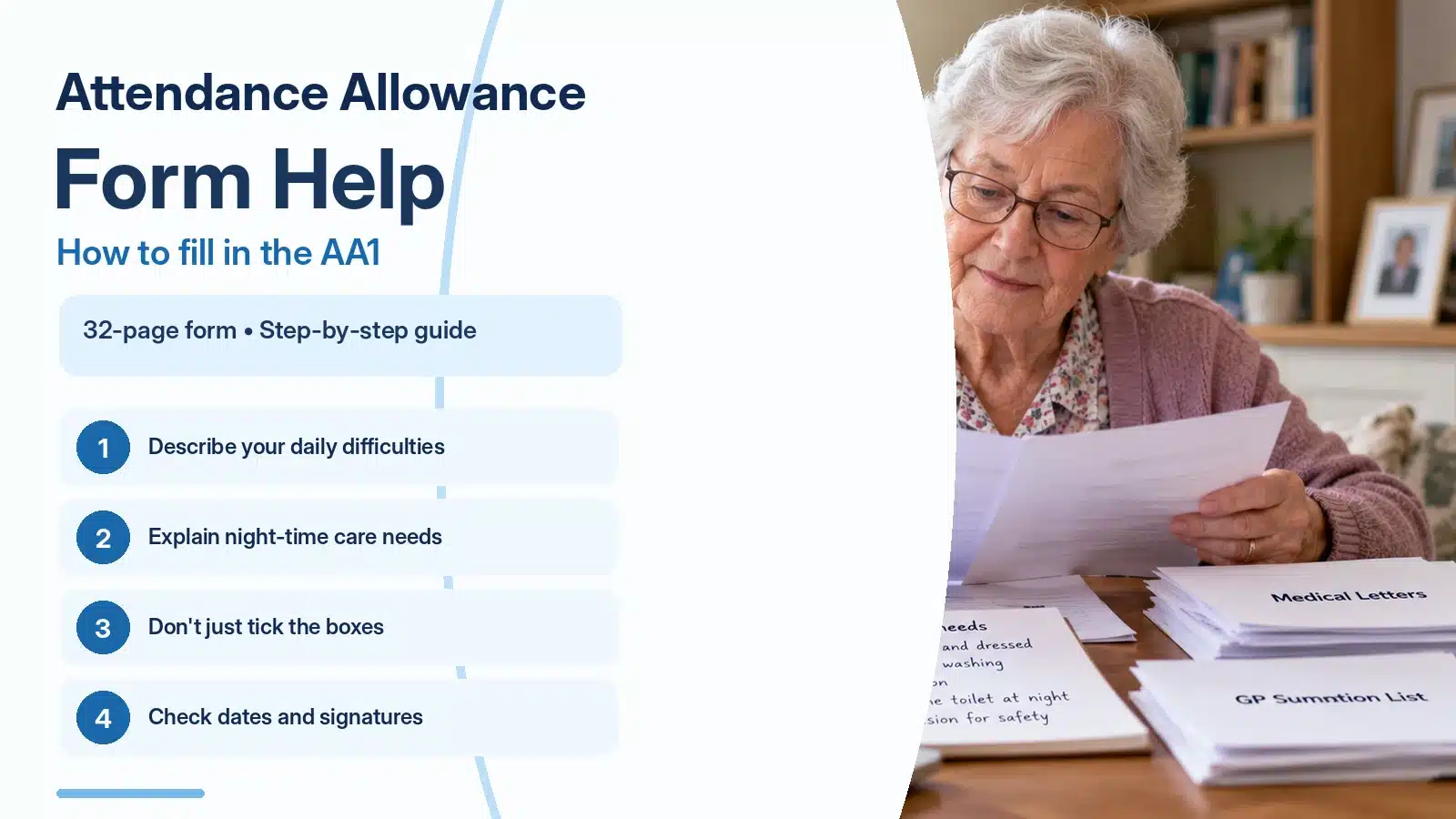
The Attendance Allowance form (the AA1) is 32 pages, but the part that matters most is the care-needs questions. Citizens Advice says it is really important to explain your needs in the blank boxes and not just tick the tick boxes. Say what is difficult, how often, how long it takes, and what could go wrong without help.
You do not have to be getting help already, and you do not have to do it alone. A relative or friend can help, advice charities such as Citizens Advice and Age UK can help, and at Attendance Allowance Services a registered Occupational Therapist completes the form for you to check and sign.
Checked in October 2026 against the official AA1 claim form (November 2025 edition) and its notes on GOV.UK, plus guidance from Citizens Advice and Age UK. This guide covers England and Wales.
Before You Start: What to Have Ready
First, check that Attendance Allowance is right for you. Our guide to what Attendance Allowance is and who can claim it sets out the basic rules before you start the form.
The notes booklet that comes with the form lists what is useful to have to hand. You do not need all of it, and you do not have to fill the form in one go. It helps to have:
- Your National Insurance number, from a card, a letter from the DWP or a payslip
- Your GP’s name and the surgery address
- A list of your medication. An up-to-date printed prescription list from your pharmacy or surgery saves you writing out every medicine and dose
- Details of anyone else you have seen about your health in the last 12 months, such as a hospital consultant, specialist nurse, physiotherapist or occupational therapist
- Your hospital record number, if you know it, from an appointment card or letter
- Dates and addresses of any stay in hospital or a care home
- Your bank or building society details, exactly as they appear on your statement or chequebook
The form asks you to use black ink. If you make a mistake, cross it out with a pen, because the form says not to use correction fluid. Make a copy of the finished form before you send it if you can.
Keep a diary of your needs first
The DWP notes suggest writing down what you needed help with, or found difficult, over one or two days, and if you have good days and bad days, keeping a record of both. Citizens Advice suggests at least a week, and has a diary template on its website. Include:
- What the task was, such as getting out of bed, using the toilet or washing
- How many times in the day or night you needed help or found it difficult
- How long each time took
- What made it hard, such as pain, breathlessness, unsteadiness or confusion
- Who helped, or what might have happened if nobody had
Help with personal tasks does not mean housework or gardening. It means things like getting in or out of bed, washing, dressing, going to the toilet, eating, taking medication, or being reminded or encouraged to do these things. Keep the diary beside you while you fill in the form, or while someone helps you.
How the AA1 Is Laid Out
The question numbers below are from the November 2025 edition of the AA1, which has 32 pages. The DWP updates the form from time to time, so check the numbers against the copy you hold.
| Questions | What they cover | What matters most |
|---|---|---|
| 1 | Special rules for people nearing the end of life | Only if it applies. You then skip the care questions and send an SR1 form from your doctor or specialist |
| 2 to 15 | About you, where you live, and signing for someone else | Accurate details. If someone signs for you, say why at question 15 |
| 16 to 20 | Illnesses, medicines, other professionals, who helps you, your GP, consent | List every condition. Sign and date the consent at question 20 |
| 21 to 27 | Reports, waiting lists, tests, your home, aids and adaptations | Send reports you hold. Say how you use aids and any difficulty with them |
| 28 | When your care needs started | A date, or roughly when. Normally you need to have needed help for 6 months |
| 29 to 41 | Care needs and supervision during the day | Write in the boxes. How often, how long, and why |
| 42 to 45 | Care needs and watching over during the night | How many times a night, how many minutes each time, how many nights a week |
| 46 and 63 | Anything else you want to tell the DWP | Use the extra space. Put your name and National Insurance number on any extra sheet |
| 47 to 49 | Hospital or care home stays, and Constant Attendance Allowance | Dates, and whether the local authority or NHS pays towards the stay |
| 50 to 54 | Bank details | Exactly as shown on your statement. Wrong details can delay payment |
| 55 to 62 | Statement from someone who knows you | Optional, but useful. Best from someone involved in your treatment or care |
| 64 and 65 | Declaration, and a list of the documents you send | The form says no benefit can be paid until the declaration is signed |
Questions 1 to 15: About You, Special Rules and Signing for Someone Else
The first question asks whether you are claiming under the special rules. These are for people who are nearing the end of life and are not expected to live longer than another 12 months. If that applies, you tick yes, you do not answer the care questions (21 to 46), and you ask your doctor or specialist for a free SR1 form to send with the claim. If you do not have the SR1 yet, the form says to send the claim anyway and send the SR1 as soon as you can, because waiting could delay payment.
Questions 2 to 14 are your personal details, where you normally live, and a few questions about time abroad. If you are filling in the form for someone else, tell the DWP about them, not you.
Question 15 is about signing for someone else. The form says you can fill it in for someone else, but they must still sign themselves unless, for example, you are their appointee, deputy or hold Power of Attorney for Property and Finance. Our guide to who can fill in the Attendance Allowance form for someone else explains the options.
Questions 16 to 27: Your Health, the Professionals Involved and Your Home
- Question 16, illnesses and medicines. List every illness or disability, how long you have had it, the medicines or treatments you take for it, and the dose. If you attach a printed prescription list you do not need to write out the medicines, but the form still wants each illness. Use the extra space at question 63 if you run out of room
- Question 17, other professionals. Anyone you have seen in the last 12 months apart from your GP, how often you see them and when you last did
- Question 18, anyone who helps you. A carer, family member, friend or neighbour, and what help you get from them
- Question 19, your GP. The form points out the GP gives medical facts and does not decide whether you get Attendance Allowance
- Question 20, consent. This lets the DWP contact your GP or the other people you have named. You do not have to agree, but the form says that if you do not, the DWP may be unable to check that you qualify
- Question 21, reports. Send copies of any assessment report, care plan or similar. Do not worry if you have none
- Question 22, waiting list for surgery. Say if you are waiting for an operation, such as a hip or knee replacement, and when it is planned
- Questions 23 to 26, tests and your home. Tests you have had, what sort of home you live in, and where the toilet and your bed are
- Question 27, aids and adaptations. A walking frame, stair lift, shower seat, grab rails and so on. Say how each one helps and any difficulty you have using it, or whether someone has to help you with it
Citizens Advice makes a good point about question 27: if you list an aid there, mention it again in the care-needs question it relates to. For example, if you use a grab rail to get in and out of the shower, say so in the washing question as well.
Question 28: When Your Care Needs Started
GOV.UK says you need to have needed help for at least 6 months, and the form asks for the date your care needs started. If you cannot remember the exact date, tell the DWP roughly when it was. The form’s own checklist reminds you to complete this question before you send it.
Questions 29 to 41: Care Needs and Supervision During the Day
The form explains that “during the day” includes the evening, that “help” means physical help, guidance or encouragement from someone else so you can do the task, and that “usually” means most of the time. It also says it is important to tell the DWP about the difficulty you have or the help you need whether you get the help or not.
The daytime questions are:
- 29: getting in and out of bed
- 30: toilet needs, including incontinence aids and catheters
- 31: washing, bathing, showering and looking after your appearance
- 32: dressing and undressing
- 33: moving around indoors, including stairs and getting in and out of a chair
- 34: falls and stumbles
- 35: cutting up food, eating and drinking
- 36: taking medicines and having treatment
- 37: communicating with other people
- 38: how many days a week you have difficulty or need help with questions 28 to 37
- 39: help needed to take part in hobbies, interests, social or religious activities
- 40 and 41: whether someone needs to keep an eye on you for your safety, why, and how many days a week
Most questions have two parts. There are tick boxes, and then a box asking if there is anything else you want to tell the DWP. Citizens Advice says to use the blank boxes and not just tick or write the number of times you need help. The tick boxes also include difficulty with motivation and concentration, so if you need encouraging or reminding to do something, tick that and explain it.
What a strong answer includes
- What you cannot do, or cannot do safely. Be specific rather than saying you “struggle”
- How many times in a day. Citizens Advice says to give the total, for example every trip to the toilet
- How long it takes. If tasks take you a long time, say so, and compare it with someone without your condition if that helps
- What it costs you. Pain, breathlessness, unsteadiness, or putting yourself or someone else in danger
- Good days and bad days. How many of each in an average week, and what help you need on each
- What would happen without help. A fall, a missed medicine, not being able to wash safely
Citizens Advice also says it is fine to repeat yourself. If difficulty reaching the toilet is caused by the same mobility problem as difficulty moving around indoors, write about it in both answers.
An illustration: weak and stronger answers
These two examples are made up to show the difference. They are not a template. Your answers need to describe your own situation.
Washing (question 31).
Weaker: “I can’t manage the shower very well.”
Stronger: Describe the exact difficulties you have, breaking down each component of the task, ensuring you inform the DWP of every element of difficulty you have performing this task and the help you need (if any)
Toilet at night (question 42).
Weaker: “I’m up a lot in the night.”
Stronger: Explain to the DWP the difficulties you have accessing the toilet at night. Again, breaking down the components and explaining to the DWP all the difficulties you have at nighttime.
Questions 42 to 45: Care Needs and Watching Over at Night
The form defines night as when the household has closed down at the end of the day. The night questions ask what help you need with things like turning over or changing position in bed, using the toilet, incontinence, taking medication, treatment or therapy, and being encouraged or reminded about these things. For each one you tick how often each night (1, 2 or 3 or more) and how many minutes each time. Question 43 then asks how many nights a week.
Question 44 asks whether you need someone to be awake to watch over you, for example because you are at risk of falling, wandering, harming yourself, or having fits or blackouts. It asks how many times a night and for how long, and question 45 asks how many nights a week.
These answers matter because the law treats day and night needs differently. Under section 64 of the Social Security Contributions and Benefits Act 1992, the night condition is met if you need prolonged or repeated attention with your bodily functions, or need another person awake for a prolonged period or at frequent intervals to watch over you for safety. Citizens Advice gives the practical thresholds:
- Attention at night: repeated means 2 or more times in the night, or just once if it takes 20 minutes or more
- Watching over at night: at least 3 times, or just once if it is for 20 minutes or more
- During the day: difficulty or need for help with personal tasks at least 3 times during the day, or supervision throughout the day to stay safe
Meeting the day or the night conditions gives the lower rate, and meeting both gives the higher rate. That is why it pays to complete the night questions carefully if you need help at night. Our guide to night-time care needs for Attendance Allowance goes into more detail.
Question 46 and Question 63: Using the Extra Space
Question 46 is a general “anything else you think we should know” box for your care needs, and question 63 is for anything else about your claim, including when other questions run out of space. The form says to continue on a separate sheet if necessary, and to write your name and National Insurance number at the top of each page.
Questions 47 to 54: Hospital, Care Homes and Bank Details
Questions 47 and 48 ask whether you are in, or recently left, a hospital, care home or similar place, and whether the local authority or NHS pays towards your stay. The notes explain why: if you are awarded Attendance Allowance while in hospital or a care home, the DWP cannot pay you until you come out, unless you are paying for your stay yourself. Question 49 asks if you receive, or are waiting to hear about, a Constant Attendance Allowance from a war pension or Industrial Injuries Disablement Benefit.
Questions 50 to 54 are your bank or building society details. The form stresses that mistakes can delay your payment, so copy them exactly from a statement or chequebook, including any building society roll or reference number.
Questions 55 to 62: The Statement From Someone Who Knows You
This section is optional, but Citizens Advice says it is best to have it completed. The form says the best person is the one most involved with your treatment or care. Citizens Advice suggests a healthcare professional you have seen recently, such as a doctor, consultant or specialist nurse. If that is not possible, a friend, relative or carer who knows how your condition affects you can do it. Talk to them first about what the DWP is looking for, which is how much help you need with personal tasks. If you are signing the form on behalf of the person it is about, someone else must complete this section.
Our guide on what evidence to include in an Attendance Allowance application covers the supporting documents that can go alongside it.
Questions 64 and 65: Declaration, Documents and the Final Check
The declaration at question 64 must be signed and dated. The form says the DWP cannot pay any benefit until you have signed it and returned the form. Question 65 asks you to list the documents you are sending, such as a prescription list, a certificate of vision impairment, a medical report or a care plan. Send copies, because the DWP does not return them.
The form ends with a checklist. Before you post it, check that you have:
- Ticked the consent box and signed at question 20
- Signed the declaration at question 64
- Given full details of your GP at question 19, other professionals at question 17 and anyone who helps you at question 18
- Completed the date your care needs started at question 28
- Answered every question that applies to you
Common Mistakes on the Form
Almost every item here comes from the form itself or from Citizens Advice and Age UK. If you want to see how these mistakes play out when a claim is refused, read our guide to Attendance Allowance pitfalls.
- Ticking boxes but leaving the written boxes blank. Explain in your own words as well
- Only describing a good day. The DWP notes say disabilities affect people more on some days than others and ask how yours varies
- Not saying how often. “I need help in the bathroom” tells the DWP much less than “four times a day”
- Forgetting the night. If you need help or watching over at night, the night questions are what can take a claim to the higher rate
- Forgetting to mention aids again. If you list an aid at question 27, mention it in the relevant care question too
- Missing a signature. Both the consent (question 20) and the declaration (question 64)
- Wrong bank details. The form warns that mistakes can delay payment, or even lose you money
Where to Get Help With the Form
You have several choices, and they are not mutually exclusive.
- Family, friends and carers. They can discuss the questions with you and write down your answers. When the form is complete, read it through together before you sign. Age UK suggests this approach for people who find forms hard because of problems with writing or expressing themselves
- Citizens Advice. Its website has a step-by-step guide, a diary template and worked examples, and you can ask an adviser for help with the form
- Your local Age UK. Age UK says you can get help from an adviser at your local Age UK, and its factsheet lists independent advice agencies among the ways to get help completing the form
- The DWP’s own helpline (0800 731 0122) can post you a paper form. GOV.UK says your claim starts on the date of the call if you return the form within 6 weeks, and Age UK says the helpline may be able to arrange a home visit to help complete the form
- A professional service. This is where Attendance Allowance Services comes in, explained below
If you apply online instead of by post, GOV.UK says your claim starts on the date you make it, and Citizens Advice suggests taking a screenshot or photo of each page, or printing the summary at the end, so you have a copy of your answers. If your award has run out, the same form is used again. See our guide to Attendance Allowance renewal.
Want Someone to Complete the Form for You?
Attendance Allowance Services is independent and is not part of the DWP. We help people who would rather not tackle 32 pages themselves.
- The eligibility check is free. You speak to a registered Occupational Therapist, with no obligation
- We complete the application for you. Your Occupational Therapist completes and endorses it, and we post it by 1st Class Royal Mail within 4 days for your approval, signature and submission to the DWP
- No fee unless it is successful. Any fee is collected after you receive the backdated payment
- Family members and carers are welcome. We are happy to talk to anyone supporting an applicant
Let an Occupational Therapist handle the form
Free eligibility check, no obligation, and no fee unless the application is successful.
Or call us on 0208 081 4500 (Monday to Friday, 9am to 5pm)
Already filled it in and been refused? You can challenge the decision. See our guide to what to do if Attendance Allowance is rejected. The usual download and posting details are in our Attendance Allowance form (AA1) guide.
Frequently Asked Questions
Where can I get help filling in the Attendance Allowance form?
You can ask a family member, friend or carer, get advice from Citizens Advice or your local Age UK, or use a service such as Attendance Allowance Services, where a registered Occupational Therapist completes the form for you to check and sign. Whoever helps, the answers need to describe your own needs.
Can someone else fill in the Attendance Allowance form for me?
Yes. A relative, friend, carer or adviser can write the answers for you. The person the form is about must normally sign it themselves, unless the person helping is their appointee, deputy or holds Power of Attorney for Property and Finance, or in the other situations the form lists at question 15.
What should I write in the care needs boxes?
Say what you find difficult or need help with, how often it happens each day or night, how long it takes, and what could go wrong without help, such as a fall. Citizens Advice says it is really important to explain in the blank boxes and not only tick the tick boxes.
Do I need someone helping me already to claim Attendance Allowance?
No. The DWP’s notes say you can still get Attendance Allowance even if you are not actually getting the help you need, and GOV.UK says you do not have to have someone caring for you in order to claim. The test is the help you need, not the help you currently get.
Should I describe my good days as well as my bad days?
Yes. The DWP notes say disabilities can affect people more on one day than another and ask you to tell them how yours varies. Explain what help you need on a bad day and on a good day, and roughly how many of each you have in an average week.
How long does the Attendance Allowance form take to fill in?
Plan for several sittings rather than one. The DWP notes say you do not have to fill in the form in one go, and that you should take your time to describe all the help you need. If you asked for the form by phone, return it within 6 weeks to keep the claim start date from your call.
What is the statement from someone who knows me?
It is an optional section of the form, questions 55 to 62, where someone who knows how your condition affects you gives their view. The form says the best person is the one most involved with your treatment or care, and Citizens Advice suggests a healthcare professional you have seen recently if possible. If you are signing for the person the form is about, someone else must complete it.
Can I save the form and fill it in on a phone or tablet?
GOV.UK says you cannot complete the PDF form on a mobile phone or tablet. Use a desktop or laptop with a PDF reader, or print the form and fill it in by hand. The form only saves if it is opened in a recent PDF reader, not in a web browser. GOV.UK also offers an online claim, as an alternative to the PDF.
What happens after I send the form?
GOV.UK says you will get a text or letter within 3 weeks that explains when you can expect a decision. The DWP may contact your GP or the other people you named for information, and you will only need an assessment if it is unclear how your condition affects you.
Does Attendance Allowance Services fill in the form for me?
Yes. A registered Occupational Therapist completes and endorses the application with you, and we post it by 1st Class Royal Mail within 4 days for you to approve, sign and submit. The eligibility check is free, and there is no fee unless the application is successful. Any fee is collected after you receive the backdated payment.