
Key Takeaways: Attendance Allowance Rates 2026/27
- Higher rate: £114.60 per week (£5,959.20 per year)
- Lower rate: £76.70 per week (£3,988.40 per year)
- Increase: 3.8% from April 2026
- Tax-free and not means-tested — your savings don’t matter
- Combined with Pension Credit: up to £10,260 per year total
- 1.86 million people currently claim — you may be missing out
Current Attendance Allowance Rates (April 2026)
Attendance Allowance rates increased by 3.8% in April 2026, confirmed by the Department for Work and Pensions (DWP). Here are the current weekly and annual amounts.
| Rate | Per Week | Per 4 Weeks | Per Year | When It Applies |
|---|---|---|---|---|
| Higher rate | £114.60 | £458.40 | £5,959.20 | You need help during both day and night, or you are terminally ill |
| Lower rate | £76.70 | £306.80 | £3,988.40 | You need help during the day or at night (but not both) |
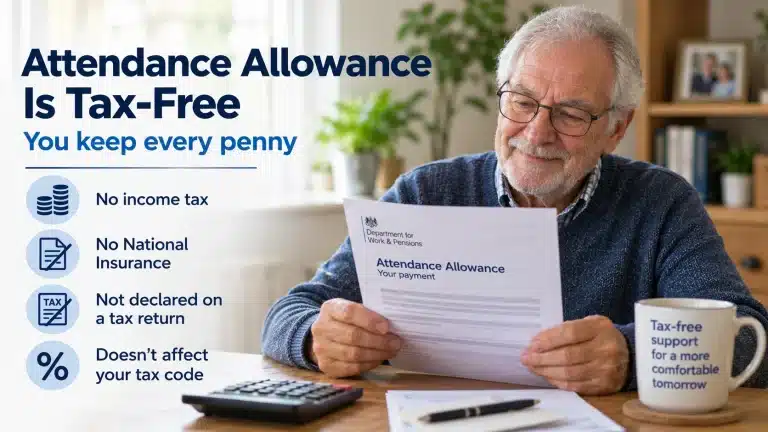
Attendance Allowance is completely tax-free. It does not count as income, does not affect your State Pension, and your savings make no difference to the amount you receive.
Payments are made every 4 weeks directly into your bank account. If your claim is successful, payment is backdated to the date the DWP received your form — which is why applying promptly matters.
Attendance Allowance Per Week, Per Month, and Per Year (2026/27)
People often ask how much Attendance Allowance works out to per month or per day. Although the DWP pays every 4 weeks (not calendar monthly), here is the complete breakdown in every time period:
| Time Period | Higher Rate | Lower Rate |
|---|---|---|
| Per day | £16.37 | £10.96 |
| Per week | £114.60 | £76.70 |
| Per 4 weeks (how it’s paid) | £458.40 | £306.80 |
| Per calendar month (approx.) | £497 | £332 |
| Per quarter (13 weeks) | £1,489.80 | £997.10 |
| Per year | £5,959.20 | £3,988.40 |
Note: The “per calendar month” figure is approximate (£114.60 × 52 weeks ÷ 12 months = £496.60, rounded to £497). The DWP always pays in 4-week cycles, so you receive 13 payments per year rather than 12 monthly payments.
The difference between the higher and lower rate is £37.90 per week — that is £1,970.80 per year. If you are currently on the lower rate and your needs have increased to include night-time care, you may be able to request a supersession to move to the higher rate.
How Attendance Allowance Rates Have Changed (2022–2026)
Rates are uprated every April in line with the Consumer Prices Index (CPI) from the previous September.
| Year | Higher Rate | Lower Rate | Annual Increase |
|---|---|---|---|
| 2022/23 | £92.40 | £61.85 | 3.1% |
| 2023/24 | £101.75 | £68.10 | 10.1% |
| 2024/25 | £108.55 | £72.65 | 6.7% |
| 2025/26 | £110.40 | £73.90 | 1.7% |
| 2026/27 (current) | £114.60 | £76.70 | 3.8% |
Source: GOV.UK — Benefit and pension rates 2026 to 2027
Total Income: Attendance Allowance Plus Related Benefits
Many people don’t realise that Attendance Allowance unlocks additional benefits. Here’s the maximum combined annual income a qualifying pensioner could receive:
| Benefit | Per Week | Per Year | Notes |
|---|---|---|---|
| Attendance Allowance (higher) | £114.60 | £5,959 | Day + night care needs |
| Pension Credit (Severe Disability) | £82.90 | £4,310 | Triggered by receiving AA |
| Council Tax Reduction | Varies | Up to £2,000+ | Contact your local council |
| Total potential extra income | £197.50+ | £10,260+ | Plus Council Tax savings |
Additionally, if someone provides you with 35+ hours of care per week, they may qualify for Carer’s Allowance (£81.90/week), bringing even more income into your household.
Are you missing out? 1.86 million people currently claim Attendance Allowance, yet thousands more are eligible but have never applied. Our free eligibility check takes 2 minutes and there’s no obligation.
Who Is Eligible for Attendance Allowance?
You may qualify for Attendance Allowance if you meet all of these criteria:
- You have reached State Pension age (currently 66)
- You have a physical disability, mental health condition, or long-term illness
- You need help with personal care or supervision to stay safe
- You have needed this help for at least 6 months (unless terminally ill — see special rules below)
- You normally live in England, Scotland, or Wales
You do not need to already have a carer. The DWP assesses based on what help you reasonably need, not what you currently receive. You also do not need a formal diagnosis — the assessment focuses on how your conditions affect daily life.
Common qualifying conditions include:
- Arthritis and mobility difficulties
- Dementia and memory problems
- Heart disease, COPD, and breathing difficulties
- Parkinson’s disease
- Diabetes (particularly with complications)
- Cancer (fast-tracked under special rules)
- Depression, anxiety, and mental health conditions
- Visual or hearing impairment
- Stroke recovery
For a full list, see our guide: Conditions that qualify for Attendance Allowance.
How Long Does Attendance Allowance Take?
The typical timeline from application to first payment:
| Stage | Typical Timeframe |
|---|---|
| DWP receives your form | Claim date starts from this day |
| DWP processing | 6–8 weeks (can be longer) |
| Decision letter received | Posted after decision is made |
| First payment (backdated) | Within 2 weeks of decision |
| Terminal illness (special rules) | Fast-tracked — often within days |
Your first payment includes all backdated amounts from when the DWP received your form. At the higher rate, a 6-week backdate is worth over £680.
Attendance Allowance vs PIP: What’s the Difference?
People often confuse Attendance Allowance with Personal Independence Payment (PIP). Here’s how they differ:
| Attendance Allowance | PIP | |
|---|---|---|
| Age | State Pension age (66+) | 16 to State Pension age |
| Assessment | Paper-based (no face-to-face) | Usually face-to-face assessment |
| Components | Care needs only (2 rates) | Daily living + mobility (4 rates) |
| Maximum weekly | £114.60 | £184.30 (both components) |
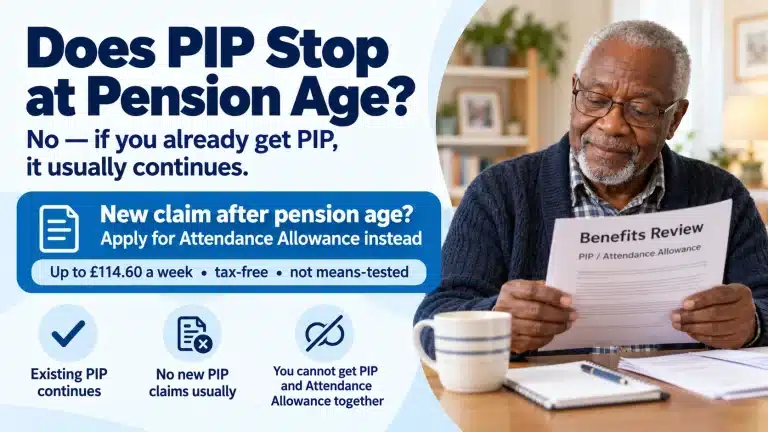
| Can you claim both? | No — if you received PIP before reaching pension age, you continue on PIP. You cannot switch to AA. If you never claimed PIP, you apply for AA at pension age. | |
Read more: Attendance Allowance vs PIP — full comparison
Scotland: Pension Age Disability Payment (PADP)
If you live in Scotland, Attendance Allowance has been replaced by Pension Age Disability Payment (PADP), delivered by Social Security Scotland. The payment rates are identical (£114.60 / £76.70), but the application process is significantly longer — the PADP form is 88 pages compared to 32 for the standard AA1.
Our team helps applicants in both England/Wales (AA) and Scotland (PADP). Start your free eligibility check here.
How to Apply for Attendance Allowance
You can apply by completing the official AA1 claim form (32 pages). The form asks detailed questions about how your health conditions affect your daily life — specifically what help you need with washing, dressing, eating, moving around, taking medication, and staying safe.
Why are so many claims rejected? Approximately 60% of initial applications are turned down. This is rarely because the applicant doesn’t qualify — it’s because the form wasn’t completed with enough detail. The DWP cannot award benefit based on vague answers like “I need help getting dressed.” They need specific examples of what you struggle with and why.
This is where professional support makes a significant difference. At Attendance Allowance Services, our HCPC-registered Occupational Therapists:
- Conduct a thorough assessment of your daily care needs
- Complete the form with the clinical detail the DWP requires
- Include professional OT evidence supporting your claim
- Handle the entire process from start to finish
Our success rate is 99% across 5,000+ claims, compared to the national average of approximately 40%.
Don’t leave money on the table.
If you’re over 66 and have any health condition that affects daily life, you may be entitled to up to £5,959 per year — tax-free.
Frequently Asked Questions
How much is Attendance Allowance per week?
Attendance Allowance pays £114.60 per week at the higher rate and £76.70 per week at the lower rate in 2026/27. Although the weekly rate is the official figure used by the DWP, payments arrive every 4 weeks (£458.40 or £306.80 depending on your rate).
How much is Attendance Allowance per month?
Attendance Allowance is paid every 4 weeks (not monthly). At the higher rate, you receive £458.40 every 4 weeks (equivalent to approximately £497 per calendar month). At the lower rate, you receive £306.80 every 4 weeks (approximately £332 per calendar month). You receive 13 payments per year rather than 12.
Read our guide on Attendance Allowance back payIs Attendance Allowance taxable?
No. Attendance Allowance is completely tax-free. It does not count as taxable income and does not affect your State Pension or other tax obligations. It is also not counted as income for means-tested benefits like Pension Credit.
When do Attendance Allowance rates go up?
Rates are uprated every April in line with the Consumer Prices Index (CPI) from the previous September. The most recent increase took effect on 7 April 2026, raising rates by 3.8%.
Does Attendance Allowance affect my other benefits?
Attendance Allowance does not reduce any of your existing benefits. In fact, receiving it may increase your entitlement to Pension Credit (via the Severe Disability Addition), Housing Benefit, and Council Tax Reduction.
Can I claim Attendance Allowance if I live alone?
Yes. You do not need to have a carer or live with someone. The benefit is based on what care you need, not what you currently receive. Many successful claimants live independently but struggle with everyday tasks.
How much is the higher rate of Attendance Allowance?
The higher rate of Attendance Allowance in 2026/27 is £114.60 per week, which equals £5,959.20 per year. You qualify for the higher rate if you need care or supervision during both day and night, or if you are terminally ill.
What is the difference between Attendance Allowance lower and higher rate?
The lower rate (£76.70/week) is for people who need care during either the day or at night. The higher rate (£114.60/week) is for people who need care during both day and night, or who are terminally ill. The difference is £37.90 per week (£1,970.80 per year).
Can I spend Attendance Allowance on anything I want?
Yes. There are no restrictions on how you spend Attendance Allowance. You can use it to pay for care, household help, mobility aids, taxis, heating bills, or anything else. The DWP does not monitor how you spend it.