The Short Answer
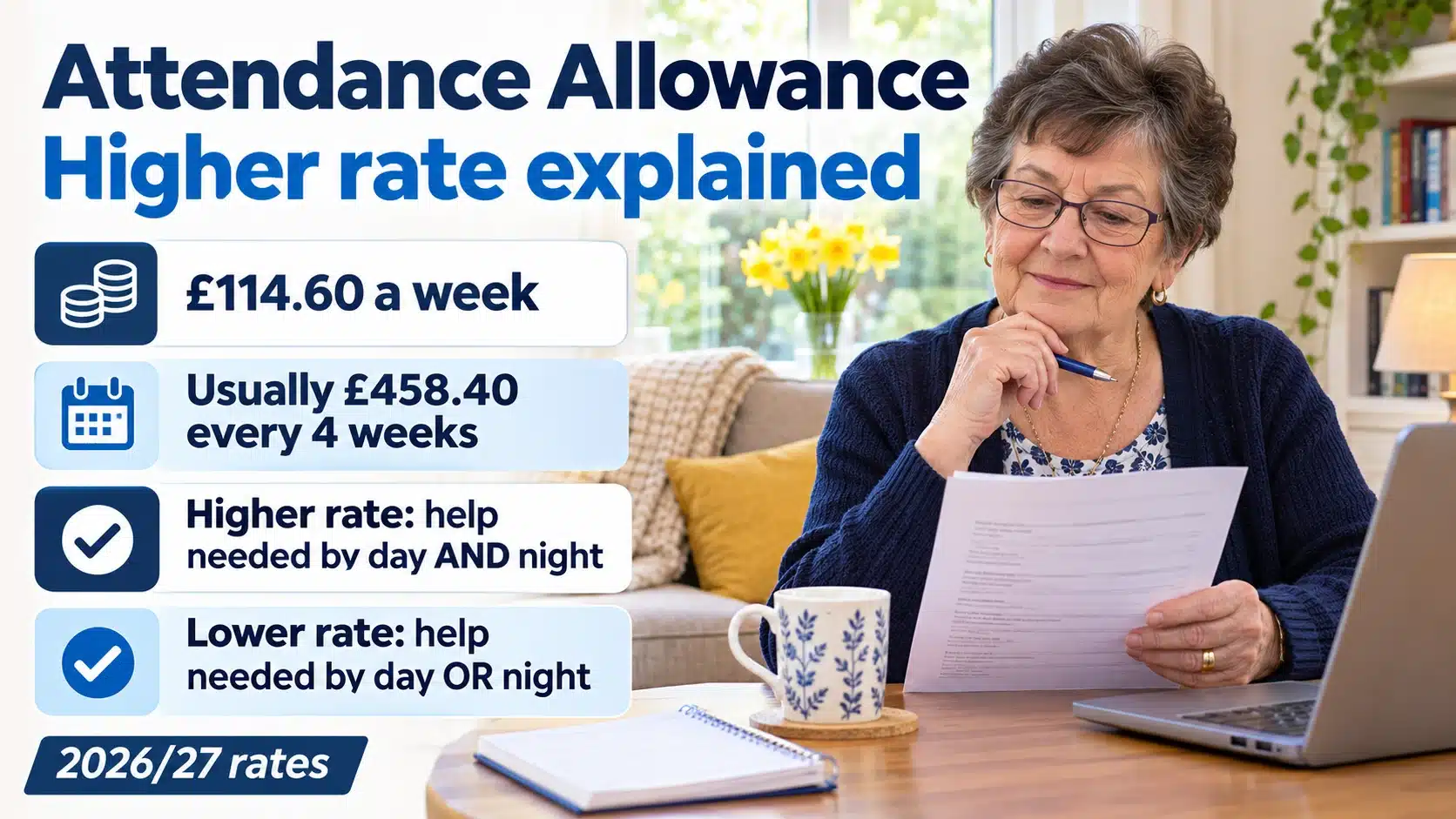
The higher rate of Attendance Allowance is £114.60 a week in 2026/27. The lower rate is £76.70. GOV.UK says the higher rate is for people who need help or supervision throughout both day and night, or who a medical professional has said are nearing the end of life.
The difference is nearly always the night. Needing help during the day or at night gives the lower rate. Needing it at both times gives the higher rate. You do not need to already have a carer, and the rate is based on the difficulty you have, or the help you need, not the help you get.
Rates and rules checked in October and November 2026 against GOV.UK, the official AA1 claim form notes, the Social Security Contributions and Benefits Act 1992, Citizens Advice and Age UK. This guide covers England and Wales.
How Much Is the Higher Rate of Attendance Allowance?
These are the weekly rates for 2026/27, which GOV.UK publishes. The “every 4 weeks” and “per year” figures are our own sums, because Age UK says Attendance Allowance is usually paid every four weeks, and a year is 52 weeks.
| Rate | Per week | Every 4 weeks | Per year (52 weeks) |
|---|---|---|---|
| Higher rate | £114.60 | £458.40 | £5,959.20 |
| Lower rate | £76.70 | £306.80 | £3,988.40 |
| Difference | £37.90 | £151.60 | £1,970.80 |
Attendance Allowance is not means-tested, so your income and savings do not change the amount. The rates are reviewed each April, so check GOV.UK for the current figures. Our guide to Attendance Allowance rates for 2026/27 has the full picture, including how the rates have changed over the last few years, and our page on the April 2026 Attendance Allowance increase shows what changed this year.
From April 2027. In a written statement on 28 October 2026, the Secretary of State for Work and Pensions said benefits that help with additional needs arising from disability will rise by 3.5%, and that the new rates will mainly come into effect from 12 April 2027. The DWP has not yet published the new weekly Attendance Allowance rates. A 3.5% rise would give about £79.40 and £118.60 a week, but that is our own arithmetic and not an official figure, so wait for GOV.UK to publish the real rates before relying on it.
Who Qualifies for the Higher Rate?
The test comes from the Social Security Contributions and Benefits Act 1992. There are two conditions, one for the day and one for the night, and the rate depends on how many you meet:
| What you need | Rate |
|---|---|
| Help or supervision during the day only | Lower |
| Help or supervision at night only | Lower |
| Help or supervision during the day AND at night | Higher |
| A medical professional has said you are nearing the end of life (special rules) | Higher |
Section 65(3) of the Act says the weekly rate is the higher rate if you satisfy both the day and the night conditions, and the lower rate in any other case. You also need to be at State Pension age, not be getting PIP, DLA care or an equivalent, and have needed the help for at least 6 months, unless you claim under the special rules.
The Day Condition
Section 64(2) says you meet the day condition if you are so severely disabled, physically or mentally, that by day you need from another person either:
- frequent attention throughout the day in connection with your bodily functions, or
- continual supervision throughout the day to avoid substantial danger to yourself or others
The AA1 notes explain “help with personal care” as day-to-day help with things like washing or getting into or out of a bath or shower, dressing, eating, using the toilet, or making yourself understood. “Supervise” means someone needs to watch over you to help you avoid substantial danger, for example when you take medicines or have treatment, to keep you away from danger you may not know is there, or to stop you hurting yourself or others.
Citizens Advice gives the practical threshold for frequent attention: difficulty with, or needing help with, personal tasks at least 3 times during the day, such as washing, getting out of bed or getting dressed. Age UK adds that “continual” does not mean non-stop, so breaks of an hour or so are fine. The need can come from falls, confusion, fits or seizures, or a condition that can get worse with little warning. The AA1 form itself says “during the day” includes the evening.
The Night Condition
Section 64(3) says you meet the night condition if you are so severely disabled that at night you need either:
- prolonged or repeated attention in connection with your bodily functions, or
- another person awake for a prolonged period or at frequent intervals to watch over you, to avoid substantial danger to yourself or others
The AA1 form defines night as when the household has closed down at the end of the day. Citizens Advice and Age UK give the practical thresholds:
- Prolonged attention: one spell of help that takes at least 20 minutes
- Repeated attention: help 2 or more times in the night
- Watching over: someone needs to be awake for 20 minutes or more, or at frequent intervals, which Age UK says is usually at least three times a night
Help at night can include getting in a comfortable position, turning over in bed, going to the toilet, dealing with incontinence, or taking medication or treatment. Our guide to night-time care needs for Attendance Allowance gives more examples and explains how to describe them on the form.
Lower Rate or Higher Rate? Some Examples
Age UK gives a real example in its factsheet: a woman with dementia whose husband applied as her appointee. A relative stays with her throughout the day to keep her safe because she wanders and forgets, but she normally sleeps through the night. She was awarded the lower rate, because she needed supervision only during the day.
The examples below are made up, to show how the day and night conditions combine. The DWP decides every case on its own facts, so they are not a prediction of any claim.
| Illustration | Conditions met |
|---|---|
| Needs help to wash and dress each morning and help with meals during the day, and sleeps through the night without help | Day only, so lower rate |
| Manages alone during the day, but a partner has to help to the toilet and back two or three times every night | Night only, so lower rate |
| Needs help with washing, dressing and the toilet several times a day, and someone helps with the toilet and turning in bed more than once each night | Day and night, so higher rate |
| Needs someone with them for safety throughout the day because of confusion and wandering, and someone has to be awake at night because they get up and wander | Day and night, so higher rate |
Nearing the End of Life: The Special Rules
GOV.UK says the higher rate also applies if a medical professional has said you are nearing the end of life, and that there is a different way to claim. The AA1 notes explain the special rules apply to people who have a progressive disease and are not expected to live longer than another 12 months. Under the special rules you get the higher rate, you are paid straight away without waiting 6 months, and the claim is dealt with more quickly.
To claim this way, you tick the special rules question on the form (question 1 on the current edition) and send an SR1 form from your doctor or specialist, which is free. The form says that if you do not have the SR1 when the form is ready, send the claim anyway and send the SR1 as soon as you can.
Does the Higher Rate Change Anything Else?
The higher rate means more money each week. GOV.UK says you could get extra Pension Credit, Housing Benefit or Council Tax Reduction if you get Attendance Allowance, and that a carer could get Carer’s Allowance if you have substantial caring needs. It does not say that either depends on which rate you get, and GOV.UK’s Carer’s Allowance page lists Attendance Allowance as a qualifying benefit without distinguishing between the rates. Check with the office that deals with each benefit. Our guides cover Pension Credit and Carer’s Allowance.
If you get Constant Attendance Allowance at the same time, for example with Industrial Injuries Disablement Benefit, GOV.UK says your Attendance Allowance is reduced by the amount of Constant Attendance Allowance you get.
How the Form Asks About It
You do not choose your rate. The DWP decides it from what you write on the form. On the current AA1:
- Questions 29 to 41 cover care needs and supervision during the day
- Questions 42 to 45 cover care needs and watching over during the night, and ask how many times a night, how many minutes each time and how many nights a week
If you need help at night, the night questions are where that shows. Answer them as carefully as the daytime ones, and say honestly what happens most nights. Our section by section guide to the Attendance Allowance form explains each question.
If You Were Awarded the Lower Rate
You have two routes, depending on what has happened:
- Your needs have changed or increased. GOV.UK says that if your circumstances change you could get a different rate, and that you must report a change of circumstances. For example, if you now need help at night as well as in the day. See our guide to Attendance Allowance renewal, which covers what to do when your needs increase
- You think the DWP got the rate wrong. You can ask for a mandatory reconsideration, which is free. GOV.UK says you usually need to ask within one month of the date of the decision, and you can ask later if you have a good reason, such as being in hospital or having had a bereavement. See our guide to what to do if your Attendance Allowance decision is wrong
Not Claiming Yet, or Worried the Rate Will Be Wrong?
If you have reached State Pension age and need help with personal care or supervision, it is worth checking whether Attendance Allowance could apply to you. At Attendance Allowance Services:
- The eligibility check is free. You speak to a registered Occupational Therapist, with no obligation
- We complete the application for you. Your Occupational Therapist completes and endorses it, including the day and night questions, and we post it by 1st Class Royal Mail within 4 days for your approval, signature and submission to the DWP
- No fee unless it is successful. Any fee is collected after you receive the backdated payment
- Family members and carers are welcome. We are happy to talk to anyone supporting an applicant
Check what rate you could be entitled to
Free eligibility check, no obligation, and no fee unless the application is successful.
Or call us on 0208 081 4500 (Monday to Friday, 9am to 5pm)
Frequently Asked Questions
What is the higher rate of Attendance Allowance?
The higher rate is £114.60 a week in 2026/27. GOV.UK says it is for people who need help or supervision throughout both day and night, or who a medical professional has said are nearing the end of life. The lower rate is £76.70 a week.
How much is the higher rate of Attendance Allowance per month?
Attendance Allowance is usually paid every 4 weeks, not by calendar month. At the higher rate that is £458.40 every 4 weeks, which is £5,959.20 over 52 weeks. These are our own sums from the £114.60 weekly rate.
What are the criteria for the higher rate of Attendance Allowance?
You need to meet both the day condition and the night condition. By day that means frequent attention throughout the day with your bodily functions, or continual supervision to avoid substantial danger. At night it means prolonged or repeated attention, or someone awake to watch over you. You also need to have needed the help for at least 6 months, unless you claim under the special rules.
What is the difference between the lower and higher rate of Attendance Allowance?
The lower rate is for help or supervision during the day or at night. The higher rate is for help or supervision during both the day and the night. The difference is £37.90 a week in 2026/27.
Can I get the higher rate if I only need help at night?
No. Needing help or supervision at night only meets the night condition, which gives the lower rate. To get the higher rate you need to meet the day condition as well, unless you are claiming under the special rules.
Can I get the higher rate if I need supervision rather than physical help?
Yes. The law counts continual supervision throughout the day to avoid substantial danger, and another person being awake at night to watch over you, as well as physical help. For example, supervision may be needed because of falls, confusion, fits or wandering.
Do I need a carer to get the higher rate of Attendance Allowance?
No. GOV.UK says you do not have to have someone caring for you in order to claim, and the DWP notes say you can get Attendance Allowance even if you are not actually getting the help you need. The rate depends on the help you need.
How long do I have to need help before I can get the higher rate?
You normally need to have needed the help for at least 6 months, and the higher rate needs both the day and night conditions to have been met over that time. The exception is the special rules for people nearing the end of life, where there is no 6 month wait.
I was awarded the lower rate but my needs have increased. What can I do?
GOV.UK says that if your circumstances change you could get a different rate, and that you must report a change of circumstances. If you think the original decision was wrong, you can ask for a mandatory reconsideration, usually within one month of the date of the decision.
Can I get the higher rate under the special rules?
Yes. If a medical professional has said you are nearing the end of life, you can claim under the special rules and get the higher rate without waiting 6 months. You tick the special rules question on the claim form and send an SR1 form from your doctor or specialist, which is free.