The Short Answer
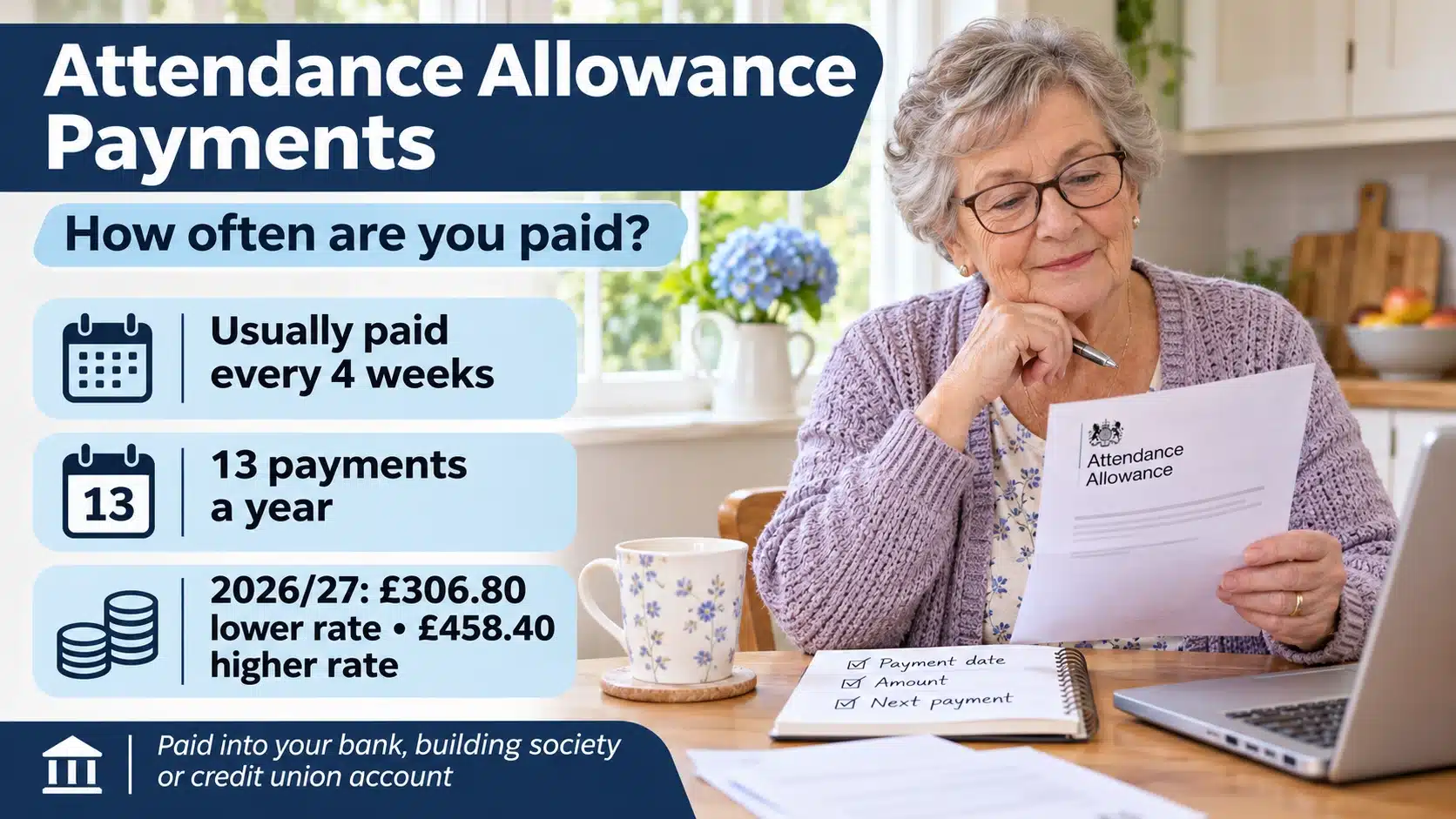
Attendance Allowance is quoted as a weekly rate, but GOV.UK says it is usually paid every 4 weeks, straight into your bank, building society or credit union account. That means 13 payments a year, not 12.
At 2026/27 rates, one four-weekly payment is £306.80 at the lower rate or £458.40 at the higher rate, before any deduction.
Checked in October 2026 against GOV.UK: How and when your benefits are paid and Age UK’s Attendance Allowance factsheet. This guide covers England and Wales.
Is Attendance Allowance Paid Weekly or Monthly?
Neither, strictly. GOV.UK describes Attendance Allowance as “paid weekly at 2 different rates”, which means the amounts are set as weekly figures. Its guide to how and when benefits are paid then lists Attendance Allowance as “usually every 4 weeks”.
Because a year has 52 weeks, four-weekly payments mean 13 payments a year. In at least one month of the year you will receive two payments, so budget with that in mind rather than expecting the same amount on the same date each month.
Age UK’s factsheet adds two details. Attendance Allowance is usually paid four weekly in arrears, which means each payment comes after the period it covers. It can also be paid at intervals of less than four weeks, and in certain circumstances weekly in advance. Your decision letter shows which applies to you.
What You Receive Each Payment (2026/27)
| Rate | Per week | Per 4-weekly payment | Per year (13 payments) |
|---|---|---|---|
| Lower rate | £76.70 | £306.80 | £3,988.40 |
| Higher rate | £114.60 | £458.40 | £5,959.20 |
These are the amounts before any deduction. GOV.UK says that if you also get Constant Attendance Allowance, your Attendance Allowance is reduced by the amount of Constant Attendance Allowance you get. See Attendance Allowance rates for 2026/27 for the full breakdown, and our page on the April 2026 Attendance Allowance increase for what changed this year.
How Attendance Allowance Is Paid
- Into an account. GOV.UK says benefits are usually paid into a bank, building society or credit union account, and you are asked for the details when you claim
- If you cannot open or manage an account. GOV.UK says to contact the office that pays your benefit to find out how to get it paid. Age UK says you can ask to use the Payment Exception Service, which lets you withdraw benefits from PayPoint outlets
- To an appointee or attorney. Age UK says Attendance Allowance can be paid to an appointee, or to someone with power of attorney, if you cannot act for yourself
- With your State Pension. Age UK says you can choose to have Attendance Allowance paid with your State Pension or another social security benefit
- Weekends and bank holidays. GOV.UK says that if your payment date falls on a weekend or bank holiday you will usually be paid on the working day before
When Do You Get Your First Payment?
GOV.UK says that if you are awarded Attendance Allowance, the decision letter will tell you when you will get your first payment. It does not publish a pay day calendar, so your decision letter is the place to look.
Payment is worked out from your claim start date, which depends on how you applied. GOV.UK says an online claim starts on the date you make it, a posted form starts on the date the DWP receives it, and a form requested by phone starts on the date of your call if you return it within 6 weeks. Age UK says your first payment will be from that date, so if the decision took several weeks, your first payment can cover the weeks since your claim started. Our guide to Attendance Allowance back pay shows how that works, and our guide to how long Attendance Allowance takes covers timescales.
What Does “DWP AA” Mean on Your Bank Statement?
How a payment appears on your statement is decided by your bank, and the DWP does not publish a list of references. “DWP AA” is commonly reported as the way an Attendance Allowance payment shows up. It fits: DWP stands for the Department for Work and Pensions and AA is the usual abbreviation for Attendance Allowance.
If you see a payment with that label and want to be sure, check:
- The amount. At 2026/27 rates a regular four-weekly payment would be £306.80 (lower rate) or £458.40 (higher rate), unless something has been deducted
- The timing. Payments arrive about every 4 weeks. A first payment can be larger if it includes money for the weeks since your claim started
- Your paperwork. Your decision letter shows the rate, the date your award started and when payments begin. Someone in the family or an adviser may also have applied on your behalf
If you still do not recognise a payment, use the contact details on any letter you have had about your claim. Do not give your bank details to anyone who contacts you out of the blue about a payment.
Who Can Receive the Payment?
Attendance Allowance is paid to the person with the care needs. It is not paid to the carer. A carer who looks after you for at least 35 hours a week, and who is not earning over the limit, may be able to claim Carer’s Allowance in their own right, and GOV.UK says your carer could get it if you have substantial caring needs. Our guide to Carer’s Allowance and Attendance Allowance explains how the two work together.
If you cannot manage your own money, Age UK says the payment can be made to an appointee, or to someone with power of attorney. That person must use the money in your interest. Citizens Advice says an appointee has the legal right to sort out someone’s benefits, including spending the money in a way that helps the person claiming. Our guide on who can fill in the Attendance Allowance form explains how an appointee is set up.
The money is yours to spend as you choose. See what Attendance Allowance is used for for ideas from other pensioners.
When Payments Change or Stop
- Hospital. Age UK says Attendance Allowance is payable for your first 28 days in hospital, if you are maintained free of charge while having treatment as an inpatient. After that payment is suspended. See Attendance Allowance when in hospital
- Care home. Age UK says that if you pay all of your care home fees yourself you can continue to receive it. If any of the costs of accommodation, board or personal care are paid from public funds, it stops 28 days after admission
- Going abroad. Age UK says it can be paid for the first 13 weeks of a temporary absence abroad, if the absence is not expected to last more than 52 weeks. Check before you travel
- A fixed-length award ending. Age UK says that if your award is for a fixed period you are normally sent a renewal form about four months before it ends. See Attendance Allowance renewal
- A change in your needs. GOV.UK says that if your circumstances change you could get a different rate, and you must report a change of circumstances
Age UK also says that if you go into or come out of a hospital or care home you should always tell the DWP, because your entitlement may be affected, and that if your Attendance Allowance stops you should tell the office that pays your other benefits, such as Pension Credit, Housing Benefit and Council Tax Reduction, so that you are not overpaid.
If Your Payment Looks Wrong
- Check your decision letter. It shows the rate and the date your award started
- Compare the amount. Multiply the weekly rate by 4. A lower amount can mean a deduction, for example for Constant Attendance Allowance
- If you disagree with the decision itself (the rate, or the start date), GOV.UK says you can ask for a mandatory reconsideration. It is free and is usually requested within one month of the date on the decision letter. See what to do if Attendance Allowance is rejected
- If a payment has not arrived, check the account details you gave, then use the contact details on your decision letter
If You Are Not Receiving It Yet
Many people are paid nothing simply because nobody has told them they could claim. If you or a family member have care needs and you are not receiving Attendance Allowance, an application may be worth making. It is not means-tested, and it can open the door to extra Pension Credit, Housing Benefit or Council Tax Reduction.
Attendance Allowance Services is independent and is not part of the DWP:
- The eligibility check is free. You speak to a registered Occupational Therapist, with no obligation
- We complete the application for you. Your Occupational Therapist completes and endorses it, and we post it by 1st Class Royal Mail within 4 days for your approval, signature and submission to the DWP
- No fee unless it is successful. Any fee is collected after you receive the backdated payment
- Family members and carers are welcome. We are happy to talk to anyone supporting an applicant
Not receiving Attendance Allowance yet?
Free eligibility check, no obligation, and no fee unless the application is successful.
Or call us on 0208 081 4500 (Monday to Friday, 9am to 5pm)
Frequently Asked Questions
Is Attendance Allowance paid weekly or monthly?
Neither. The rates are set as weekly figures, but GOV.UK says Attendance Allowance is usually paid every 4 weeks. That means 13 payments a year, so in at least one month you will receive two payments.
How often is Attendance Allowance paid?
Usually every 4 weeks, according to GOV.UK. Age UK adds that it can be paid at intervals of less than four weeks and, in certain circumstances, weekly in advance. Your decision letter shows how you are paid.
How is Attendance Allowance paid?
Into a bank, building society or credit union account, according to GOV.UK. If you cannot open or manage an account, you can ask about the Payment Exception Service, which lets you withdraw benefits from PayPoint outlets. It can also be paid to an appointee or someone with power of attorney.
What day is Attendance Allowance paid?
GOV.UK does not publish a single pay day. Your decision letter tells you when your first payment will be, and after that payments follow your cycle, usually every 4 weeks. If a payment date falls on a weekend or bank holiday you will usually be paid on the working day before.
What does DWP AA mean on my bank statement?
Banks decide how a payment appears, but DWP AA is commonly reported as the label for an Attendance Allowance payment from the Department for Work and Pensions. Check the amount and date against your decision letter. At 2026/27 rates a regular four-weekly payment would be £306.80 at the lower rate or £458.40 at the higher rate.
Is Attendance Allowance paid in advance or in arrears?
Age UK says it is usually paid four weekly in arrears, which means after the period it covers. It can be paid at intervals of less than four weeks and, in certain circumstances, weekly in advance.
Can Attendance Allowance be paid to someone else, such as a family member?
It is paid for the person with care needs. If that person cannot act for themselves, Age UK says it can be paid to an appointee or someone with power of attorney, who must use it in the person’s interest. It is not paid to a carer, although a carer may be able to claim Carer’s Allowance in their own right.
Can Attendance Allowance be paid with my State Pension?
Age UK says you can choose to have Attendance Allowance paid with your State Pension or another social security benefit. Your decision letter and your pension details show how you are currently paid.
Does Attendance Allowance stop when you go into hospital?
Age UK says it is payable for the first 28 days in hospital if you are maintained free of charge while having treatment as an inpatient, after which payment is suspended. Always tell the DWP when you go into or come out of hospital.
Why was my first Attendance Allowance payment larger?
Payment runs from your claim start date, which is the date you made an online claim, the date the DWP received a posted form, or the date of your call if you phoned for a form and returned it within 6 weeks. If the decision took several weeks, your first payment can cover the time since then.