The Short Answer
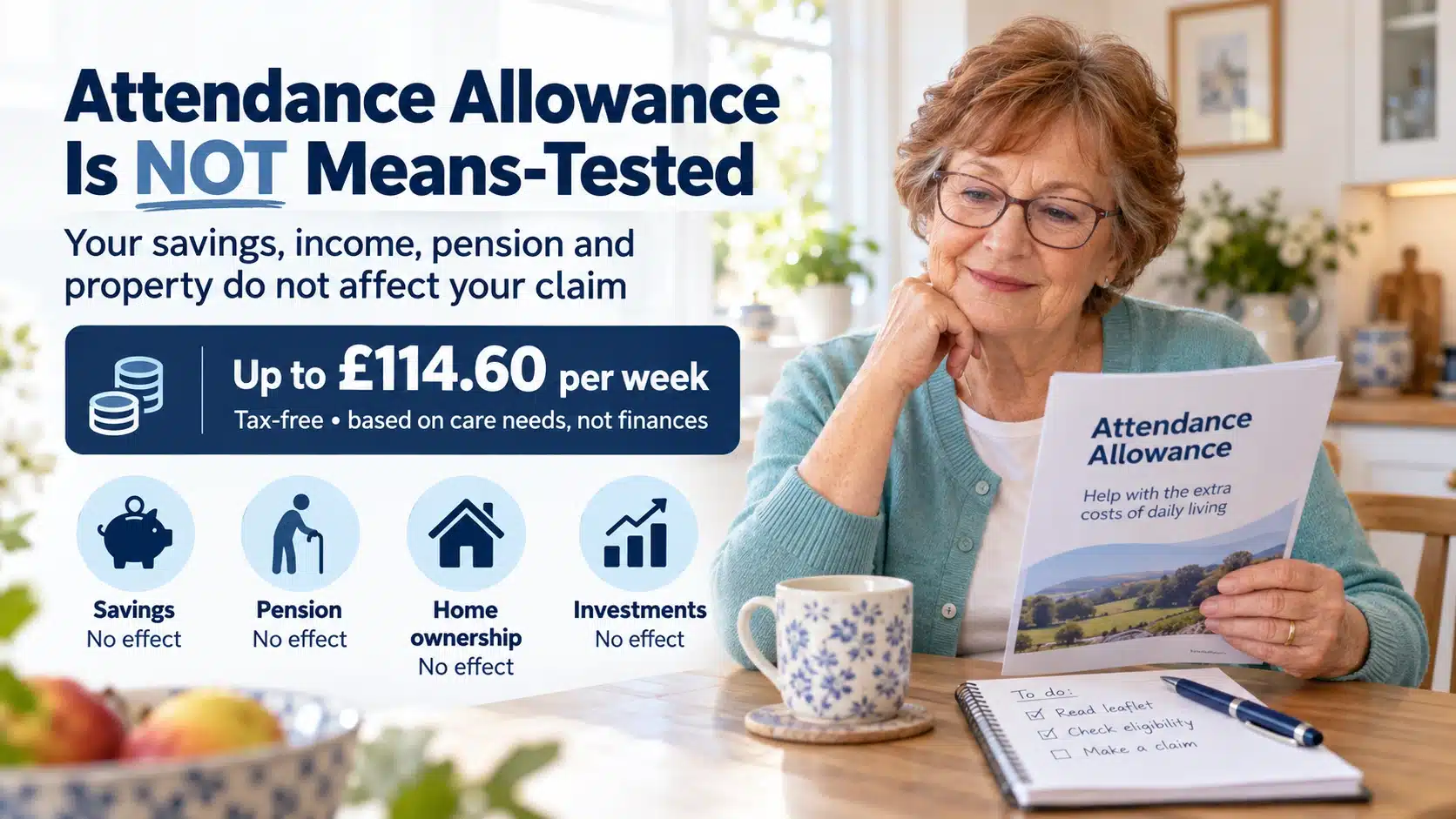
No. Attendance Allowance is NOT means-tested. Your savings, income, property, investments, and pension are completely irrelevant. Whether you have £500 or £500,000 in the bank, you can claim exactly the same amount — up to £114.60 per week (£5,959.20 per year), tax-free.
What Does “Not Means-Tested” Actually Mean?
A means-tested benefit looks at how much money you have before deciding if you qualify. Pension Credit, Housing Benefit, and Council Tax Reduction are all means-tested — the more savings or income you have, the less you receive.
Attendance Allowance works differently. It is based entirely on your care needs — how much help you need with daily living because of a physical or mental health condition. The DWP does not ask about your finances. They do not check your bank account, your pension income, or whether you own your home.
What Does NOT Affect Your Attendance Allowance Claim
| What People Worry About | Does It Affect AA? |
|---|---|
| Savings in the bank | No — any amount |
| State Pension income | No |
| Private or workplace pension | No |
| Owning your home | No |
| Investment income | No |
| Your spouse’s or partner’s income | No |
| Other non-means-tested benefits (e.g. State Pension) | No |
| Whether you receive care or pay for it | No — you just need to need it |
What DOES Affect Your Claim
Only two things matter for Attendance Allowance:
- Your age: You must be over State Pension age (currently 66)
- Your care needs: You must have difficulty or need help with personal care or supervision due to a physical or mental health condition, and had this difficulty help for at least 6 months
That is it. No financial assessment, no home visits to inspect your assets, no bank statements required.
Why This Misconception Is So Costly
The belief that Attendance Allowance is means-tested is one of the biggest reasons the benefit is under-claimed in the UK. Government estimates suggest that up to a third of eligible people do not claim — many because they wrongly assume their savings or pension disqualify them.
The Real Cost of Not Claiming
- Higher rate: £114.60/week = £5,959.20/year — tax-free
- Lower rate: £76.70/week = £3,988.40/year — tax-free
- Plus gateway benefits: Claiming AA can unlock the Severe Disability Premium in Pension Credit (up to £81.50/week extra), council tax reductions, and Carer’s Allowance for your carer
- Every week you delay is money permanently lost — AA is only backdated to the date your application is scanned by the DWP
Attendance Allowance vs Means-Tested Benefits
It helps to understand which benefits ARE means-tested and which are not:
| Benefit | Means-Tested? | Note |
|---|---|---|
| Attendance Allowance | No | Based on care needs only |
| State Pension | No | Based on NI contributions |
| Pension Credit | Yes | Income and savings checked — but AA is ignored |
| Housing Benefit | Yes | Income and savings checked |
| Council Tax Reduction | Yes | Varies by local authority |
Crucially, when Pension Credit IS calculated, Attendance Allowance income is completely ignored. This means you can receive AA and Pension Credit simultaneously — and claiming AA can actually increase your Pension Credit through the Severe Disability Premium.
The Gateway Effect — How AA Unlocks Extra Money
Because Attendance Allowance is not means-tested, it acts as a gateway to other benefits:
- Severe Disability Premium: If you live alone and receive AA, you may qualify for an extra £81.50/week in Pension Credit
- Council Tax discount: AA can qualify you for reductions or exemptions
- Carer’s Allowance: If someone cares for you 35+ hours/week, they can claim Carer’s Allowance (£81.90/week) based on your AA award
- Blue Badge: Higher rate AA can support applications for disabled parking
For a full breakdown, see our guide on what Attendance Allowance is used for.
Your savings do not disqualify you. Your care needs do qualify you.
If you or a family member struggles with daily tasks due to a health condition, you may be entitled to up to £5,959/year in tax-free support — regardless of your financial situation. Our free eligibility check takes 2 minutes.
Frequently Asked Questions
Is Attendance Allowance means-tested?
No. Attendance Allowance is not means-tested. Your savings, income, property, investments, and pension are completely irrelevant to your claim. The only things that matter are your age (over State Pension age) and your care needs due to a health condition.
Can I claim Attendance Allowance if I have savings?
Yes — there is no savings limit. Whether you have £100 or £1 million in savings, you can claim exactly the same amount of Attendance Allowance. The DWP does not ask about your finances and does not check your bank accounts.
Does my pension affect Attendance Allowance?
No. Neither your State Pension nor any private or workplace pension affects your Attendance Allowance. AA is paid on top of all pension income and does not reduce any other benefit you receive.
Does Attendance Allowance affect my other benefits?
Attendance Allowance does not reduce any other benefit. In fact, it can increase them — claiming AA can unlock the Severe Disability Premium in Pension Credit, worth up to £81.50/week extra. It is also completely tax-free.
If Attendance Allowance is not means-tested, what IS it based on?
Attendance Allowance is based solely on your care needs. The DWP assesses whether you have difficulties or need help with daily activities like washing, dressing, eating, using the toilet, or getting around safely — or whether you need someone to supervise you. The level of help you need determines whether you receive the lower rate (£76.70/week) or higher rate (£114.60/week).
Can I own my home and still claim Attendance Allowance?
Yes. Home ownership has no bearing on Attendance Allowance. Whether you own your home outright, have a mortgage, or rent, it does not affect your eligibility or the amount you receive.