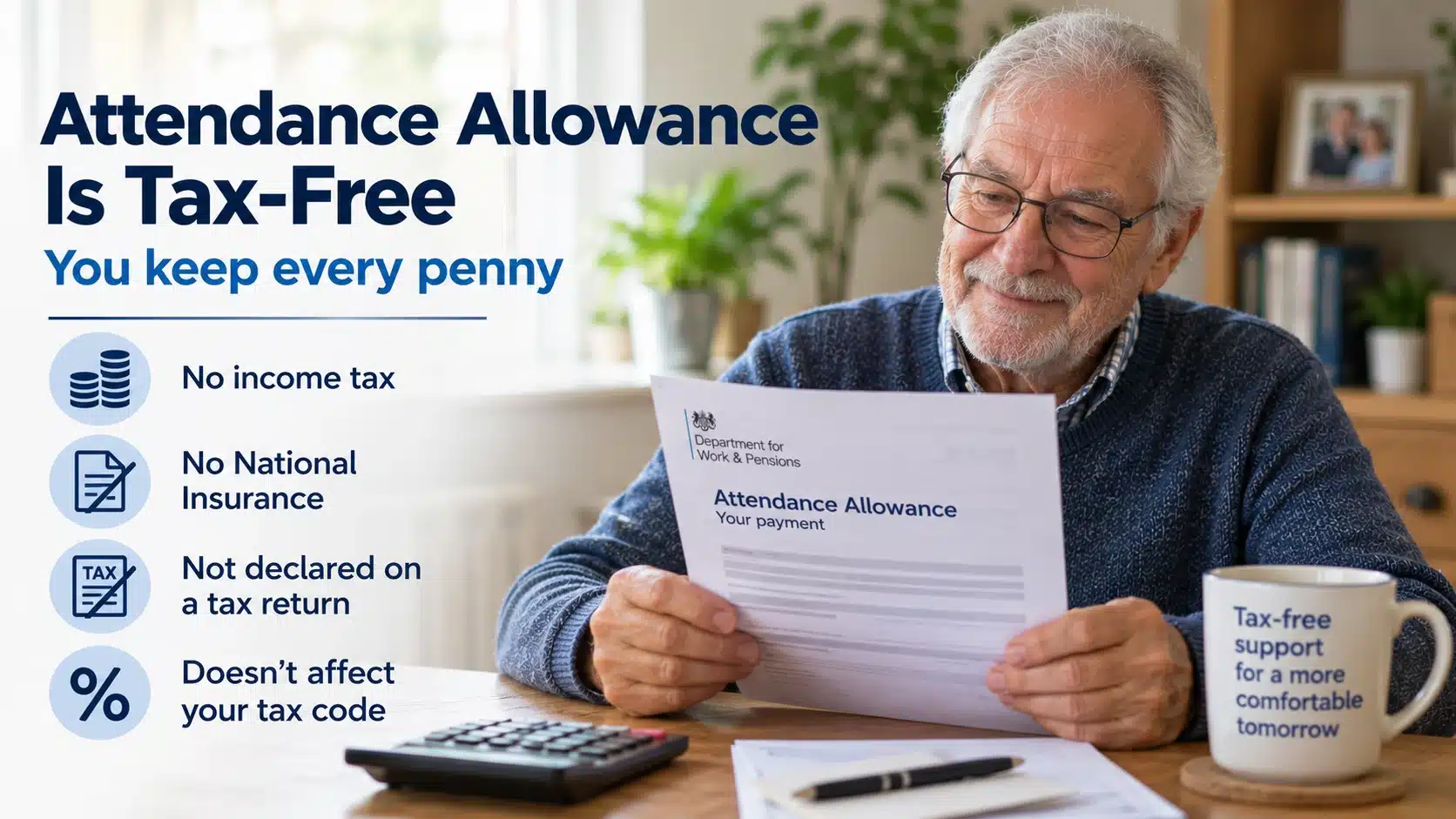
The Short Answer
No. Attendance Allowance is completely tax-free. You pay no income tax, no National Insurance, and you do not need to declare it on your tax return. Whether you receive the lower rate of £76.70 per week or the higher rate of £114.60 per week, you keep every single penny.
Why Attendance Allowance Is Tax-Free
Attendance Allowance is classified as a disability benefit by the UK Government. Under UK tax law, disability benefits are exempt from income tax. This applies regardless of your other income – even if you pay tax on your State Pension or private pension, Attendance Allowance remains completely untaxed.
This is not a concession or a temporary arrangement. It is written into UK income tax law: the Income Tax (Earnings and Pensions) Act 2003 lists Attendance Allowance among the exempt benefits.
Exactly What “Tax-Free” Means for You
When we say Attendance Allowance is tax-free, we mean:
- No income tax – it is not added to your taxable income
- No National Insurance – no NI contributions are due
- No self-assessment declaration – you do not report it on a tax return
- No effect on your tax code – HMRC does not adjust your tax code because of AA
- No effect on your tax bracket – even if you are a higher-rate taxpayer, AA does not count toward the threshold
How Much You Keep – The Full Picture
Here is exactly what you receive, with nothing deducted:
| Rate | Per Week | Per Month | Per Year | Tax Paid |
|---|---|---|---|---|
| Higher rate | £114.60 | £497.60 | £5,959.20 | £0 |
| Lower rate | £76.70 | £332.70 | £3,988.40 | £0 |
Compare that with a private pension: if you draw £5,959 from a private pension and you are a basic-rate taxpayer, you would lose roughly £1,192 to income tax. Attendance Allowance puts the full amount in your pocket.
Does Attendance Allowance Affect Your Other Benefits?
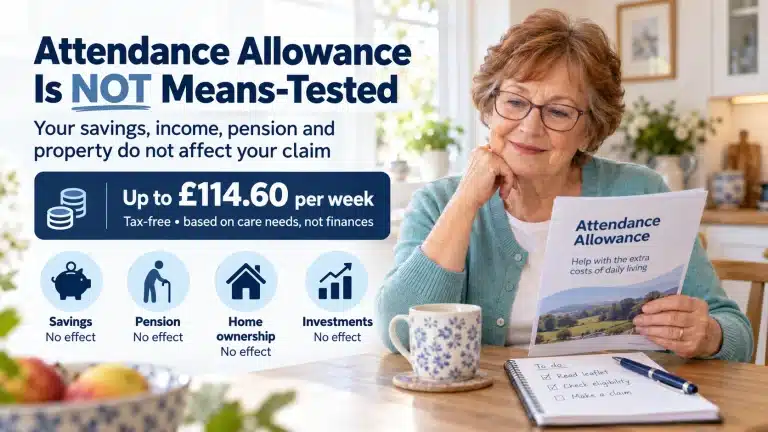
Not only is Attendance Allowance tax-free; it is also not means-tested. This means:
- It does not reduce your State Pension – AA is paid in addition to your pension
- It does not reduce Pension Credit – Pension Credit calculations ignore AA entirely
- It does not affect Housing Benefit – AA is disregarded as income
- It does not usually affect Council Tax Reduction – AA is normally disregarded, although each council sets its own scheme
In fact, receiving Attendance Allowance can increase your other benefits. If you get Pension Credit and live alone, it can unlock the Severe Disability Addition (£86.05/week extra in 2026/27). It can also qualify a carer to claim Carer’s Allowance (£86.45/week). One thing to know: the Severe Disability Addition is not paid if anyone is paid Carer’s Allowance for looking after you, so it is worth checking which is worth more before a carer claims.
Example: What Attendance Allowance Is Really Worth
Margaret, 74, lives alone and gets Pension Credit. She receives the higher rate of Attendance Allowance (£114.60/week) and the Severe Disability Addition in her Pension Credit (£86.05/week). Together that is £200.65/week (£10,433.80/year), all tax-free. This is an illustration only; what you get depends on your own circumstances.
Do I Need to Tell HMRC About Attendance Allowance?
No. Because Attendance Allowance is exempt from income tax, you do not need to:
- Report it on a Self Assessment tax return
- Notify HMRC that you receive it
- Include it when calculating your annual income for tax purposes
Because the benefit is exempt, there is no action required on your part for tax purposes.
What About Other Disability Benefits?
The main UK disability benefits are tax-free, as is Pension Credit. The State Pension and Carer’s Allowance are not:
| Benefit | Taxable? |
|---|---|
| Attendance Allowance | No – tax-free |
| Personal Independence Payment (PIP) | No – tax-free |
| Disability Living Allowance (DLA) | No – tax-free |
| Carer’s Allowance | Yes – taxable |
| State Pension | Yes – taxable |
| Pension Credit | No – tax-free |
Note on Carer’s Allowance: While Attendance Allowance is tax-free, if your carer claims Carer’s Allowance based on your AA award, their Carer’s Allowance is taxable. However, most carers who only receive Carer’s Allowance will fall within the Personal Allowance (£12,570) and pay no tax in practice.
Attendance Allowance is 100% tax-free. You keep every penny.
Up to £5,959 per year with no income tax, no National Insurance, and no need to declare it. If you or a family member needs help with daily living due to a health condition, check your eligibility in 2 minutes.
Frequently Asked Questions
Is Attendance Allowance taxable?
No. Attendance Allowance is completely exempt from income tax. You do not pay any tax on it, you do not need to declare it on a tax return, and it does not affect your tax code. You keep the full amount – up to £114.60 per week (£5,959.20 per year).
Do I need to declare Attendance Allowance on my tax return?
No. Because AA is a tax-exempt disability benefit, you do not include it on a Self Assessment tax return. HMRC does not count it as income. There is no paperwork required on your part.
Does Attendance Allowance count as income?
Not for tax purposes or for means-tested benefit calculations. Attendance Allowance is disregarded as income when calculating Pension Credit, Housing Benefit, and Council Tax Reduction. It does not count toward your taxable income and does not push you into a higher tax bracket.
Will Attendance Allowance affect my State Pension?
No. Attendance Allowance is paid on top of your State Pension. The two are completely independent – receiving one does not reduce the other. Both are paid into your bank account and AA remains tax-free even if your State Pension is taxable.
Is Carer’s Allowance also tax-free?
No, Carer’s Allowance is taxable, unlike Attendance Allowance. However, most carers who only receive Carer’s Allowance and a small pension will fall within the £12,570 Personal Allowance and pay no tax in practice. Your Attendance Allowance itself is always tax-free regardless.
Can I claim Attendance Allowance if I pay higher-rate tax?
Yes. Your tax rate has no bearing on your eligibility for Attendance Allowance. Whether you pay no tax, basic-rate, or higher-rate, you can claim AA based on your care needs alone. The amount you receive is exactly the same regardless of your income level.